
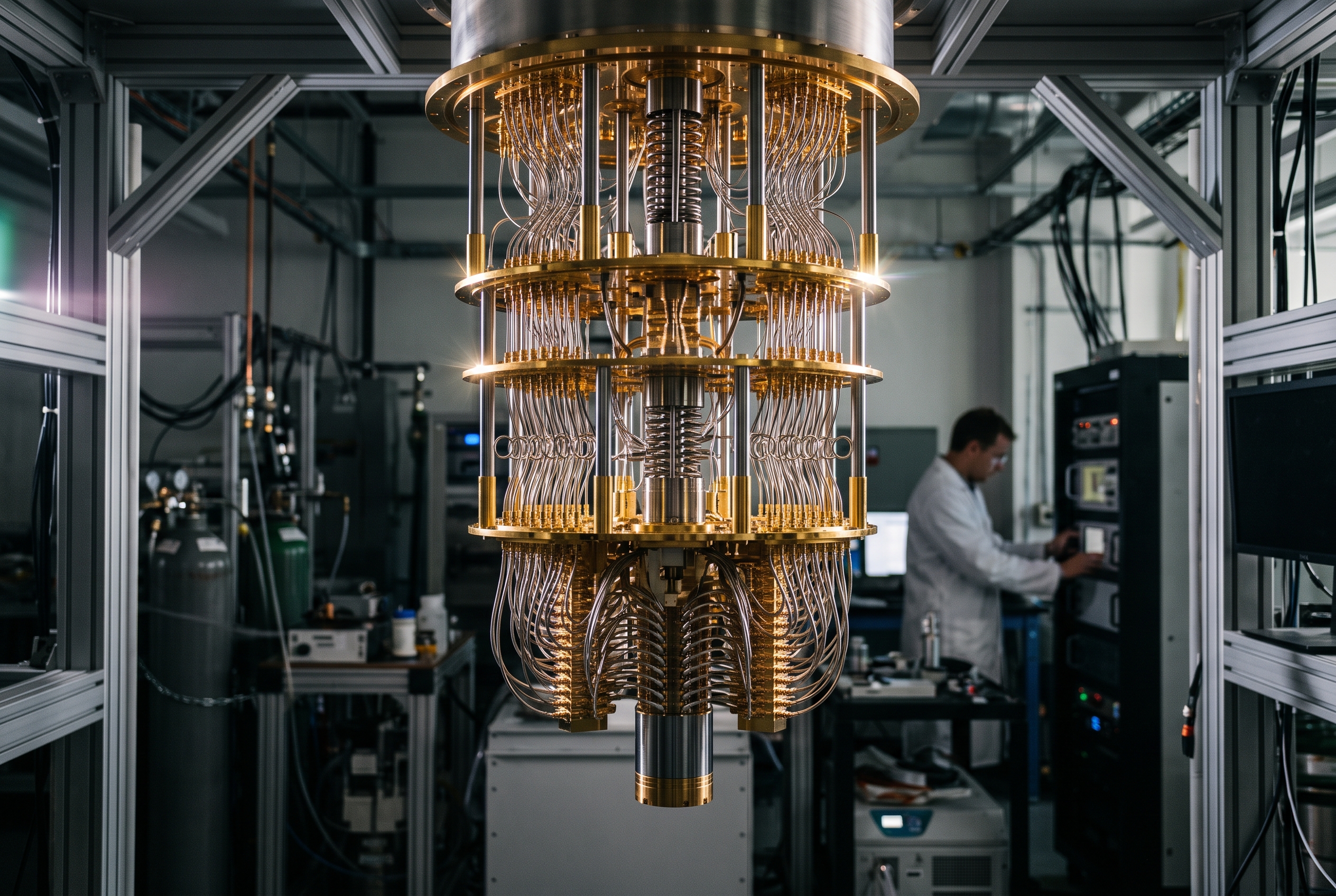
Imagine a computational task that would take the world’s fastest supercomputer 10 septillion years to complete[cite: 2]. To put that in perspective, if the supercomputer started calculating at the Big Bang 13.8 billion years ago, it would have covered less than a trillionth of a trillionth of the necessary time[cite: 2]. Now, imagine a chip no bigger than the palm of your hand finishing that exact task in just 3 minutes and 20 seconds[cite: 2]. This is the reality of Google’s latest quantum processor, known as Willow[cite: 2].
Understanding the Quantum Engine
When exploring emerging technology, breaking down foundational concepts is essential. A classical computer uses bits—ones and zeros—that act like a light switch that is either on or off[cite: 2]. A quantum computer uses “qubits,” which behave more like a coin spinning on a table[cite: 2]. While it spins, the coin is not strictly heads or tails, but a combination of both simultaneously—a state known as superposition[cite: 2]. When qubits are linked together in a state of entanglement, the computational possibilities expand exponentially[cite: 2].
Willow features 105 superconducting qubits made of tiny aluminum loops that act as artificial atoms when frozen[cite: 2]. When operating, the chip accesses 2 to the power of 105 possibilities at once, which equates to roughly 40 septillion concurrent paths[cite: 2]. Instead of checking solutions one by one, quantum algorithms let all possible paths interfere like ripples on a pond, canceling out the wrong answers and piling up the right one[cite: 2].
The True Breakthrough: Crossing the Error Threshold
While finishing a Random Circuit Sampling (RCS) test 10 septillion years faster than the Frontier supercomputer is a massive headline[cite: 2], the true engineering milestone lies in error correction.
For 30 years, the quantum computing field struggled with a fundamental curse: qubits are incredibly fragile[cite: 2]. Heat, a stray photon, or minor vibrations can cause a qubit to lose its state, turning calculations into random noise[cite: 2]. To fix errors, engineers theoretically needed to add more qubits, but historically, adding more qubits simply introduced more places for errors to occur[cite: 2].
Willow is the first chip to successfully cross the theoretical “threshold” where adding qubits actually helps[cite: 2]. The team proved that by grouping physical qubits into larger logical patches using surface codes, adding more qubits suppresses the error rate[cite: 2]. On Willow, the logical error rate dropped to just 0.143% per cycle, essentially halving the errors as the system scaled[cite: 2]. For the first time, the hardware became clean enough to support continuous growth[cite: 2].
Verifiable Advantage: Quantum Echoes
To address skeptics who argue that RCS tests are just arbitrary mathematical mazes designed specifically for quantum chips to win[cite: 2], Google ran a different test called “Quantum Echoes” (Out of Time Order Correlator)[cite: 2].
- This process involves letting a quantum system scramble information forward, tweaking a single qubit, and then attempting to unscramble it backward[cite: 2].
- If the machine is truly quantum, a faint echo survives the noise and interference[cite: 2].
- Using 65 of its qubits, Willow tracked this surviving echo 13,000 times faster than the Frontier supercomputer[cite: 2].
- Unlike the 10 septillion-year metric, this 13,000-fold speedup is highly verifiable because separate quantum chips can run the exact same echo and confidently compare their results[cite: 2].
A Multiverse of Computation?
The sheer power of this processor has reignited profound philosophical debates within the physics community. Hartmut Neven, the head of Google Quantum AI, noted that Willow’s astonishing performance lends credence to the idea that quantum computation occurs across many parallel universes[cite: 2].
Drawing on predictions made by Oxford physicist David Deutsch in 1997, this perspective suggests that the chip completes these impossible tasks by collaborating with versions of itself across the multiverse, sharing the results to achieve unprecedented speed[cite: 2]. While many physicists argue that standard quantum mechanics perfectly explains the chip without needing alternate realities, the mathematical foundation remains identical regardless of the interpretation[cite: 2].
The Road Ahead
To achieve these milestones, Willow is housed in a gold and steel chandelier-like fridge in Santa Barbara[cite: 2]. It is cooled to 10 millikelvin—a temperature 270 times colder than deep space—to keep the qubits from drowning in thermal noise[cite: 2].
While the industry is still orders of magnitude away from a machine capable of cracking modern RSA encryption—which is estimated to require just under a million noise-free qubits—the trajectory is now clear[cite: 2]. The foundational rule that errors can be systematically suppressed as chips grow larger has been undeniably proven[cite: 2]. Over the next decade, as technology advances, quantum computers will inevitably transition from physics demonstrations into powerful tools capable of simulating new materials, discovering revolutionary catalysts, and redefining global cybersecurity[cite: 2].
Leave a Reply