
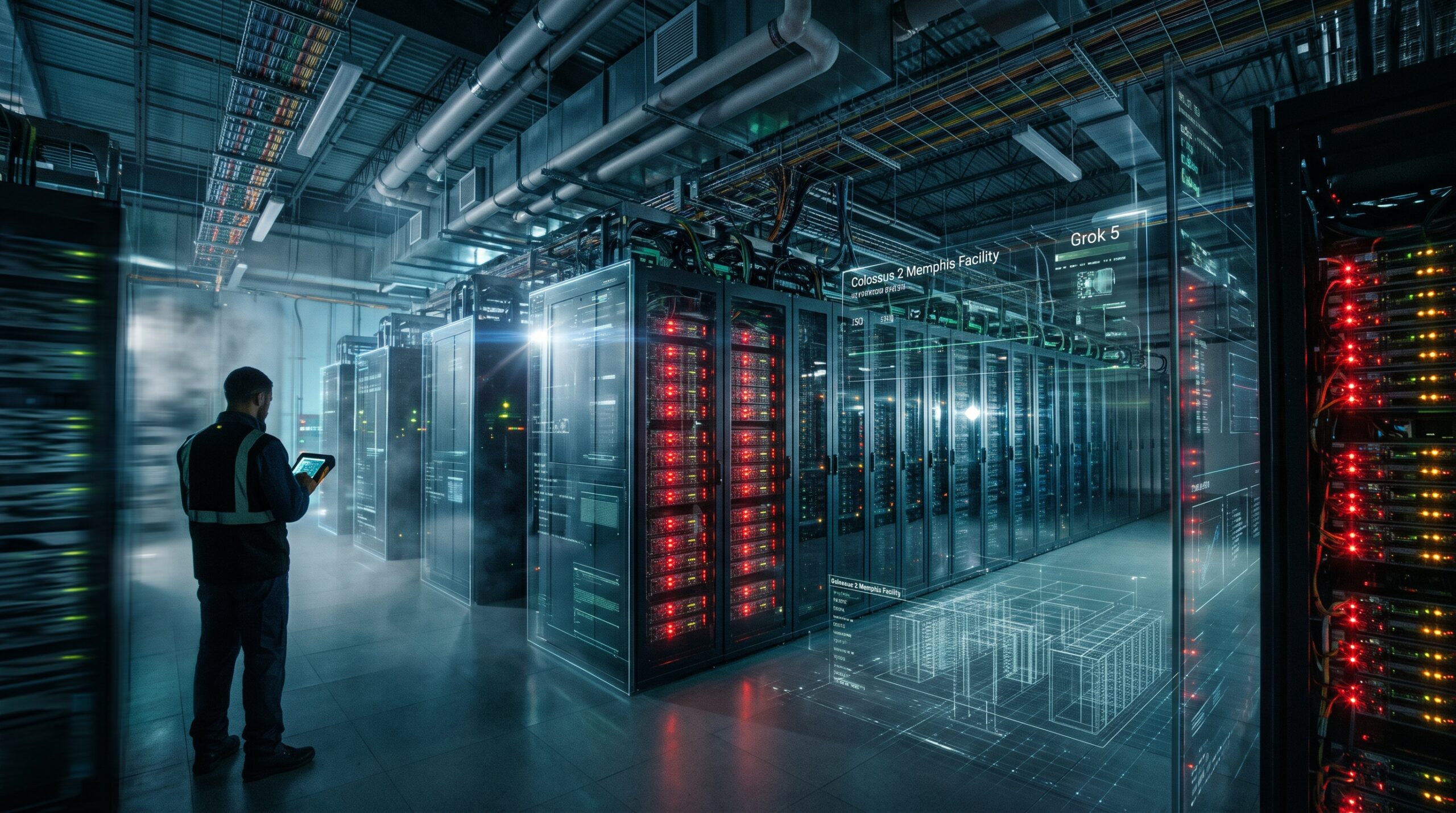
Elon Musk has made monumental promises regarding Grok 5, positioning it as the most powerful frontier AI model ever created. While xAI’s current models may lag slightly behind industry leaders on public leaderboards, the sheer scale, exclusive data access, and unprecedented compute power behind Grok 5 suggest the AI race is far from settled.
Unprecedented Scale and Colossus 2 The foundation of Grok 5 is its massive 6-trillion-parameter architecture, double the 3-trillion parameters used for Grok 3 and 4. However, xAI is not just scaling up raw size; the model is engineered for a much higher “intelligence density per gigabyte,” making it smarter, faster, and significantly more cost-effective to run. This staggering architecture is currently training on Colossus 2, xAI’s supercomputer in Memphis. To power this, SpaceX has brought 1.4 gigawatts of computing power online, with goals to reach 2 gigawatts by the end of the year and an astonishing 10 to 15 gigawatts by 2027.
The SpaceX Data Advantage Unlike rival AI labs that rely exclusively on publicly scraped internet data, Grok 5 has a distinct proprietary advantage. The model is being trained on the entire history of SpaceX’s internal data, including highly complex launch logs, engineering specifications, and manufacturing data. This injection of exclusive, high-level physics and engineering data could give Grok 5 an unparalleled edge in scientific reasoning and real-world problem-solving.
Multimodal Mastery and Real-Time Video Grok 5 is designed to be inherently multimodal from the ground up, seamlessly processing text, pictures, audio, and video. Its most highly anticipated capability is real-time video understanding. While most current models can analyze static images or short clips, Grok 5 aims to process and understand live video feeds as they happen—a fundamental capability that Musk argues is essential for ever achieving Artificial General Intelligence (AGI).
The Agent Harness: Cursor and Grokbot A model’s raw intelligence is only as useful as the software surrounding it—often referred to as the “agent harness.” xAI is aggressively building out this ecosystem. In a massive strategic move, SpaceX reportedly acquired Cursor, one of the world’s most popular AI coding tools, for $60 billion to serve as a world-class coding harness for Grok. Meanwhile, Grokbot, xAI’s work assistant, is experiencing explosive growth, recently reaching 800,000 paying weekly users who rely on it for end-to-end task completion like research and sales outreach.
Ignoring the “Benchmaxing” Trend xAI is actively avoiding the industry trend of “benchmaxing”—training models specifically to score high on famous public tests. While earlier Grok models struggled on public coding tasks, they perform significantly better on private, unseen tests. By optimizing for actual usefulness rather than public leaderboards, Grok 5 aims to deliver practical utility inside real-world products rather than hollow high scores.
AGI Speculation and Release Timeline Musk has stated that Grok 5 is the first model where he sees a non-zero chance—calculating roughly a 10% probability—of achieving AGI. While the release date has shifted from early this year to a target before the end of 2026, xAI’s roadmap is clear. With Grok 4.9 expected to rival current top-tier models before Grok 5 even launches, the AI landscape is on the verge of massive disruption.
Leave a Reply