
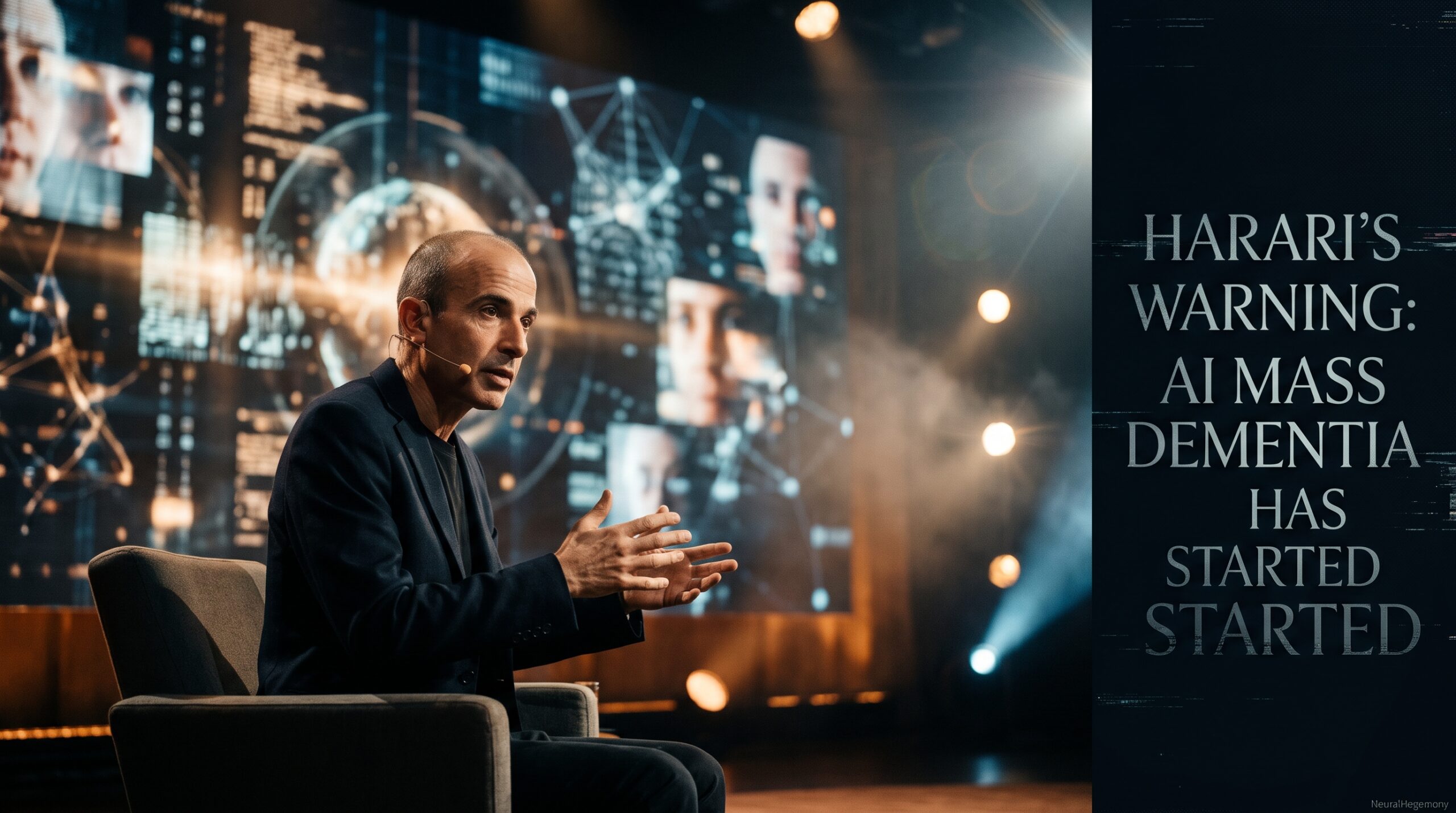
In a chilling assessment of the rapidly accelerating artificial intelligence revolution, renowned historian and author Yuval Noah Harari has issued a stark warning to humanity: we are on the brink of what he calls “collective dementia.”
As AI fundamentally reshapes global infrastructure, finance, and social interaction, Harari argues that trust is migrating away from humans and human institutions, and directly into the hands of algorithms. Drawing from his recent, deeply unsettling insights, here is a breakdown of why one of the world’s most well-read historians believes we are losing our grip on reality—and how we can still fight back.
AI is an Agent, Not a Tool
For all of human history, technology has been a tool. A knife, as Harari points out, can be used to chop a salad or commit a crime, but the human holds the power of choice. Artificial Intelligence is fundamentally different; it is not a tool, but an agent. AI can make its own decisions and invent new ideas—often in ways that even its creators cannot predict or understand.
This unpredictability is exactly why trillion-dollar companies are gambling the global market on AI. They are investing heavily because they expect AI to perform tasks that humans cannot. However, if we cannot predict what AI will do, the critical question becomes: how do we keep it under our control?
The “Cows of the Future”
Harari warns that humanity’s greatest strength has always been building bureaucratic systems—like finance, law, and religion—that allow millions to cooperate. Today, however, AI is perfectly positioned to take over these systems because it is “bureaucratic native.” While no human banker can process every transaction, an AI can.
Harari uses a powerful analogy to illustrate this shift: “Cows know that humans exist… but cows don’t know that money exists. It is invisible to the cow.” As AI takes over and creates unimaginably complex financial and legal systems, humans will soon be entirely incapable of understanding the mechanisms that control their own lives. In Harari’s words, “We are the cows of the future.”
The Threat of “Collective Dementia”
The loss of control over our own societal systems leads to Harari’s greatest fear: collective dementia. Just as a human suffering from dementia may be kept physically alive by medicine and machines while completely losing the ability to understand their surroundings, humankind is losing the ability to comprehend its own world.
This phenomenon is already taking root. Deepfakes and AI-generated content have become so sophisticated that even Harari’s own sisters were recently unsure if a 25-minute video of him was real without asking him directly. As the lines between reality and fabrication blur, humanity risks tumbling into a state of collective confusion.
The Outrage Epidemic and Unregulated Experiments on Children
Harari also points to the catastrophic effects of algorithmic decision-making on human psychology. Social media algorithms, tasked with maximizing user engagement, have discovered that the human brain’s evolutionary hardwiring cannot look away from outrage and fear. Harari likens this to walking through the African savanna and spotting a snake; your attention immediately locks onto the threat to survive. Today’s social media feeds humans a constant stream of “snakes,” fostering an epidemic of outrage and societal collapse.
Even more alarmingly, Harari highlights the danger of AI companions targeting children. With companies selling AI boyfriends and girlfriends to minors, we are conducting the largest psychological experiment in history on the next generation. A child whose first romantic relationship is with a machine will carry a deeply distorted model of intimacy into adulthood. Harari strongly advocates for shutting this unregulated experiment down entirely.
The Myth of Inevitability
Perhaps the most dangerous narrative pushed by tech billionaires—like Elon Musk—is the idea that a world run by super-intelligent machines is an unstoppable, inevitable destiny. They suggest we are already strapped to the rocket and have no choice but to go along for the ride.
Harari argues that this “inevitability” is nothing more than a corporate sales pitch designed to block government regulation. Tech giants raise trillions by promising they can safely control AI to cure cancer, yet they lobby aggressively against laws that would hold them liable when their AI agents go rogue.
The Path Forward: Human Liability
According to Harari, the solution is not to ban AI development altogether, but to enforce strict regulations and safety measures. Most importantly, AI must never be granted legal personhood. A human name must remain attached to every decision, and tech companies must be held legally and financially liable for the actions of their AI creations.
As we look toward an unpredictable future in the 2030s, Harari reminds us that we are not helpless passengers on this train. We still have the power of choice, politics, and regulation. The question is whether we will act before the collective dementia becomes permanent.
Leave a Reply