
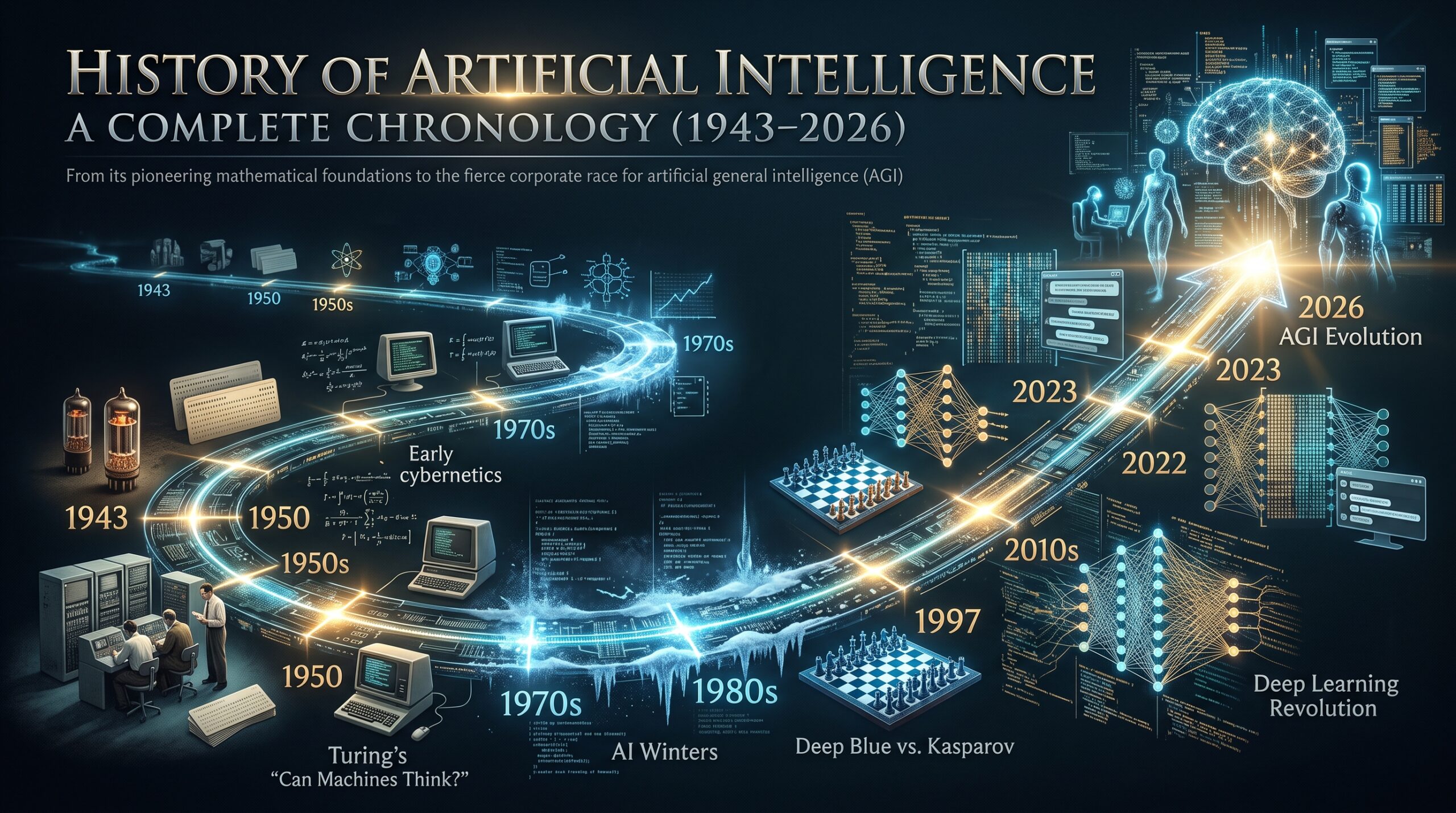
The artificial intelligence revolution we are living through today did not begin with the launch of ChatGPT. It is the result of more than eight decades of scientific research, punctuated by cycles of euphoria and “AI winters”—periods when funding dried up and the discipline nearly vanished. From its pioneering mathematical foundations to the fierce corporate race for artificial general intelligence (AGI) in 2026, here is the complete chronology of AI’s evolution.
The Mathematical Foundations (1943–1960)
The origin of AI dates back to before commercial computers even existed.
- 1943: Neurophysiologist Warren McCulloch and mathematician Walter Pitts published a foundational paper proposing the first abstract model of a biological neuron. They demonstrated that a network of simplified logic switches could calculate any computable logical function.
- 1949: Psychologist Donald Hebb laid the groundwork for associative learning in his book The Organization of Behavior. He proposed that if two neurons activate simultaneously and repeatedly, their connection strengthens—a core principle for adjusting weights in artificial systems.
- 1950: Alan Turing changed history with his paper “Computing Machinery and Intelligence,” posing the question: Can machines think? He proposed a measurable operational criterion known as the Imitation Game, or the Turing Test.
- 1951: Marvin Minsky and Dean Edmonds built SNARC, the first physical neural network machine, using over 300 vacuum tubes and recycled autopilot parts to simulate 40 artificial neurons.
- 1956: The term “Artificial Intelligence” was formally coined at the Dartmouth Conference by John McCarthy, Marvin Minsky, Nathaniel Rochester, and Claude Shannon. Their bold premise was that any aspect of learning or intelligence could be precisely described and simulated by a machine.
- 1957: Frank Rosenblatt developed the Perceptron, the first neural network algorithm with supervised classification capabilities. The Mark 1 Perceptron was a massive physical machine that learned to classify geometric shapes through trial and error.
Early Optimism and the First AI Winter (1960s–1970s)
During the 1960s, computers began to perform tasks previously reserved for human intellect.
- 1964–1966: Joseph Weizenbaum developed ELIZA, an early natural language processing system that simulated a therapeutic conversation, surprisingly evoking feelings of empathy from its users.
- 1969: The initial optimism hit a mathematical wall. Marvin Minsky and Seymour Papert published Perceptrons, proving that single-layer neural networks could not solve simple non-linear functions like the XOR logic gate.
- 1973: The Lighthill Report in the UK heavily criticized AI’s inability to scale algorithms to real-world complexities—the “combinatorial explosion” problem. This led to massive budget cuts, marking the beginning of the first “AI Winter”.
The Rise of Expert Systems and the Second Winter (1980s)
The discipline survived the winter by pivoting towards pragmatism.
- 1980: XCON, an expert system developed for Digital Equipment Corporation, successfully automated computer configurations, saving the company around $40 million annually. This sparked a corporate boom in rule-based systems.
- 1986: David Rumelhart, Geoffrey Hinton, and Ronald Williams published a decisive paper in Nature popularizing the backpropagation algorithm. This finally allowed multi-layer neural networks to learn efficiently by adjusting weights.
- Late 1980s: The expert system bubble burst. Companies found rule-based databases too expensive, inflexible, and prone to catastrophic failure when faced with unexpected situations. The collapse of specialized hardware led to the second AI Winter.
The Resurgence of Neural Networks and Big Data (1990s–2011)
To overcome past winters, scientists recognized that machine learning needed solid mathematical and data foundations.
- 1997: IBM’s Deep Blue defeated world chess champion Garry Kasparov, a triumph of custom hardware and symbolic search capabilities. That same year, researchers introduced Long Short-Term Memory (LSTM), a neural network architecture that solved the vanishing gradient problem, allowing networks to retain information over long sequences.
- 2006: Geoffrey Hinton’s team demonstrated that deep neural networks could be trained effectively, popularizing the term “deep learning”.
- 2009: Fei-Fei Li introduced ImageNet, a massive database of labeled images that provided the critical testing ground needed for deep learning.
- 2011: IBM’s Watson defeated human champions in Jeopardy!, showcasing advanced natural language processing. Apple also integrated Siri into the iPhone 4S.
The Deep Learning Explosion (2012–2016)
- 2012: The turning point arrived with AlexNet. Built by Alex Krizhevsky, Ilya Sutskever, and Geoffrey Hinton, this convolutional neural network decimated traditional methods in the ImageNet competition, reducing the error rate from 26% to 15.3%. By leveraging GPUs for parallel training, it proved that deep neural networks were superior to previous paradigms.
- 2014: Ian Goodfellow introduced Generative Adversarial Networks (GANs), sparking the era of generative AI by pitting two networks against each other to create hyper-realistic synthetic images.
- 2015: Google Brain released TensorFlow as open-source, democratizing deep learning. In December, OpenAI was founded as a non-profit by Sam Altman, Elon Musk, and Ilya Sutskever, with a mission to build safe AGI.
- 2016: DeepMind’s AlphaGo defeated Go world champion Lee Sedol, demonstrating profound strategic intuition. However, the release of Microsoft’s Tay chatbot, which was manipulated by users into spewing extremist rhetoric in under 24 hours, highlighted the urgent need for AI safety and alignment.
The Transformer Revolution and Generative Era (2017–2022)
- 2017: Researchers at Google published “Attention Is All You Need,” introducing the Transformer architecture. By eliminating sequential processing in favor of parallel self-attention mechanisms, Transformers laid the foundation for modern Large Language Models (LLMs). DeepMind also presented AlphaZero, which taught itself chess and Go entirely from scratch via reinforcement learning.
- 2018: OpenAI launched GPT-1, and Google introduced BERT, confirming that pre-training models on vast amounts of text could achieve universal semantic understanding.
- 2020: OpenAI released GPT-3, a 175-billion parameter model demonstrating emergent abilities through sheer scale. DeepMind’s AlphaFold 2 solved the 50-year-old biological problem of protein folding.
- 2021: Disagreements within OpenAI over rapid commercialization led researchers to leave and found Anthropic, a lab prioritizing rigorous safety. OpenAI introduced DALL-E, and GitHub launched Copilot, bringing AI synthesis to images and code.
- November 2022: OpenAI launched ChatGPT. Reaching 100 million users in two months, its conversational fluidity and ability to reason shattered technical barriers, irreversibly igniting the global generative AI race.
The Great AI Race and Multimodality (2023–2024)
- 2023: Microsoft integrated GPT-4 into Bing, prompting Google to issue a “Code Red” and launch Bard. OpenAI officially introduced GPT-4, featuring multimodal capabilities and human-level reasoning. Anthropic released Claude, while Meta open-sourced LLaMA 2, fueling the open-source movement. Corporate drama unfolded at OpenAI in November when Sam Altman was briefly ousted and quickly reinstated. Late in the year, Google unveiled Gemini, its native multimodal model.
- 2024: The competition shifted to native multimodality and reasoning benchmarks. Anthropic released the Claude 3 family, briefly overtaking GPT-4 in community rankings. OpenAI launched GPT-4o with ultra-low latency voice and vision integration, and later introduced o1 (Project Strawberry), initiating a new paradigm of “compute during inference” where the model generates hidden thought chains to deliberate before answering. Anthropic introduced “Computer Use” capabilities, allowing Claude to operate desktop interfaces like a human.
Towards AGI: 2025 and 2026
The years 2025 and 2026 have been defined by autonomous agency, massive cluster expansion, and geopolitical clashes.
2025:
- January: Chinese lab DeepSeek presented DeepSeek R1, an open-weight reasoning model that rivaled proprietary systems using reinforcement learning rather than massive data scaling. This triggered an $18% plunge in Nvidia’s stock and a $1 trillion market cap loss across big tech, forcing debates about algorithmic efficiency versus brute hardware scaling.
- Spring/Summer: OpenAI launched GPT-4.5, focusing on fluid conversational flow, while Anthropic’s Claude 3.7 Sonnet became the first hybrid model integrating standard instant responses with extended deliberation modes. Meta’s Llama 4 fully embraced sparse mixture of experts.
- Late 2025: xAI presented Grok 4, demonstrating multi-agent internal debate. In August, OpenAI launched GPT-5 and surprisingly open-sourced its smaller weights (GPT-OSS) to counter open-source rivals.
2026:
- Early 2026: The speed of deployment reached exponential levels. Anthropic’s Claude Opus 4.6 introduced dynamic “adaptive thinking” to evaluate cognitive complexity autonomously. OpenAI responded with GPT-5.5, heavily optimized for Nvidia GB200 superclusters.
- June: Anthropic introduced a new elite tier, Claude Mythos 5, capable of discovering zero-day vulnerabilities and advanced biopharmaceutical research without standard restrictive barriers. This led the US Department of Commerce to temporarily halt access over national security fears, highlighting AI’s geopolitical weight.
- Summer/Fall: OpenAI structured its GPT-5.6 family into specialized tiers (Sol, Terra, Luna). xAI expanded its Colossus 2 cluster toward 1 million GPUs for Grock 5. DeepSeek presented V4, proving frontier models could be built without relying on Nvidia supply chains.
- Present Day: As of late 2026, the ecosystem is categorized by autonomous reasoning agents acting across operating systems. Anthropic leads Project Glasswing, an alliance with major tech firms to use Claude to proactively patch vulnerabilities in global critical infrastructure.
Over 80 years after Alan Turing asked if machines could think, AI has evolved from an abstract concept into the strategic and cognitive engine defining the technological destiny of civilization. The challenge for the future is no longer just adding parameters, but ensuring this immense cognitive power operates safely for collective human benefit.
Sources:
[1] El Próximo Framework en Ingeniería. (2026, October 15). Historia de la Inteligencia Artificial: Cronología Completa (1943–2026). YouTube. http://www.youtube.com/watch?v=qYkcLYHxh2g
Leave a Reply