
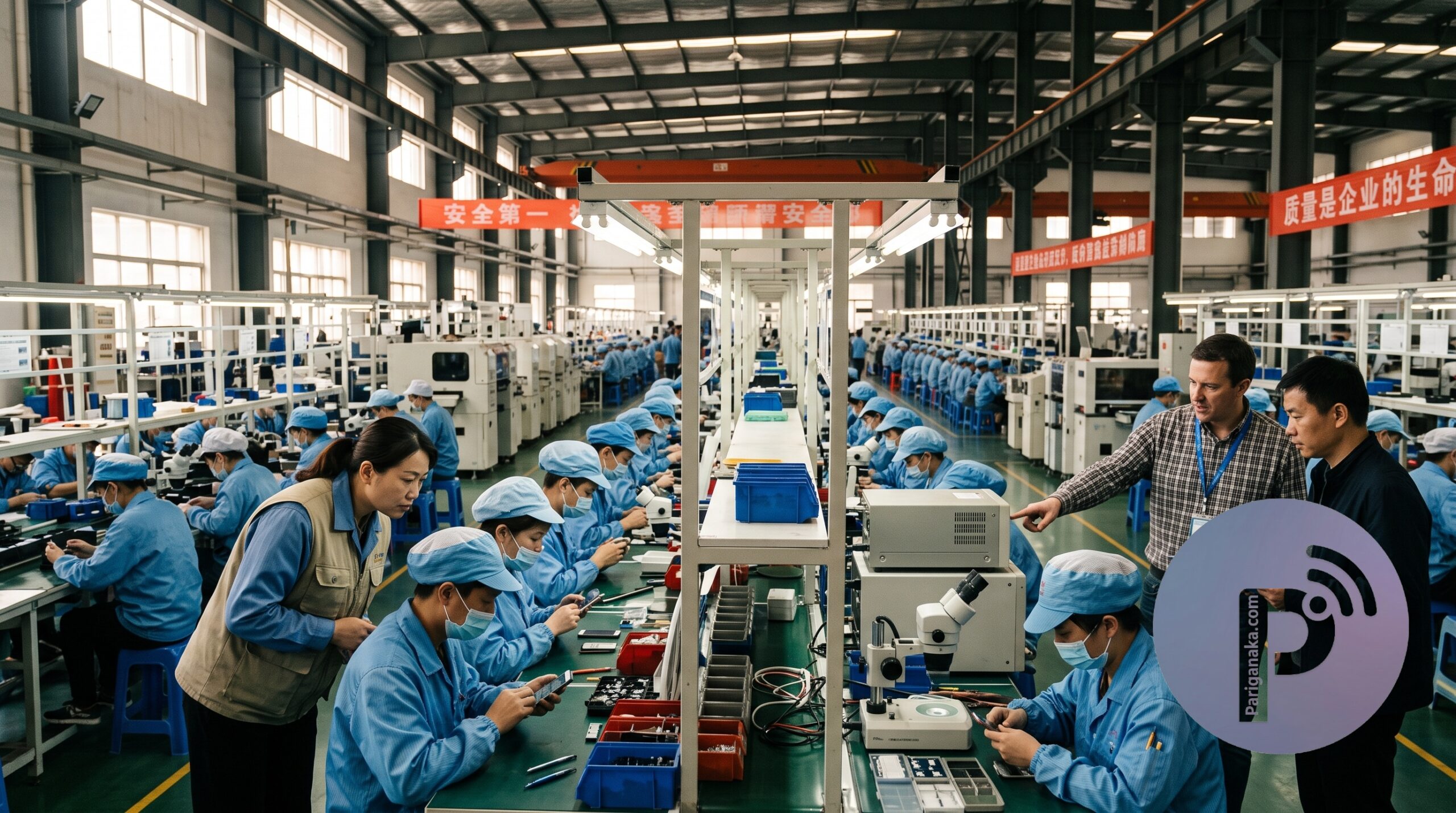
For years, the story of Apple’s immense success has focused on the unparalleled design brilliance of Steve Jobs, the operational mastery of Tim Cook, and the marketing engine of Cupertino. However, investigative journalist Patrick McGee—author of the acclaimed book Apple and China: The Capture of the World’s Greatest Company—argues that there is another, much larger narrative: Apple had a “nation-building-like influence” on China.
In a recent interview with Bloomberg Tech, McGee unraveled how Apple’s relentless pursuit of perfection inadvertently transformed China from a low-cost outsourcing destination into a dominant global manufacturing and technological superpower.
The “Cook Plan”: A $275 Billion Commitment
The turning point in the Apple-China relationship came around 2016. Chinese leadership, spearheaded by Xi Jinping, was heavily pushing the “Made in China 2025” initiative to make the country a self-reliant tech titan. Apple was facing an existential crisis, fearing that its products could be blacklisted in its most crucial manufacturing hub and retail market.
To secure its standing, an internal Apple team analyzed their ongoing supply chain investments in China—amounting to roughly $55 billion per year just in factory machinery and wages for over three million workers. In May 2016, Tim Cook visited the citadel of communist power in Beijing and promised to quintuple that figure. He committed a staggering $275 billion over five years to the Chinese manufacturing sector.
To put that into perspective, the Marshall Plan, which the U.S. used to rebuild a devastated Europe and ward off communism after World War II, was roughly $131 billion over four years. The “Cook Plan” was double that, fundamentally acting to ingratiate Apple with Beijing.
Cultivating an Unrivaled Ecosystem
Apple’s impact on China wasn’t merely financial; it was deeply instructional. Terry Gou, the founder of Foxconn, realized early on that working with Apple wasn’t initially about high profit margins. Apple engineers were notoriously demanding, rejecting components and forcing unprecedented levels of quality and discipline onto the factory floor.
Gou recognized that the training his workforce received from Apple was invaluable. By learning to meet Apple’s exacting standards, Foxconn learned how to please anyone. Apple trained millions of workers and effectively built entire industrial clusters devoted to creating the iPhone.
This knowledge inevitably spilled over. McGee points out that while traditional narratives claim Apple killed Nokia, it was actually the Chinese competitors (like Xiaomi, Huawei, Oppo, and Vivo) who benefitted from Apple’s supply chain that collectively decimated the legacy smartphone makers. By building the world’s best supply chain for itself, Apple unintentionally armed its greatest rivals.
The Unintended Geopolitical Consequences
According to a former Apple vice president interviewed by McGee, the engineers setting up shop in China in the early 2000s weren’t thinking about geopolitics; they were solely focused on getting their products made flawlessly.
However, the lack of geopolitical foresight has left the United States heavily reliant on a foreign rival. While politicians debate “re-industrialization,” the reality is stark. China’s trade surplus with the world continues to grow, and their manufacturing dominance is deeply entrenched. When a final product is stamped “Made in India” or “Made in Vietnam,” it is often just the final assembly step; the vast majority of the complex manufacturing still originates in China.
As China begins applying AI to further optimize its thousands of factories—focusing on 3% to 5% efficiency gains across production lines rather than just theoretical models—their manufacturing advantage could stretch from years into decades.
The Way Forward
Can the U.S. compete by simply trying to replicate China’s infrastructure? McGee argues no. The U.S. cannot replicate China’s 300-million-strong migrant workforce. Instead, America must rely on its unique advantages: its global network of allies and its ideals. By deepening interdependent trade relationships with countries like Mexico and India, the West can attempt to build an alternative supply chain network, though unwinding the deep integration built by companies like Apple will be a monumental task.
Leave a Reply