
Artificial intelligence has rapidly become one of the most pressing issues defining the geopolitical relationship between the United States and China[cite: 4]. As Chinese President Xi Jinping prepares for a high-stakes state visit to the White House to meet with President Donald Trump—his first in more than a decade—AI has unexpectedly taken center stage alongside traditional friction points like trade and Taiwan[cite: 4].
But what does this AI tech race look like from inside China? A closer look reveals a massive, state-led push to build infrastructure, cultivate homegrown talent, and position Chinese technology as an open alternative for the global stage[cite: 4].
The Infrastructure Boom in Inner Mongolia
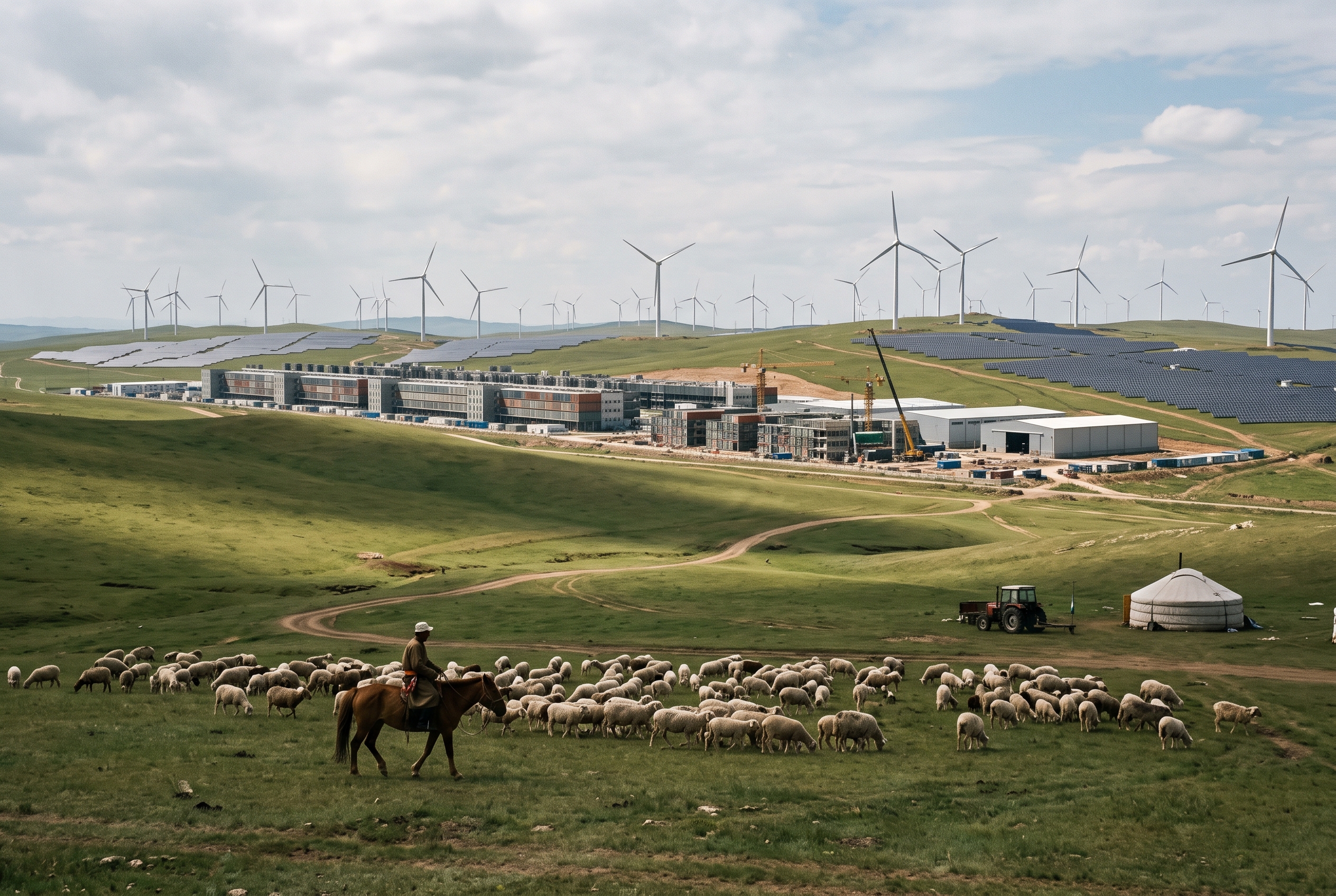
To support its AI ambitions, China is heavily investing in massive data centers, finding the perfect environment in Inner Mongolia[cite: 4]. The region offers two essential resources for these facilities: vast open space and abundant renewable energy[cite: 4]. As you drive through the rolling grasslands, the landscape is now dominated by towering wind turbines and seas of solar panels, supporting China’s plan to eventually power 80% of its data centers with renewable energy[cite: 4].
The scale of construction is staggering. Backed by a $75 billion investment, new data storage facilities the size of multiple airports are continuously being built in phases at “China speed”[cite: 4]. Areas that were just farmland a few months prior are now sprawling technological hubs[cite: 4].
The Tale of Two Chinas
Despite this rapid modernization, public opinion and the reality on the ground remain divided[cite: 4]. The Stanford AI index suggests that the Chinese public generally views AI development more favorably than populations in the US, where there is significant local opposition to data center construction[cite: 4].
However, interviewing locals in Inner Mongolia reveals the stark contrast of “two Chinas”[cite: 4]. While some express immense national pride in China leading the world in infrastructure, others feel left behind[cite: 4]. Local farmers, some earning roughly $450 a month herding sheep and cattle, report feeling little to no benefit from the billions being spent next door[cite: 4]. For rural farmers relying on basic pocket Wi-Fi devices and phones with cracked screens, AI remains a distant, irrelevant concept[cite: 4].
Cultivating Homegrown Talent
Unlike the infrastructure push, China’s approach to AI education touches everyday urban life[cite: 4]. The government is deeply integrating AI and robotics into the educational system, beginning as early as kindergarten[cite: 4].
- Children are interacting with AI-powered chess robots, developing emotional attachments and learning to coexist with the technology from a very young age[cite: 4].
- For adults, AI study centers are scattered across the country to improve public literacy on the subject[cite: 4].
- At the university level, there is a concerted effort to keep high-achieving tech students within China[cite: 4]. Facing tougher US visa restrictions, top students are being incentivized to stay home with government support for AI startups and research[cite: 4].
Furthermore, unlike in the United States—where prominent tech CEOs have publicly called for a slowdown in AI development due to safety concerns—there is absolute silence on that front from Chinese tech executives[cite: 4]. Because the AI push is deeply state-led and heavily promoted by state media propaganda, openly opposing the rapid development of AI would mean directly challenging the government[cite: 4].
The Geopolitical Strategy: Open-Weight Models and Trade
On the global stage, China bristles at Western warnings that its AI rise poses a national security threat, viewing such rhetoric as an attempt to contain its growth[cite: 4]. In response, China is aggressively marketing its AI as a tool for the “good of humanity” by utilizing open-weight models[cite: 4]. By publishing their code openly, Chinese tech companies are courting the Global South, offering customizable AI systems as an alternative to closed American models[cite: 4]. This strategy aims to embed Chinese software and apps deeply into global populations[cite: 4].
This technological race is heavily intertwined with ongoing trade negotiations. A current trade truce—which involves China purchasing US soybeans in exchange for granting the US access to rare earth minerals and China receiving some high-end US chips—is set to expire in November[cite: 4]. As the two nations sit down to negotiate, securing advanced computing chips remains a critical priority for China, even as it publicly touts its ability to develop practical AI applications, like humanoid robots, using less advanced technology[cite: 4].
Ultimately, for President Xi Jinping, the AI revolution is not just about computing power; it is proof of a shifting global dynamic[cite: 4]. It serves as a tool to sit across the table from the United States as a technological equal, reinforcing his narrative that the East is rising[cite: 4].
Leave a Reply