
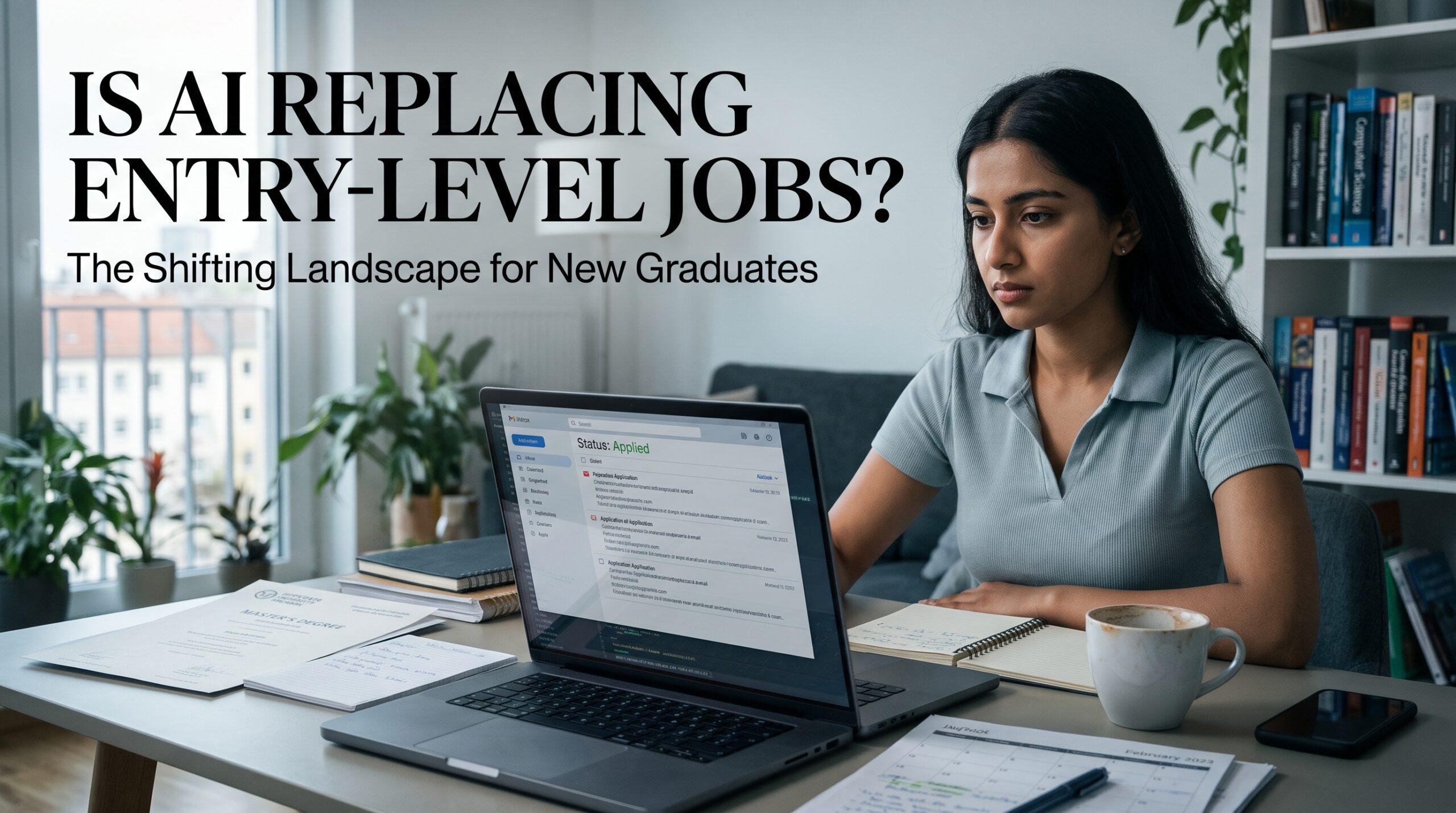
The transition from university to the professional world has rarely been more challenging. Graduates entering the workforce are encountering an evolving job market where artificial intelligence is increasingly performing tasks that once belonged to entry-level professionals.
The Entry-Level Bottleneck For many recent graduates, even those with advanced technical degrees, finding that crucial first role has become a grueling process. Take Sai Pranavi, a computer science master’s graduate in Germany, who applied for over 300 positions with barely any offers. Her struggle is not unique; it reflects a broader trend where employers are scaling back workforce numbers, often replacing junior roles with AI tools. In fact, employers are increasingly adjusting to AI not necessarily through mass layoffs, but by slowing down hiring, which disproportionately impacts younger workers seeking entry-level opportunities.
The Evolution of Required Skills The rise of generative AI has fundamentally altered what companies expect from new hires. In fields like software development, routine programming tasks are now routinely handled by AI. This means that traditional programming skills are no longer sufficient on their own. Graduates who solely focus on conventional methods may find it difficult to compete. To stay relevant, new professionals must actively engage with current AI capabilities and build skills that complement these technologies. Ultimately, AI is more likely to change how jobs are performed rather than eliminate them entirely, meaning workers must adapt to new workflows.
The Role of Education The rapid integration of AI in the workplace highlights a significant gap in higher education. Many university degree programs have been slow to adapt, with digital processes, automation, and AI still playing too small a role in their curricula. Experts suggest that educational institutions need a comprehensive overhaul to ensure students can interact with AI on a practical level, transforming a potential threat into an opportunity for greater productivity and innovation.
Moving Forward While the landscape is daunting, it is not without hope. Success in this new era requires resilience and a willingness to continuously upskill. Pranavi’s eventual success in securing a job underscores that persistence, combined with the readiness to learn new, AI-relevant skills, is the most effective strategy for navigating today’s transformed job market.
Leave a Reply