
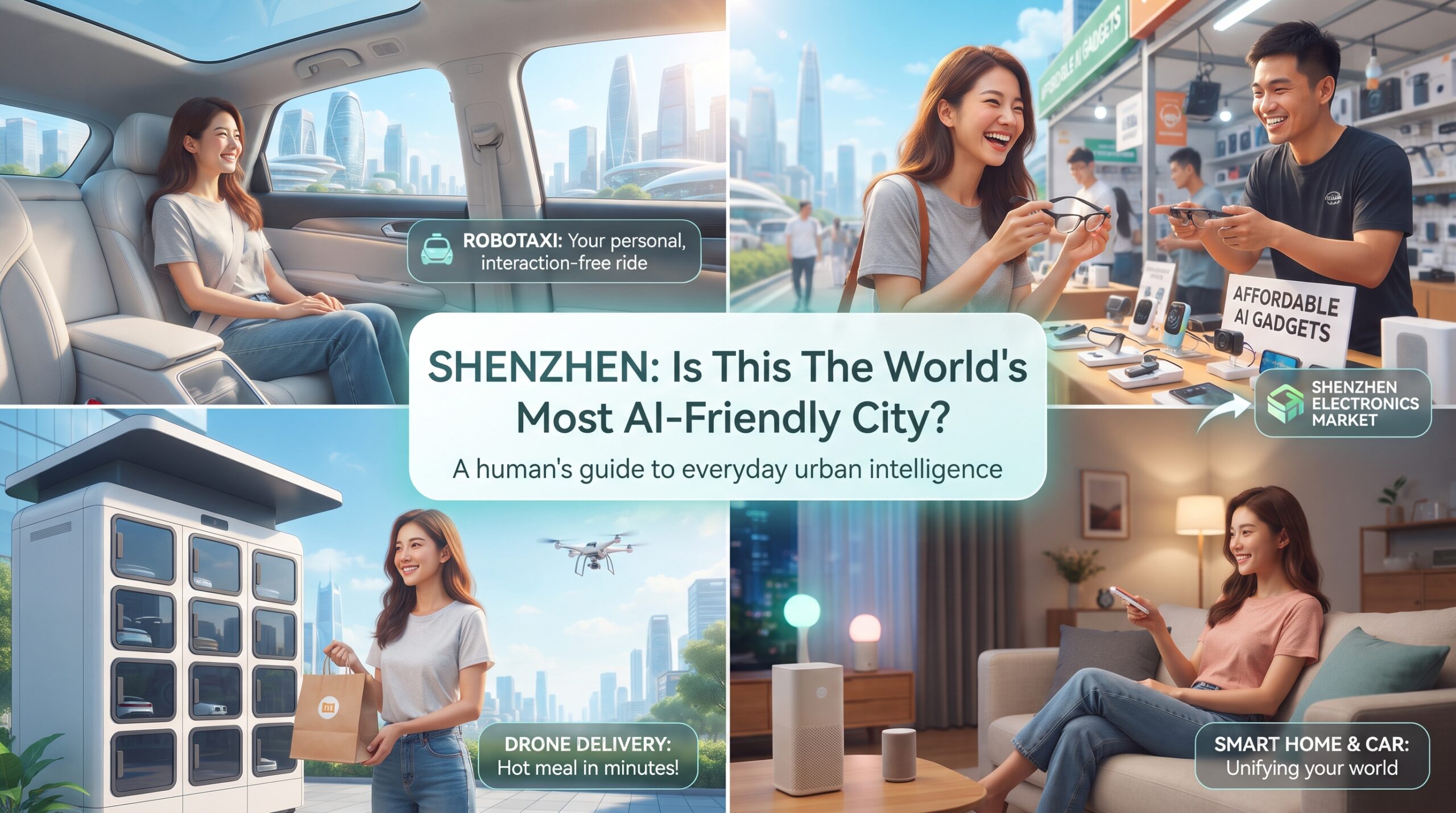
When discussions of artificial intelligence arise in North America, conversations often default to basic text tools, clumsy automated emails, or generic chatbot replies[cite: 3]. However, cities like Shenzhen, China—widely celebrated as one of the most futuristic urban centers on the globe—are taking a radically different approach[cite: 3]. Rather than existing solely as software on a screen, artificial intelligence in Shenzhen has woven itself directly into the fabric of daily life, transforming transportation, retail, robotics, and consumer electronics.
1. Autonomous Mobility: The Robotaxi Experience
Getting around a high-tech metropolis requires more than conventional human-driven vehicles. While self-driving initiatives expand across North America, Shenzhen has long integrated autonomous ride-hailing services into its public transportation ecosystem[cite: 3].
- The Ride: Passengers can easily book driverless taxis through local apps[cite: 3]. Once inside, the vehicle autonomously adjusts, managing steering, acceleration, and complex urban navigation around pedestrians, cyclists, and heavy traffic[cite: 3].
- User Reception: Many local commuters favor these autonomous cabs for practical reasons. Introverted passengers appreciate the silent, interaction-free ride, and the vehicles are often noted for their cleanliness and cost efficiency—averaging roughly two-thirds the price of standard human-driven rides[cite: 3].
2. Advanced Retail: Robot Stores and Exoskeletons
Shenzhen’s commercial landscape features specialty stores dedicated entirely to robotics and emerging tech hardware, where consumers can purchase or rent automated devices for personal use[cite: 3].
- Interactive Robotics: Retail spaces feature robotic arms capable of playing games like rock-paper-scissors[cite: 3], alongside consumer-grade humanoid robots equipped with bilingual voice interactions (English and Mandarin)[cite: 3], facial expressions, and advanced applications.
- Exoskeleton Trials: Wearable robotics designed to support human mobility—such as shoulder-and-waist frameworks that assist with walking and leg elevation—are publicly accessible for testing[cite: 3]. While carrying the weight of the apparatus requires initial physical adjustment, these units demonstrate practical use cases for physical rehabilitation and mobility assistance[cite: 3].
3. High-Speed Drone Deliveries
The logistics and food delivery sector in Shenzhen operates at an entirely different scale. Advanced drone delivery stations now feature multi-compartment automated lockers[cite: 3]. Customers simply input a verification code to retrieve hot or cold meals and beverages delivered via aerial drones in a matter of minutes[cite: 3], complete with insulated, eco-friendly packaging and structured recycling instructions[cite: 3].
4. Total Ecosystem Integration: The Xiaomi Smart Living Model
Major hardware ecosystems demonstrate how artificial intelligence unifies domestic and automotive environments. Modern plug-in hybrid vehicles—such as the Xiaomi Sky Nomad—feature built-in AI voice controls that seamlessly bridge the gap between personal transit and smart home management[cite: 3].
Demonstrations of integrated smart home systems reveal how voice commands or automated routines can simultaneously adjust lighting, manage climate control, control media playback, and activate security cameras, synchronizing appliances and vehicles into a single responsive network[cite: 3].
5. The World’s Biggest Electronics Market: Affordable AI for Everyone
Beyond high-end showrooms, Shenzhen’s massive electronics markets make AI technology accessible at consumer-friendly price points[cite: 3]. Spanning multi-lingual, internationally friendly floors[cite: 3], vendors offer a vast array of practical AI gadgets:
- Educational Tools: AI-powered student tablets integrated with national school curricula, featuring interactive tutors to help solve math problems and practice languages[cite: 3].
- Smart Health & Wellness: Advanced fingertip health monitors utilizing PPG technology to track vital signs and fatigue levels, alongside AI-driven massage devices and interactive companion robots[cite: 3].
- Everyday Gadgets: Affordable consumer tech, including specialized AI translation devices and smart glasses priced for everyday utility[cite: 3].
Conclusion
Shenzhen’s rapid integration of artificial intelligence into transit, retail, logistics, and home automation showcases a future where emerging tech is not just a novelty, but a practical utility. As urban centers continue to evolve, Shenzhen provides a compelling glimpse into what an AI-integrated daily life actually looks like[cite: 3].
Leave a Reply