
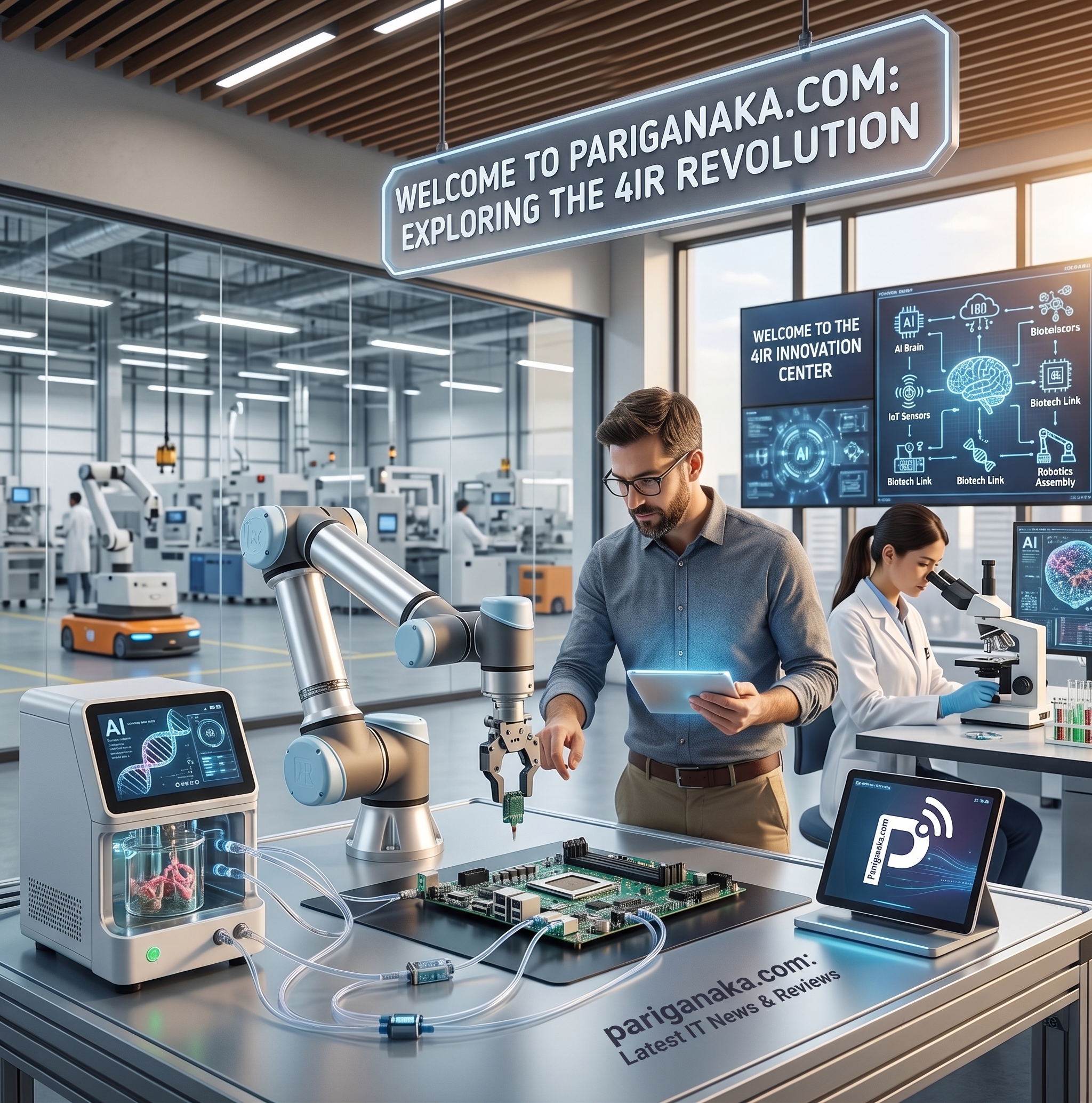
Welcome back to Pariganaka.com, your trusted hub for the latest IT news and reviews.
As we navigate through 2026, you might be hearing the term “Fourth Industrial Revolution” (4IR) everywhere. But with artificial intelligence dominating the headlines—from AI-powered smart factories to humanoid robots—a major question arises: is the 4th Industrial Revolution simply the AI Revolution?
The short answer is yes, but with a massive technological twist. While AI is undeniably the “brain” driving this era, this revolution is about much more than just software. Here is a breakdown of why this era is increasingly being called the “Intelligence Age”.
What is the 4th Industrial Revolution?
The term “Fourth Industrial Revolution” was popularized in 2016 by Klaus Schwab, the founder of the World Economic Forum. It describes a rapid period of technological advancement in the 21st century that follows the digital-focused Third Industrial Revolution.
At its core, 4IR is driven largely by the convergence of digital, biological, and physical innovations. It is a systemic shift that actively blurs the lines between the physical, digital, and biological worlds.
Why AI is the Engine of the “Intelligence Age”
While 4IR encompasses many cutting-edge technologies, AI is the central pillar that makes all other systems function intelligently. Because of this, the Fourth Industrial Revolution is now frequently referred to as the “Intelligence Age”.
Here is how AI is driving this new era:
- The Orchestrator: AI is a key driver of Industry 4.0, actively orchestrating other advanced technologies like robotics, automated vehicles, and real-time data analytics.
- Smart Factories: The 4IR fosters “smart factories” where production environments and logistics are organized with minimal human intervention. Cyber-physical systems within these factories create virtual copies of the physical world and make decentralized decisions.
- Next-Gen Robotics: Modern humanoid robots are rapidly becoming more versatile and flexible, thanks directly to AI advancements like machine learning and reinforcement learning.
- Mass Automation: By enabling machines to perform complex tasks, AI is redefining production processes and reducing changeover times.
Beyond AI: The Grand Convergence
While AI is the driving force, the true power of the Fourth Industrial Revolution lies in its convergence with other groundbreaking fields. AI acts as the catalyst, but it operates alongside:
- Biological Innovations: Low-cost gene sequencing and techniques like CRISPR have massively expanded our ability to edit the building blocks of life.
- Immersive Realities: Augmented Reality (AR) and Virtual Reality (VR) bridge the gap between human experience and the digital realm by allowing users to interact with digital content in simulated environments.
- Advanced Connectivity: The Internet of Things (IoT) helps physical objects “think” and “talk” to one another, optimizing everything from medical devices to building infrastructure through networks of sensors.
The Future is Now
The Fourth Industrial Revolution is not just a prediction of the future; it is a call to action happening right now. AI is the brain, but the integration of robotics, biotechnology, and IoT is the body that brings this revolution into our physical world.
Leave a Reply