
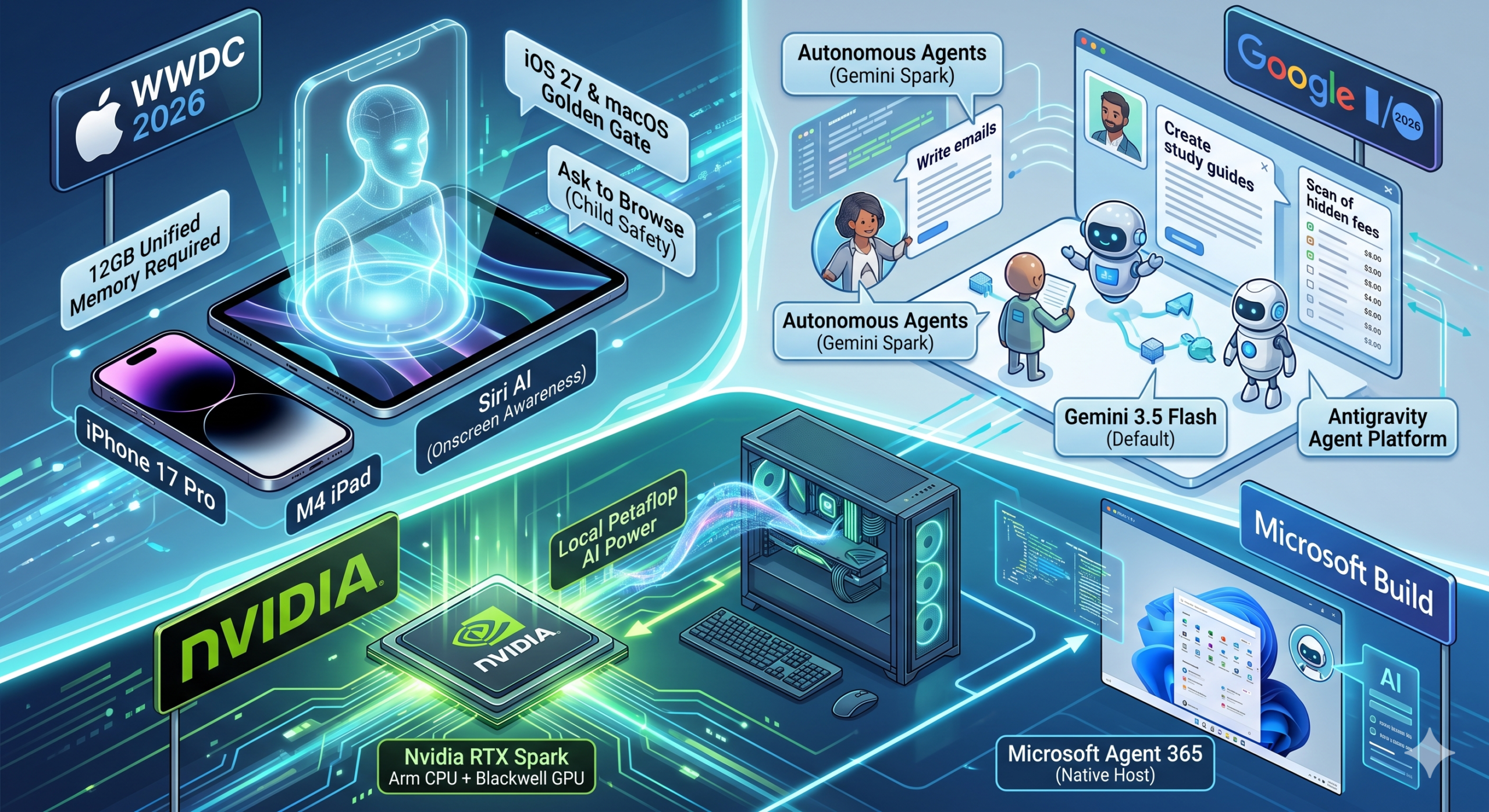
If you thought the AI race was slowing down, June 2026 just proved otherwise. Over the past few weeks, the biggest names in tech—Apple, Google, Microsoft, and Nvidia—hosted their flagship developer conferences and completely reshaped the landscape of consumer tech and artificial intelligence. We are officially moving past simple chatbots; the new era is all about “Autonomous Agents” and powerful on-device processing.
Here is your ultimate recap of the biggest announcements that will change how you use your devices this year.
🍏 Apple WWDC 2026: Siri Gets a Massive “Brain” Update
At WWDC 2026, Apple finally delivered the upgrade users have been demanding for years, unveiling the next generation of Apple Intelligence and a completely rebranded “Siri AI”.
- Siri AI: The new voice assistant features onscreen awareness, real back-and-forth conversational capabilities, and deep personal context to execute app actions.
- iOS 27 & macOS Golden Gate: Alongside iOS 27, Apple announced macOS 27, officially named macOS Golden Gate, which features new “Liquid Glass” design refinements and focuses heavily on performance improvements.
- Hardware Limitations: There is a catch. The most powerful on-device Siri AI features require 12GB of unified memory. This means these advanced tools will be exclusive to devices like the iPhone 17 Pro, iPhone 17 Pro Max, iPad models with M4 chips, and Macs running M3 chips or later. The standard iPhone 17 will miss out on the full experience.
- Child Safety: Apple also expanded parental controls, including an “Ask to Browse” feature that requires kids to request permission to access new websites.
🤖 Google I/O 2026: Welcome to the “Agentic” Gemini Era
Google’s keynote made it clear that AI is transitioning from tools that just assist you, into independent “agents” that can navigate complex tasks across your workflow.
- Gemini 3.5 Flash: This new, incredibly fast model is now the default engine powering the Gemini app and Google’s AI Mode in Search. It is significantly faster than other frontier models, boasting four times the output tokens per second.
- Gemini Omni: Google teased a groundbreaking new model capable of generating any output modality from any input, starting initially with video generation.
- Antigravity: For developers, Google launched “Antigravity,” an agent-first development platform that allows users to easily spin up specialized subagents to tackle complex workflows securely.
- Gemini Spark: Consumers are getting a new 24/7 AI agent designed to independently write emails, create study guides, and even look out for hidden fees.
💻 The Hardware Shift: Nvidia & Microsoft Push AI to the PC
While Google and Apple focused on software and ecosystems, Nvidia and Microsoft are focusing on the raw power needed to run these agents locally.
- Nvidia RTX Spark: Moving beyond the data center, Nvidia introduced the RTX Spark superchip. This pairs an Arm CPU with a Blackwell GPU to deliver roughly one petaflop of local AI computing power directly to personal computers.
- Microsoft Agent 365: At its Build conference, Microsoft pushed “Agent 365” to general availability, positioning the Windows operating system as a native host for autonomous AI agents.
The Bottom Line: If the past two years were about picking your favorite AI chatbot, 2026 is about choosing your AI platform. Whether it’s an Apple ecosystem powered by Siri AI, an Android device guided by Gemini agents, or a powerhouse Windows PC running an Nvidia superchip, our devices are about to get dramatically smarter and more independent.
Leave a Reply