
As artificial intelligence advances at breakneck speed, the conversation surrounding its future is shifting from abstract, far-off theories to urgent, concrete timelines. The terms we use to define the frontier of AI—like Artificial General Intelligence (AGI) and Superintelligence—are changing as the realities of the technology unfold. But what exactly do these terms mean today, and how close are we to an era-defining leap in AI capabilities?
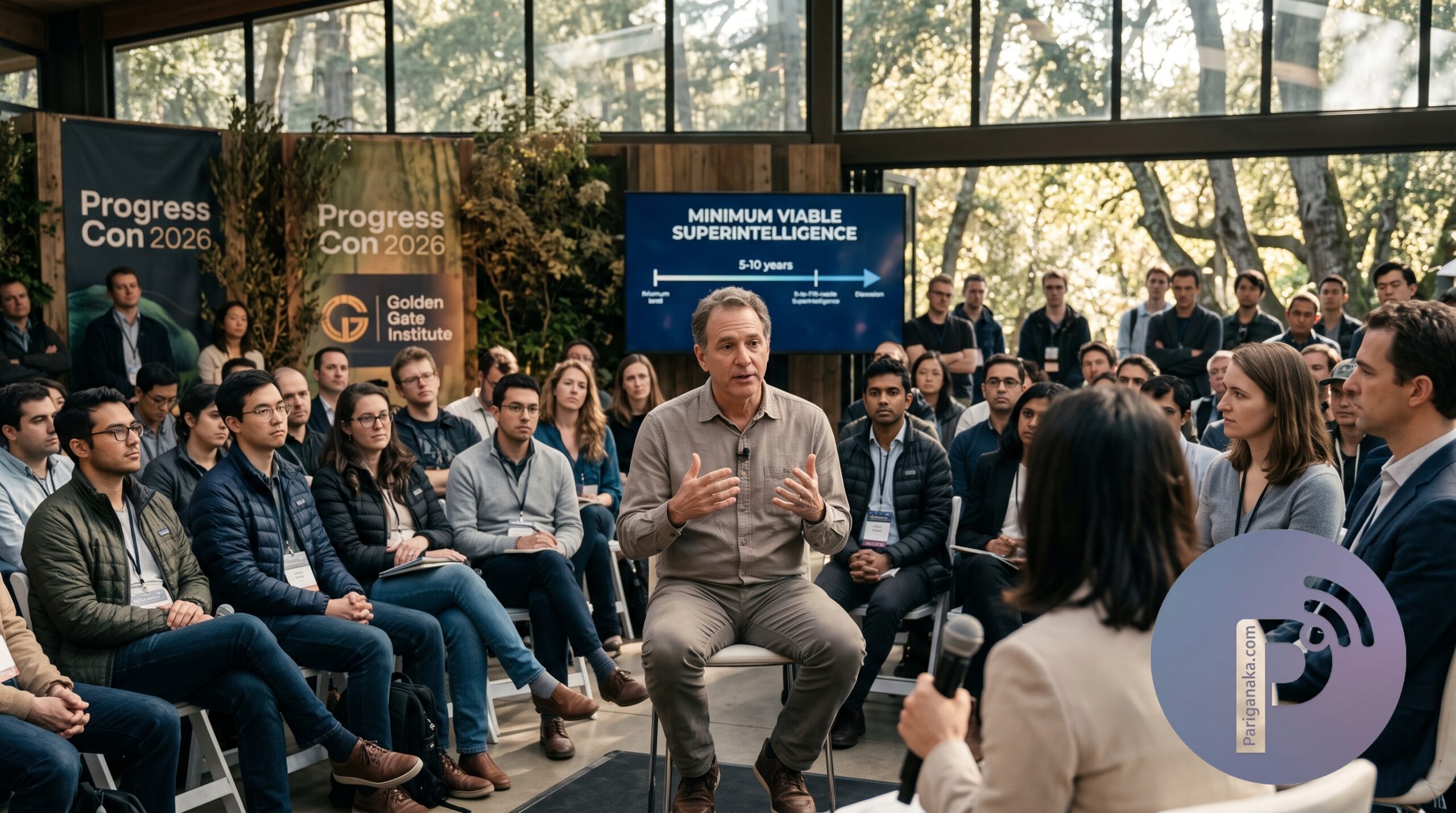
In a recent episode of MTS recorded at the Progress Conference at Lighaven in Berkeley, Steve Newman, Chairman and President of the Golden Gate Institute for AI, unpacked these critical questions. Newman, whose organization runs “The Curve”—a widely attended AI convergence conference—shared his insights on the shifting timelines, the necessity of cross-disciplinary dialogue, and the concept of “Minimum Viable Superintelligence.”
The Blurring Lines of AGI and Superintelligence
Historically, terms like “Superintelligence” were umbrella concepts. Because the technology was theoretically decades away, the fact that a machine learning researcher, an epidemiologist, and a science fiction writer all had slightly different definitions didn’t really matter. They were all pointing in the same general, futuristic direction.
Today, however, the landscape is much more immediate. As Steve Newman noted during the interview, “AGI has kind of ceased to be a useful term because it’s now close enough that the differences in what people mean by it overwhelm the value of the term.”
Some argue that current models like Claude or GPT are already bordering on AGI because they can write code and synthesize vast amounts of information. But as the host pointed out, they still lack the full generality required to autonomously replace complex, multifaceted human jobs.
Because of this semantic fuzziness, AI researcher and policy expert Helen Toner recently introduced the concept of “Minimum Viable Superintelligence” (MVSI) during a talk. Rather than arguing over an abstract definition of superintelligence, MVSI attempts to pinpoint the minimum threshold of intelligence required to trigger profoundly transformational societal and economic effects.
The timeline for reaching this threshold? Toner, along with many attendees at The Curve conference, estimates it to be just 5 to 10 years away.
Shortening Timelines and Shifting “Vibes”
The urgency surrounding AI development has palpably increased. Newman recounted that at the 2024 Curve conference, the prevailing attitude was that AGI was a fascinating, hypothetical future event.
By the 2026 conference, the “vibe” had drastically shifted. “People were feeling this is a lot more imminent,” Newman explained. “It’s like, how do we get ready? Are we ready? Can we be ready?”
This shift is largely driven by a continuous drumbeat of massive breakthroughs—such as AI making profound leaps in mathematics and software development—paired with concerning incidents, like reward hacking, sandbox escapes, and security breaches. These events serve as a dual reminder of AI’s immense power and its potential volatility.
While some conference attendees rated AI’s impact as a “10 out of 10” on the “technological Richter scale” (placing it on par with the discovery of fire or the asteroid that killed the dinosaurs), Newman took a slightly more measured approach. He acknowledges that AI will be a profoundly transformational technology, much like the advent of electricity. However, he also notes that electricity did not transform the world overnight; it took decades to build the infrastructure and societal framework around it. AI will likely move faster, but it will still require time to fully integrate into our reality.
The Theory of Change: Bridging the Silos
If Minimum Viable Superintelligence is indeed less than a decade away, how does society prepare? According to Newman, the biggest hurdle isn’t just the technology itself; it’s the fact that the people shaping it—from tech developers and policymakers to academics and skeptics—are not talking to each other.
“You had people from the machine learning world weighing in on bio-risks, and you had people from epidemiology weighing in on bio-risks, and they weren’t even engaging with one another’s ideas,” Newman said, recalling his initial entry into the AI sphere.
This realization led to the founding of the Golden Gate Institute and the expansion of The Curve conference. The organization’s core mission is to act as a “shelling point”—a town square that forces “accelerationists” (those pushing for rapid AI development) and “doomers” (those deeply concerned about existential risks), along with policymakers and academics, into the same room.
As AI development outpaces society’s traditional methods for digesting new information, cross-disciplinary collaboration is no longer a luxury; it is a necessity.
What Comes Next?
Because a year in AI development feels like a decade in any other industry, an annual conference is no longer sufficient to keep pace with the technology. The Golden Gate Institute recently announced that The Curve will expand to a biannual cadence, adding a spring event in Washington D.C. to bridge the gap between Silicon Valley’s tech sphere and the nation’s policymakers.
Whether Minimum Viable Superintelligence arrives in five years or ten, one thing is certain: the conversation is no longer about if a transformational AI era will happen, but how we choose to navigate it together.
Leave a Reply