
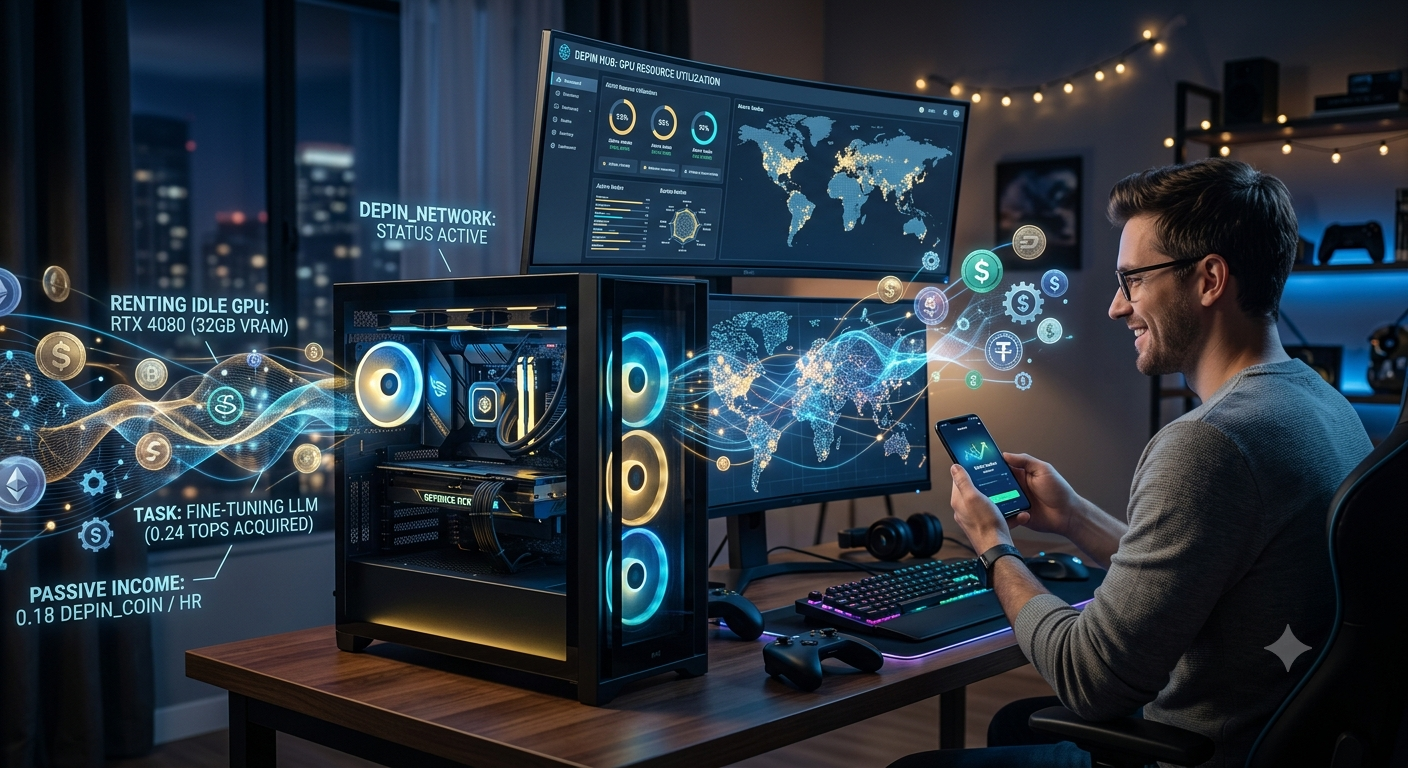
For years, PC enthusiasts viewed hardware through a single lens: performance per dollar. We bought high-end GPUs for gaming, 3D rendering, or crypto mining. However, as we move through 2026, a massive paradigm shift is taking place. The global explosion of AI models and autonomous agents has created an insatiable demand for raw computing power.
Enter DePIN (Decentralized Physical Infrastructure Networks). This technology is changing the game, allowing everyday tech enthusiasts and readers of Pariganaka.com to rent out their idle hardware to crowd-sourced AI computing networks.
What is DePIN?
DePIN stands for Decentralized Physical Infrastructure Networks. It uses blockchain-based token rewards to incentivize people to build, maintain, and operate physical hardware networks in the real world.
Instead of tech giants building billion-dollar server farms to train AI, DePIN protocols stitch together thousands of individual, consumer-grade PCs across the globe into a massive, decentralized supercomputer.
The 2026 Reality: The centralized cloud is congested. High-end enterprise GPUs (like NVIDIA’s latest architectures) are tightly rationed. DePIN platforms act as an alternative marketplace, utilizing the idle consumer GPUs sitting in living rooms worldwide.
How It Works: From Gaming to Training AI
If you own a modern mid-to-high-end graphics card (such as an NVIDIA RTX 40/50 series or AMD Radeon RX 7000/8000 series) or a cutting-edge processor with a high-TOPS NPU, your computer is essentially a tiny goldmine when you aren’t using it.
- The Client Software: You install a lightweight, secure client node from a trusted DePIN provider (e.g., platforms like Io.net, Render Network, or Akash).
- Resource Allocation: When you step away from your PC to sleep or go to work, the client automatically spins up, allocating your idle GPU VRAM and processing threads to the network.
- Task Execution: The network assigns your PC small chunks of larger tasks—such as rendering architectural frames, processing machine learning data sets, or running fine-tuning loops for LLMs.
- Earning Passive Income: In exchange for your compute time, you earn native tokens or stablecoins directly into your digital wallet.
Centralized Cloud vs. DePIN Compute
| Feature | Centralized Cloud (AWS / Azure) | DePIN Compute (Decentralized) |
|---|---|---|
| Cost for AI Startups | High (Premium pricing due to scarcity) | Low (Up to 70% cheaper via distributed nodes) |
| Availability | Subject to waitlists and enterprise contracts | Instant, global permissionless access |
| For the Hardware Owner | You pay them monthly subscription fees | They pay you for your idle hardware uptime |
| Data Redundancy | Vulnerable to single data center outages | Highly resilient; distributed across thousands of nodes |
Addressing the Elephants in the Room: Security and Power
While the prospect of making passive income from your gaming rig sounds incredible, two major questions naturally arise: Is it safe? and Is it efficient?
1. Zero-Knowledge and Containerized Security
You might wonder if malicious actors can access your personal files while using your hardware. Modern DePIN clients use isolated Docker containers and virtual machines. The AI workloads run inside a strict sandbox environment with zero access to your host operating system, storage drives, or personal data.
2. The Power-to-Profit Ratio
With electricity costs being a critical factor for tech enthusiasts globally, profitability hinges on efficiency. Fortunately, modern 2026 GPU architectures have vastly superior performance-per-watt ratios compared to the old crypto-mining days. Furthermore, AI training workflows typically leverage VRAM capacity rather than pinning the core clock at 100% power continuously, keeping heat generation and electricity bills surprisingly manageable.
What This Means for the Pariganaka Community
The DePIN movement represents a democratization of technology. It shifts the power (and profit) away from monopolistic data centers and places it back into the hands of individual hardware owners.
When you build a PC today, you are no longer just buying a machine for entertainment or personal productivity. You are investing in a micro-enterprise capable of contributing to the global AI infrastructure. As 2026 continues to push the boundaries of decentralized tech, keeping an eye on DePIN networks might just be the smartest hardware move you make this year.
Leave a Reply