
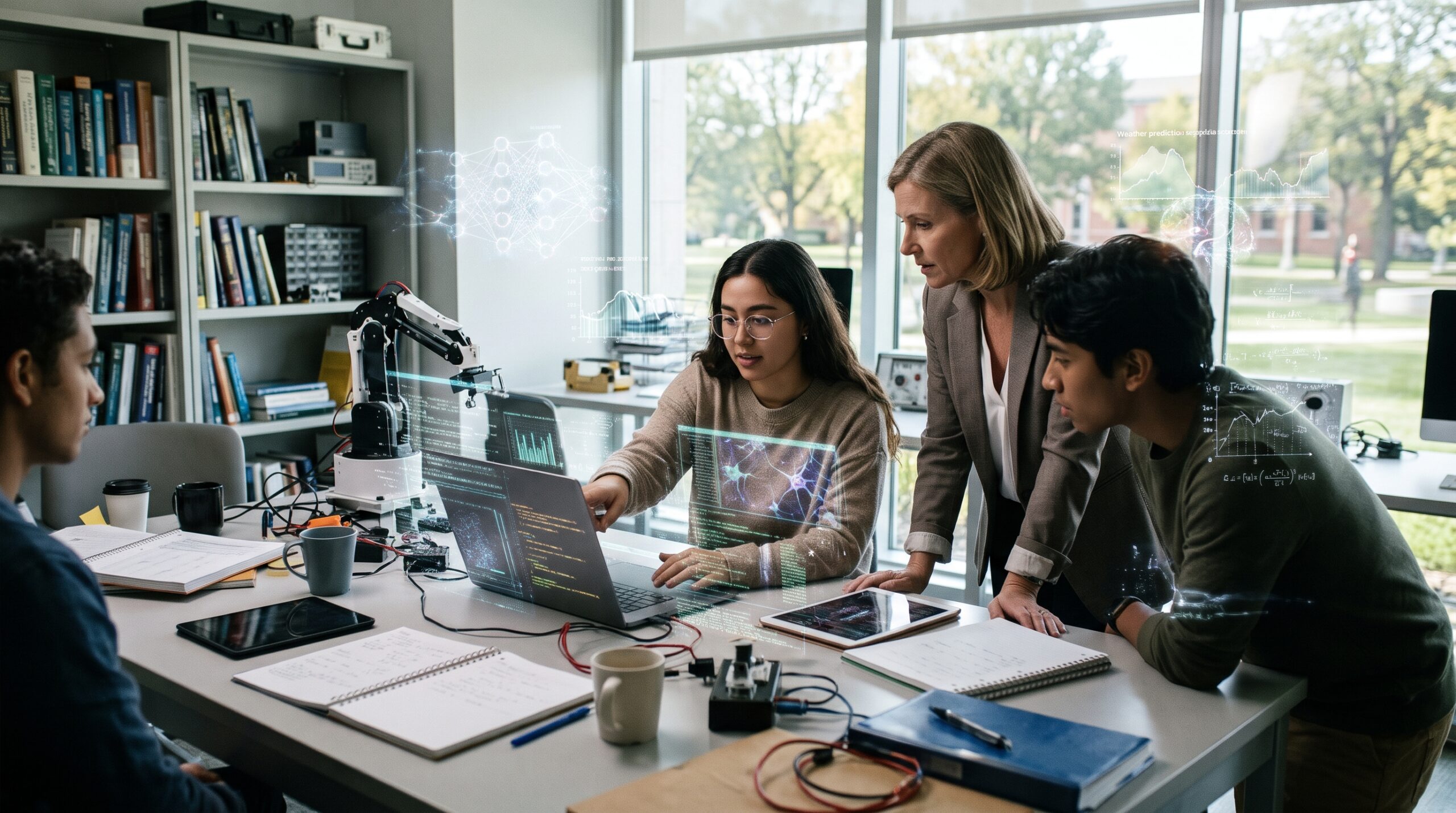
As artificial intelligence reshapes the boundaries of scientific discovery, many find themselves wondering what place humans will hold in this new paradigm. Google Research Principal Product Manager Lizzie Dorfman recently shed light on this evolving landscape, offering a compelling perspective: AI is not here to replace our core skills; it is here to amplify them.
The narrative that AI will render coding or foundational knowledge obsolete is largely hype. While AI is undeniably accelerating the pace of scientific breakthroughs—such as predicting the weather accurately, forecasting flu hospitalizations, and identifying previously unseen structures in the human brain—the need for robust human understanding remains critical.
The Persistence of Foundational Skills
One of the most persistent myths surrounding AI is that “people won’t need to know how to code anymore.” Dorfman explicitly characterizes this idea as hype, emphasizing that humans still need to understand the fundamental mechanics of what is happening under the hood.
When conducting research, understanding the process from ideation to result is essential. A foundational grasp of mathematics and coding enables professionals to identify errors, question the validity of results, and uncover new opportunities. While AI systems can rapidly generate hundreds of thousands of scientific experiments—compressing months of work into a single night—human scientists are still required to interpret these outcomes and ensure the technology is harnessed effectively. Foundational knowledge lasts beyond AI, acting as the bedrock upon which new technologies are built.
The Human in the Loop: Why We Need More Scientists
Rather than eliminating the need for scientists, AI is making them more valuable. Dorfman draws a parallel to the invention of the steam engine: just as trains increased the demand for coal because people traveled more, AI is increasing the capacity for scientific research. We are no longer constrained solely by time.
AI tackles the “technological drudgery”—the debugging of code, the tedious reproduction of old papers, and the exhaustive review of old documentation. By lifting this burden, scientists are freed to pursue more ambitious questions. Consequently, the world will actually need more graduate students and scientists to capitalize on this accelerated pace of discovery.
What Should You Study Today?
For those starting their careers today, navigating a world of constant technological evolution can feel daunting. Dorfman advises building a foundation around what you are intrinsically motivated to learn. Because learning something you care about is significantly easier, following your interests provides the resilience needed to adapt.
Her core advice includes:
- Build something: Gain hands-on experience by creating a project. This demystifies the process and helps clarify your long-term interests.
- Embrace discomfort: The ability to be a lifelong learner requires being comfortable with being a novice. Pushing through this “consciously incompetent” phase propels you forward.
- Connect technology to value: The future will heavily rely on individuals who can operate at the intersection of new technologies and practical, beneficial products.
Ultimately, the goal of AI integration is not human obsolescence, but the dramatic reduction of technological drudgery. By maintaining our foundational skills and focusing on lifelong learning, we can leverage AI to spend more time on the work that truly matters.
Leave a Reply