
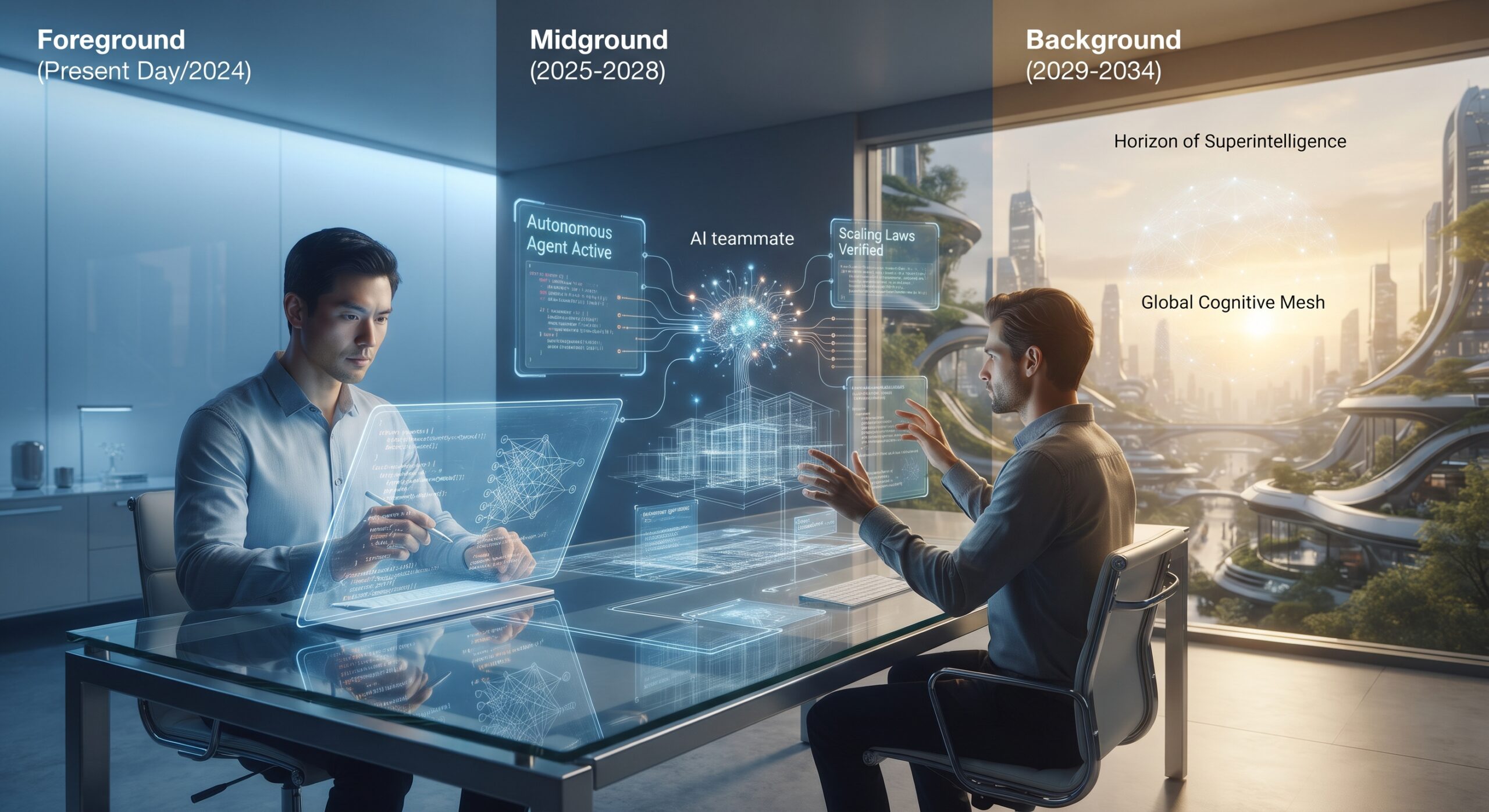
The trajectory of artificial intelligence is moving at a blistering pace, transitioning from simple text-prompt generators to autonomous digital workers and potential precursors to Artificial General Intelligence (AGI). In a recent deep-dive discussion featured on Joe Lonsdale’s channel, leading Anthropic researchers—including reinforcement learning experts Sholto Douglas and Nick Marwell—sat down to map out what the next ten years hold for technology, employment, and human society.
Rather than viewing AI as a stagnant tool, industry insiders are planning for a reality where AI models function more like independent digital entities. Here is a breakdown of the key themes, trends, and projections discussed regarding the upcoming decade.
1. Compressing Centuries of Technological Evolution
One of the core takeaways from the conversation is the sheer velocity of modern compute trends. Driven by massive compounding investments in hardware and compute clusters, AI capabilities are scaling exponentially.
Researchers note that the progress we are witnessing is compressing what would historically take centuries of technological innovation into mere decades. As trend lines for compute power and algorithmic efficiency double at unprecedented rates, the resulting economic impact is projected to vastly eclipse the transformations seen during the Industrial Revolution.
2. From Typing Code to AI Teammates
The evolution of coding and specialized logic has acted as the vanguard for modern AI advancement. While early models required strict, step-by-step instructions to output basic lines of code or draft emails, today’s landscape looks vastly different:
- The Shift to Autonomy: AI models are increasingly shifting from passive tools to active digital teammates. They integrate into team workspaces (like Slack or Teams), handle complex structural changes independently, and save developers and researchers hours or days of manual labor.
- Why Math and Code First: Code and mathematics provide objective frameworks where performance can be rigorously evaluated. This allowed developers to rapidly scale reinforcement learning, establishing a robust foundation before expanding into more nuanced, unstructured domains.
3. Approaching AGI and the Horizon of Superintelligence
Discussions around Artificial General Intelligence (AGI) are no longer confined to science fiction; researchers are actively budgeting for milestones within the next couple of years.
As models transition from tools into autonomous entities, evaluating progress relies heavily on sophisticated benchmarks (“evals”) that test reasoning, long-horizon planning, and problem-solving. The ultimate destination is a regime of superhuman AI, where systems can reliably connect dots across disparate fields of science, engineering, and commerce far beyond human capacity.
4. Economic Opportunities vs. Societal Bottlenecks
While existential debates often dominate mainstream headlines, the near-term economic reality is heavily tied to infrastructure, revenue ramps, and productivity:
- Employment and Productivity: For now, AI is largely boosting productivity and supplementing human workflows. However, the economic bottleneck is shifting toward how quickly industries can adapt to a workforce where humans increasingly collaborate with—or hand off tasks entirely to—autonomous agents.
- The Post-Scarcity Vision: Looking toward the end of the decade, successful scaling opens up pathways toward a post-scarcity world driven by hyper-efficient automated labor and scientific acceleration. However, realizing this future relies heavily on intelligent political governance, resource distribution, and managing the massive energy demands required to power next-generation compute.
Outlook
The next ten years will redefine the boundary between human effort and machine capability. As Anthropic and other leading labs push closer to AGI, society faces a dual challenge: capturing the monumental economic and scientific abundance promised by AI while navigating the profound structural shifts it will bring to labor, security, and human control.
Would you like to explore a specific segment of this discussion further, such as their insights on reinforcement learning or the economic timeline toward AGI?
- Explore the technical scaling laws mentioned by the researchers.
- Discuss the economic and employment impacts projected for the late 2020s.
Leave a Reply