
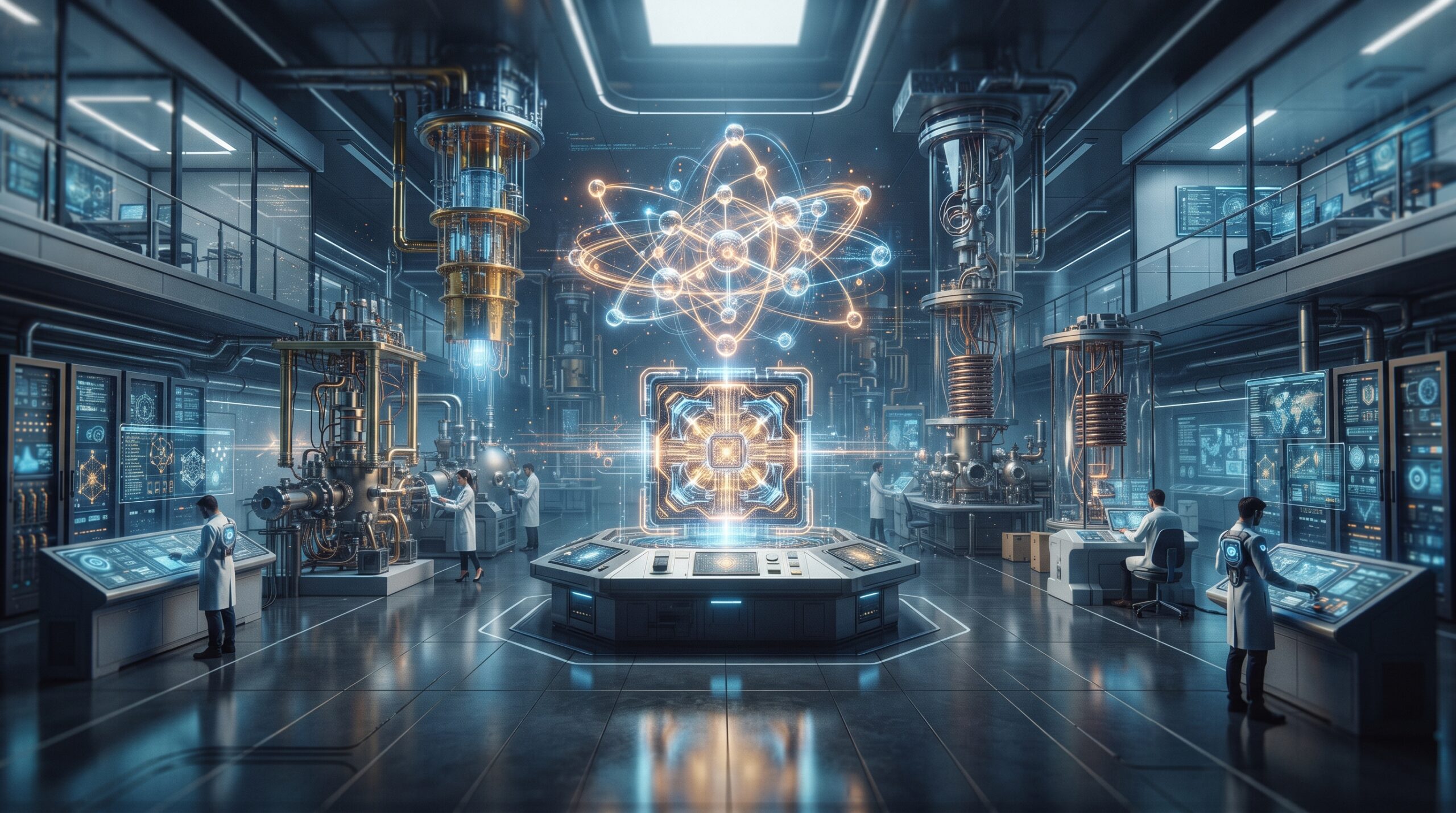
While classical computers are like reliable cars built for familiar roads, quantum computing represents an entirely new dimension—much like transitioning from land transport to aviation, opening up paths that traditional roads could never reach. Once confined to the realm of science fiction, quantum computing is rapidly shifting from theory to practical reality.
1. The Fundamental Limits of Classical Computing
Everything in our physical world is governed by the laws of quantum mechanics. However, modeling complex natural systems—such as protein molecules and chemical compounds—presents an exponentially large problem. Even the most powerful classical supercomputers hit a fundamental processing wall when trying to simulate these molecular structures accurately on their own.
2. Quantum-Centric Supercomputing
Rather than replacing classical computers entirely, the breakthrough lies in quantum-centric supercomputing. By pairing Quantum Processing Units (QPUs) with traditional CPUs and GPUs, complex challenges are broken down into constituent pieces and distributed across different processing capabilities.
This hybrid approach is already yielding real-world scientific breakthroughs. For instance, institutions like IBM, the Cleveland Clinic, and Japan’s RIKEN Institute successfully utilized quantum-supercomputing workflows to simulate a protein consisting of over 12,000 atoms—marking the largest molecule ever modeled on a quantum computer. This capability paves the way for vastly improved drug discovery and advanced therapeutics.
3. Decades of Development and Scaling
Quantum information science has deep roots, with foundational concepts pioneered decades ago at research centers like IBM’s Thomas J. Watson Research Center. Over the years, the field has evolved from theoretical foundations to cloud-accessible hardware—where over 4 trillion circuits have been executed and thousands of research papers published.
A major focus of modern quantum roadmaps involves improving operational scale and accuracy through advanced error correction and error mitigation. Newer generations of hardware are continuously pushing the boundaries of quality and reliability.
4. What Lies Ahead
As the industry looks toward the next decade, the focus centers on developing scalable, fault-tolerant quantum computers and integrating broader quantum technologies into standard workflows. Quantum computing is no longer just a futuristic concept—it is here, active, and fundamentally changing how we solve problems that conventional roads can never reach.
Leave a Reply