
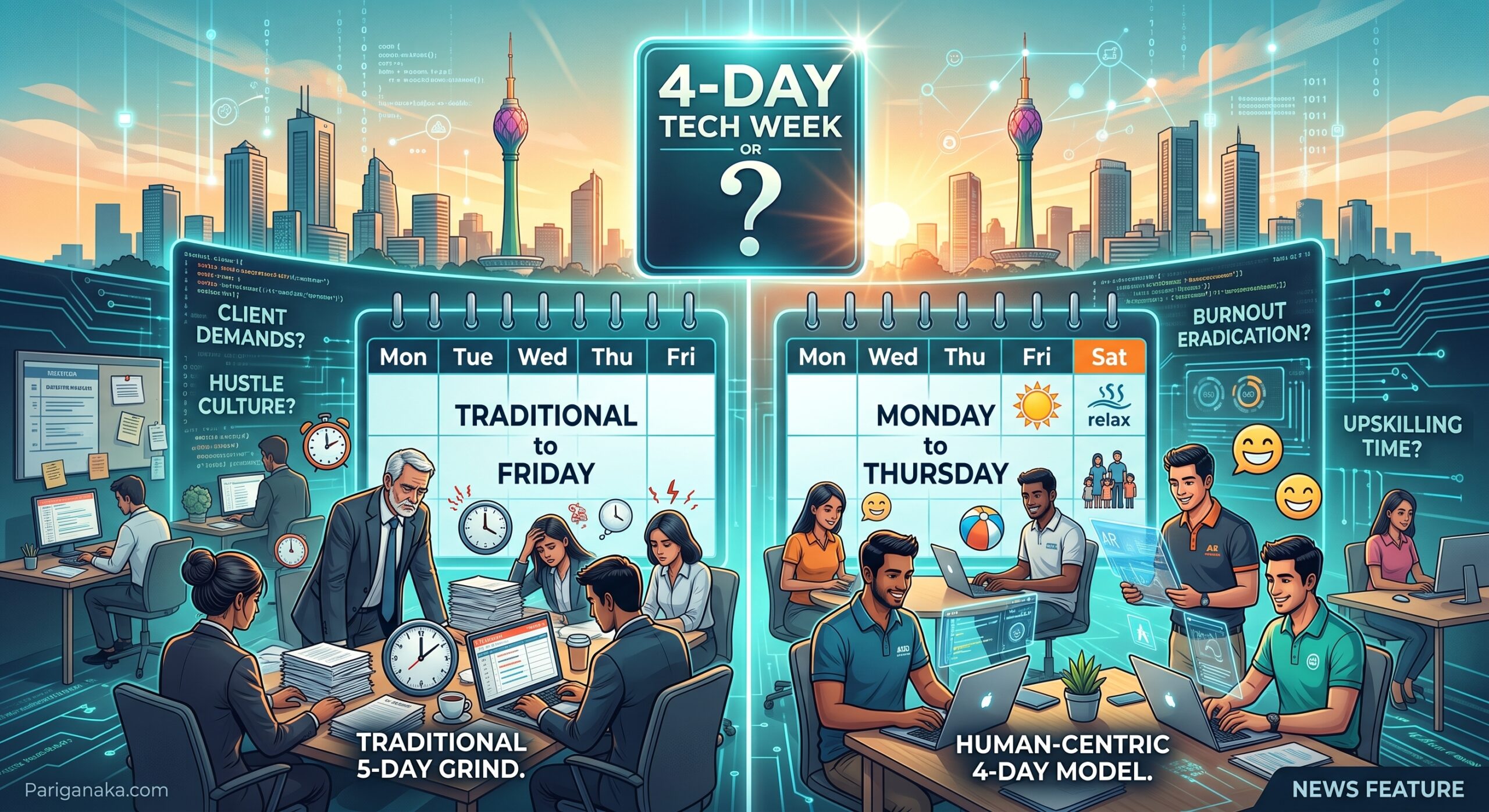
As major global tech giants finalize their permanent transition to a four-day work week this year, the ripple effects have officially reached Sri Lanka. Colombo’s corporate boardrooms are currently locked in debate over a critical question: Can local IT and digital firms adopt a shortened work week without sacrificing their competitive edge in the global market?
The traditional 40-hour work week is undergoing a rapid, technology-driven re-evaluation. With the explosive rise of AI workflow integration in 2026, software engineers and digital professionals are no longer bound by the same time constraints. Automated debugging, AI-assisted coding, and intelligent administrative agents have streamlined operations to the point where five days of output can comfortably be achieved in four.
The Productivity Paradox and AI
Early reports from global tech hubs implementing the four-day schedule indicate a surprising trend: productivity does not drop. Instead, condensed schedules force teams to eliminate unnecessary meetings and micro-management, prioritizing “deep work.”
Local advocates argue that this model perfectly aligns with a human-centric approach to technology. A guaranteed three-day weekend provides digital workers with vital time to disconnect, combatting the severe burnout and “screen fatigue” that currently plagues the IT industry. Furthermore, it allows professionals the breathing room to upskill, explore passion projects, and reconnect with their families and local communities.
The Outsourcing Hurdle
Despite the clear human benefits, Sri Lanka faces unique structural challenges. The local tech economy is heavily reliant on global outsourcing and servicing international clients across multiple time zones.
“The challenge isn’t whether our developers can do the work in four days; it is whether our international clients will accept us not being online on a Friday,” notes a senior project manager at a leading Colombo-based software firm. “Moving to a four-day week requires a massive shift in how we bill for services—moving away from ‘hours logged’ to ‘value delivered’.”
Additionally, industry insiders point to a lingering traditional corporate mindset in the region that still mistakenly equates long hours spent at a desk with employee loyalty and dedication. Many local companies currently lack the Key Performance Indicator (KPI) frameworks required to measure actual creative output accurately.
Evolution, Not Revolution
While an overnight, industry-wide shift to a Monday-to-Thursday schedule is unlikely for most Sri Lankan firms, a transition is already underway. To remain competitive in attracting top-tier talent, several local startups and progressive tech companies are experimenting with hybrid models. These include highly flexible working hours, alternating four-day weeks, and mandatory “no-meeting, half-day Fridays.”
The consensus is clear: the future of work in Sri Lanka is shifting. The companies that will thrive are those that learn to trust their teams to deliver high-quality results, rather than simply monitoring the hours they stay logged in.
How would a permanent four-day work week impact your current daily routine and overall productivity?
Leave a Reply