
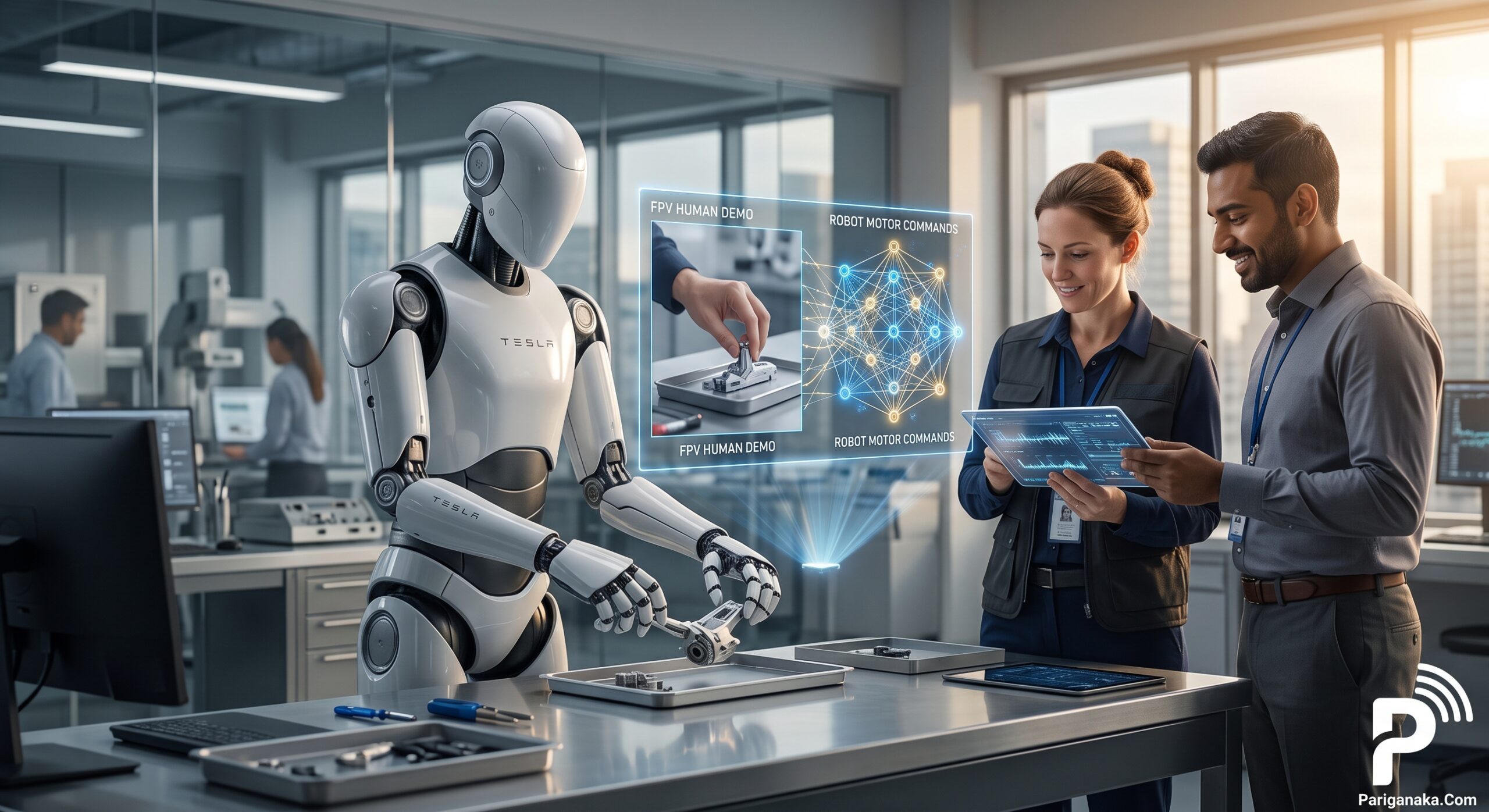
In what could be a defining moment for artificial intelligence and robotics, Tesla’s Optimus may have just crossed a major technological threshold. Instead of manually programming a humanoid robot for every single individual job, Tesla is proving that a robot can learn a vast toolbox of skills by simply observing how a human performs a task and feeding that information into a learning system.
The Power of a Unified Mind
The real challenge for humanoid robotics is not simply walking or picking up an object; it is learning hundreds of different tasks without engineers needing to write isolated software for each one. In a May 2025 demonstration, Tesla showcased Optimus performing a surprisingly diverse range of physical tasks—sweeping with a broom, throwing away trash, using a vacuum cleaner, tearing a paper towel, opening a cabinet, and even moving a Model X component onto a factory dolly.
The true breakthrough beneath this impressive display is that these drastically different physical behaviors were all being handled through one single neural network. Instead of having an isolated intelligence for sweeping and a completely separate one for opening doors, Tesla’s machine learning model processes vision, interprets the situation, selects an action, and generates movement as one flexible, general-purpose system.
Learning Directly from Human Video
According to Milan Kovac, Tesla Optimus Vice President, the team has made a significant breakthrough in transferring learning directly from human videos to the robot. Currently, the system uses first-person video, allowing the robot to associate the visual information of what a human sees with the sequence of physical actions required to complete the task.
However, Tesla’s long-term goal for this technology is much bigger: transitioning from specialized first-person training videos to ordinary, third-person internet videos or randomly captured camera footage. Humans already generate an enormous amount of visual data every day through cooking tutorials, home improvement videos, and factory demonstrations. If Optimus can extract useful physical behaviors from this vast online library, the potential training dataset becomes virtually limitless.
General-Purpose Flexibility vs. Traditional Robotics
Traditional factory robots are incredibly fast and precise, but they are rigid. A robotic arm designed to install a component thousands of times on an assembly line requires significant reprogramming if the workstation moves or the task changes.
Optimus takes a radically different approach. Because it possesses a human-like bipedal body, it is designed to operate in environments already built for humans—meaning doors, tools, shelves, workbenches, and household objects do not need to be redesigned around the machine.
The Road to Real-World Reliability
While the single neural network demonstration proves this learning architecture is possible, a controlled video is very different from real-world deployment. Real-world integration requires reliability, speed, cost efficiency, and repeatability; a robot that succeeds nine times out of ten might look impressive on camera, but it remains unsuitable for a critical industrial process.
To bridge this reliability gap, Tesla is relying heavily on simulation and reinforcement learning. By exposing the AI to countless virtual scenarios, the robot can practice falling, balancing, reaching, and reacting to unexpected situations repeatedly without damaging physical hardware. If Tesla can successfully scale this human-video learning and simulation pipeline, Optimus will shift from a machine trained for specific demonstrations into a genuinely autonomous entity capable of continuously learning tomorrow’s physical tasks.
Leave a Reply