
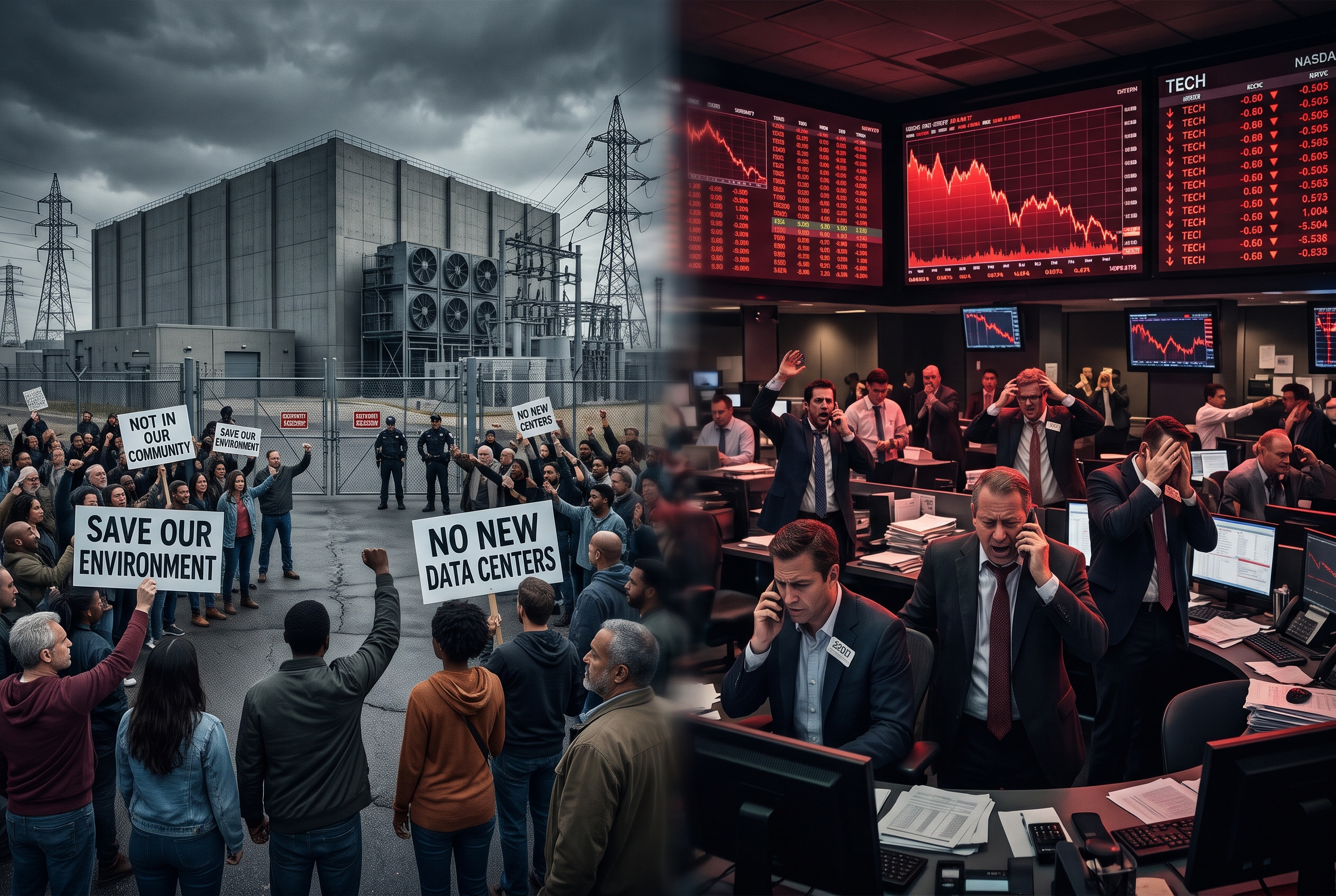
Wall Street recently experienced an absolute bloodbath, with an astonishing $2.5 trillion wiped off the value of American tech firms in a single day. But the catalyst wasn’t a failure in the technology itself, nor was it a traditional economic metric. The trigger was a wave of voter backlash during the US midterm elections aimed squarely at the physical backbone of the artificial intelligence revolution: data centers.
The Root of the Revolt Data centers—the vast warehouses of powerful computers that process everything from your banking transactions to AI chatbot queries—have quietly become a major political flashpoint. Building these massive facilities requires immense amounts of electricity, land, and water.
According to polling data highlighted by BBC Verify, around half of US voters said data centers were a crucial or major issue for them in the midterms, and an overwhelming 75% stated they would oppose a new data center being built in their community. Residents have grown increasingly vocal about how these facilities push up local energy bills, harm the surrounding environment, and generate relentless noise.
This localized anger translated into political action. The Democratic sweep in the midterms was accompanied by voter support for dozens of ballot measures imposing strict restrictions on the construction of new data centers. Politicians are now suggesting temporary bans, local veto rights, and mandates requiring tech owners to fully foot the bill for local energy and water infrastructure upgrades.
A Global Ripple Effect The uncertainty surrounding the future of US data center construction immediately spooked investors, creating a snowball effect that reached far beyond American borders.
Asian markets, heavily reliant on the American tech ecosystem, took a massive hit. In South Korea, a circuit breaker was triggered to suspend trading for 20 minutes to prevent panic selling. Major memory chip suppliers Samsung Electronics and SK Hynix—who provide the crucial hardware that goes into US AI data centers—lost roughly 10% of their stock value right as the market opened. Investors panicked over the prospect that harsher US regulations would stall AI infrastructure buildouts, effectively killing the demand for Asian chips.
Correction or Crash? With trillions wiped out, many are asking if the so-called “AI bubble” has burst. However, financial experts urge calm. Bob Parker, a senior adviser at the International Capital Market Association, believes this is a market correction rather than a repeat of the 2008 financial crisis or the early 2000s dot-com crash. Tech companies today boast incredibly strong balance sheets and high profitability, making a catastrophic, long-term downtrend unlikely.
Charlene Jackson, chief executive of the digital consultancy Cloud9, echoed this sentiment, viewing the sell-off as a “blip” and noting that business demand for AI integration is only accelerating. Furthermore, Donald Trump took to Truth Social to express “100% support” for super intelligence, arguing that states turning away from AI development are throwing away massive economic opportunities.
The Future of AI Infrastructure If new data center construction is successfully capped by local legislation, the AI tools you use today won’t suddenly stop working. However, the evolution of AI could slow down dramatically. Because artificial intelligence requires exponentially more computing power to become “smarter,” pausing new data centers acts as a speed limit on the industry’s progress.
Interestingly, this legislative hurdle might inadvertently protect the biggest players. Tech giants already possess vast data center networks; it is the smaller, newer rivals who will be hit hardest if they are blocked from building the infrastructure needed to compete.
With protests extending as far as the Netherlands—where activists recently broke into a Microsoft data center construction site in Amsterdam—the industry is being forced to look for out-of-the-box solutions. To bypass land-use complaints and environmental concerns, tech leaders are now seriously considering an idea straight out of science fiction: building data centers in space, orbiting the Earth like satellites.
Whether the industry looks to the stars or finds a way to appease local communities, it is clear that the future of AI is no longer just in the hands of tech billionaires—it is in the hands of the voters who live next door.
Leave a Reply