
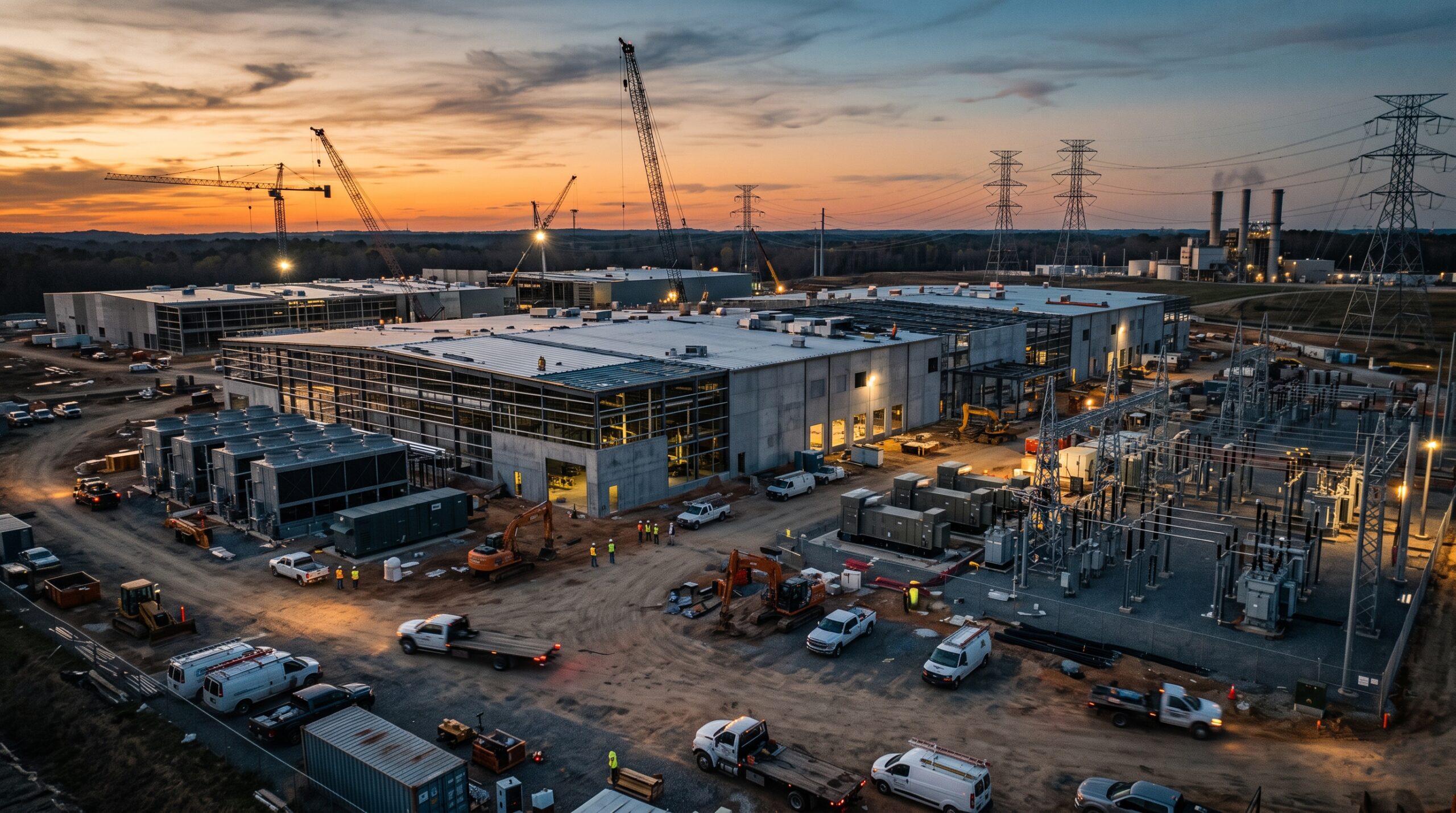
Artificial intelligence is almost universally pitched as a software revolution. We envision a future driven by autonomous systems, chatbots like ChatGPT, and increasingly intelligent digital models. However, the reality of AI is shockingly physical.
Beneath the sleek user interfaces of modern AI applications lies an ever-expanding footprint of warehouses, power stations, cooling systems, semiconductor plants, and mountains of raw minerals.
This unprecedented physical build-out raises an uncomfortable question: What happens if the economic value generated by AI never catches up with the infrastructure being built to support it?
The $3 Trillion Infrastructure Boom
The scale of this infrastructure expansion is staggering. As of April 2026, the United States was home to 4,423 listed data centers—roughly 12.9 for every million Americans.
Real estate and investment firm JLL projects that nearly 100 gigawatts of additional data center capacity will be needed between 2026 and 2030. Funding this expansion will potentially require a staggering $3 trillion in investment.
What makes this boom highly unusual is the sequence of profitability. Enormous amounts of money are being generated before the ultimate product—the AI software itself—proves broadly profitable. Throughout the supply chain, players are cashing in now:
- Developers are acquiring highly sought-after land.
- Construction companies are building state-of-the-art facilities.
- Utilities are expanding electricity networks to handle the immense load.
- Semiconductor companies are selling processors at premium prices.
- Banks are providing the massive financing required to keep it moving.
Technology giants like Amazon, Microsoft, Google, and Meta act as both the promoters of the AI revolution and the primary sources of demand for the infrastructure that supports it, eagerly reserving vast amounts of computing capacity.
The Profitability Gap
A long-term data center lease proves there is high demand for computing power, but it does not prove that the companies ultimately deploying these AI models can generate sufficient returns from them. This is where the narrative starts to fracture.
According to a 2026 McKinsey survey, the actual corporate adoption and profitability of AI remain surprisingly low:
- Only 37% of organizations reported any company-wide earnings benefit from AI.
- A mere 6% stated that AI generated significant value (representing at least 5% of earnings).
Furthermore, the RAND Corporation has estimated that more than 80% of AI projects fail. This massive gap between infrastructure spending and actual end-user profitability has Wall Street sounding the alarm. Analysts are increasingly pointing out that while the underlying technology is undoubtedly amazing, broad economic adoption hasn’t materialized yet, making the current investment surge look suspiciously like a bubble.
A Self-Sustaining Investment Loop
The current AI ecosystem is characterized by an insular loop of capital. Major tech companies and cloud providers invest heavily in AI developers. Those AI developers, flush with cash, then spend enormous sums purchasing chips and computing capacity from companies directly connected to their own investors.
Ultimately, the sustainability of this entire system depends on customers outside of this investment loop finding economically valuable, profitable uses for AI.
Geopolitics, National Security, and Raw Power
Despite Wall Street’s hesitations, governments are throwing their weight behind the boom. Across the US, 38 states provide dedicated incentives for data centers, including property tax reductions and exemptions for computers and electricity. In July 2025, an executive order was signed to accelerate federal permitting for AI data centers exceeding 100 megawatts.
The reason is simple: AI infrastructure is now a pillar of national security. The Pentagon’s Joint Warfighting Cloud Capability program gives tech giants access to military cloud contracts worth upwards of $9 billion. AI infrastructure is no longer just about tech; it is a vital part of America’s national power architecture.
This brings a heavy physical toll:
- Energy: Data centers require enormous quantities of electricity, extending the lifespan of fossil fuels and driving new demand for natural gas.
- Minerals: Each megawatt of data center capacity requires an estimated 75 tons of minerals and metals, including copper, aluminum, gallium, and rare earths.
What Happens if the Bubble Bursts?
The AI race has transcended algorithms. It is now a battle over energy, electrical grids, military computing, and state power. America is constructing vast physical infrastructure in anticipation of an AI economy whose ultimate profitability remains entirely unproven.
If AI eventually delivers on its world-changing promises, this extraordinary investment will be viewed as the necessary foundation of the next technological era.
If it does not, the defining question of the next decade won’t be about technology at all. It will be financial: Who ultimately carries the cost of all the infrastructure that has already been built?
Leave a Reply