
While generative AI has spent the last few years transforming our digital experiences, the next frontier of artificial intelligence is physical—and the financial stakes are astronomical. With Nvidia CEO Jensen Huang estimating the total addressable market for physical AI at $40 trillion, and Morgan Stanley forecasting a $25 trillion robotics market by 2050, the race to bring autonomous machines into the real world is heating up.
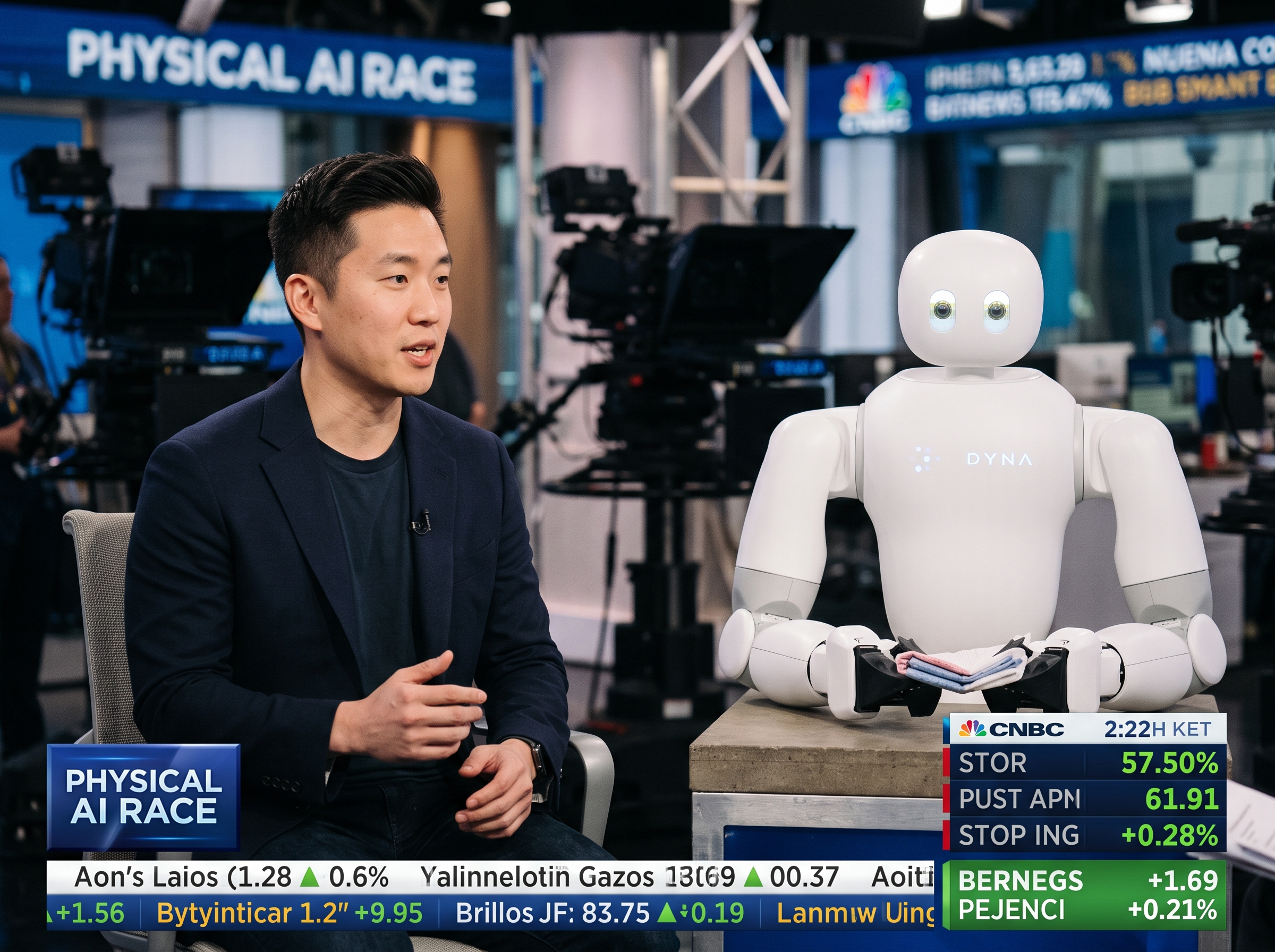
To navigate this emerging market, Andrew Kang co-founded Robostrategy, the first closed-end fund to list on the NASDAQ focused specifically on investments in private robotics and physical AI companies. In a recent CNBC interview, Kang shed light on the state of the industry, bringing along a tangible example of this progress: a robot named “Taku.”
From Prototypes to the “Waymo Approach”
For decades, industrial robotic arms have been standard on factory floors, but general-purpose robots navigating human spaces have largely remained in the prototype phase. However, Kang notes that we are finally moving past that hurdle.
Robots like Taku are currently being deployed in the real world, though not yet in the millions. Instead of attempting to do everything at once, robotics companies are taking what Kang calls the “Waymo approach.”
“A lot of physical AI is being developed for these narrow tasks, and eventually over time the models get better and better, and then they start to generalize,” Kang explained. Taku, for instance, is currently deployed in specialized hospitality tasks, such as folding napkins and laundry.
Kang noted that a Taku unit is already working at a busy dumpling restaurant in New York. By taking over tedious, repetitive tasks like folding towels for hours on end, the robot frees up human employees to focus on higher-skill labor.
The Data Moat
Achieving this level of autonomy requires immense amounts of data. Just as self-driving cars need billions of miles of road experience, physical AI models need hundreds of thousands of hours of real-world interaction.
Kang highlighted portfolio company Path Robotics, which focuses on AI-enabled welding. After nearly a decade of developing their models through hundreds of thousands of welding hours, the company recently signed a $600 million contract with Huntington Ingalls, one of the world’s largest shipbuilders.
The Private Market Advantage
While tech giants like Tesla, Amazon, and SpaceX are heavily invested in robotics, Kang believes the most compelling opportunities lie in the private sector.
He points to companies like Figure AI, suggesting their humanoid technology is currently just as advanced—if not slightly more so—than Tesla’s Optimus. Kang doesn’t believe the robotics space will be a “winner-take-all” market. Instead, he expects it to mirror the automotive industry, with different companies dominating specific market segments, from luxury to utility.
“A lot of those companies are private today,” Kang noted, drawing comparisons to Anthropic, SpaceX, and OpenAI. “These companies stay private for longer and longer… There’s just so much money from corporations, sovereign wealth funds, and other big pots of capital allowing these companies to stay private.”
Re-industrializing America
Geopolitics is also playing a major role in accelerating the domestic robotics market. Recent US government blacklists targeting Chinese physical AI and LiDAR companies have created a vacuum that American startups are eager to fill.
While Robostrategy has some defense investments, Kang emphasizes their main focus is on commercial services and real-world applications. “The American government has made it clear that it’s very important that America should re-industrialize, that they should build factories here,” Kang said.
As the US pushes to bring manufacturing back home, the demand for physical AI to supplement the human workforce is only expected to grow, setting the stage for a multi-trillion-dollar robotic revolution.
Leave a Reply