
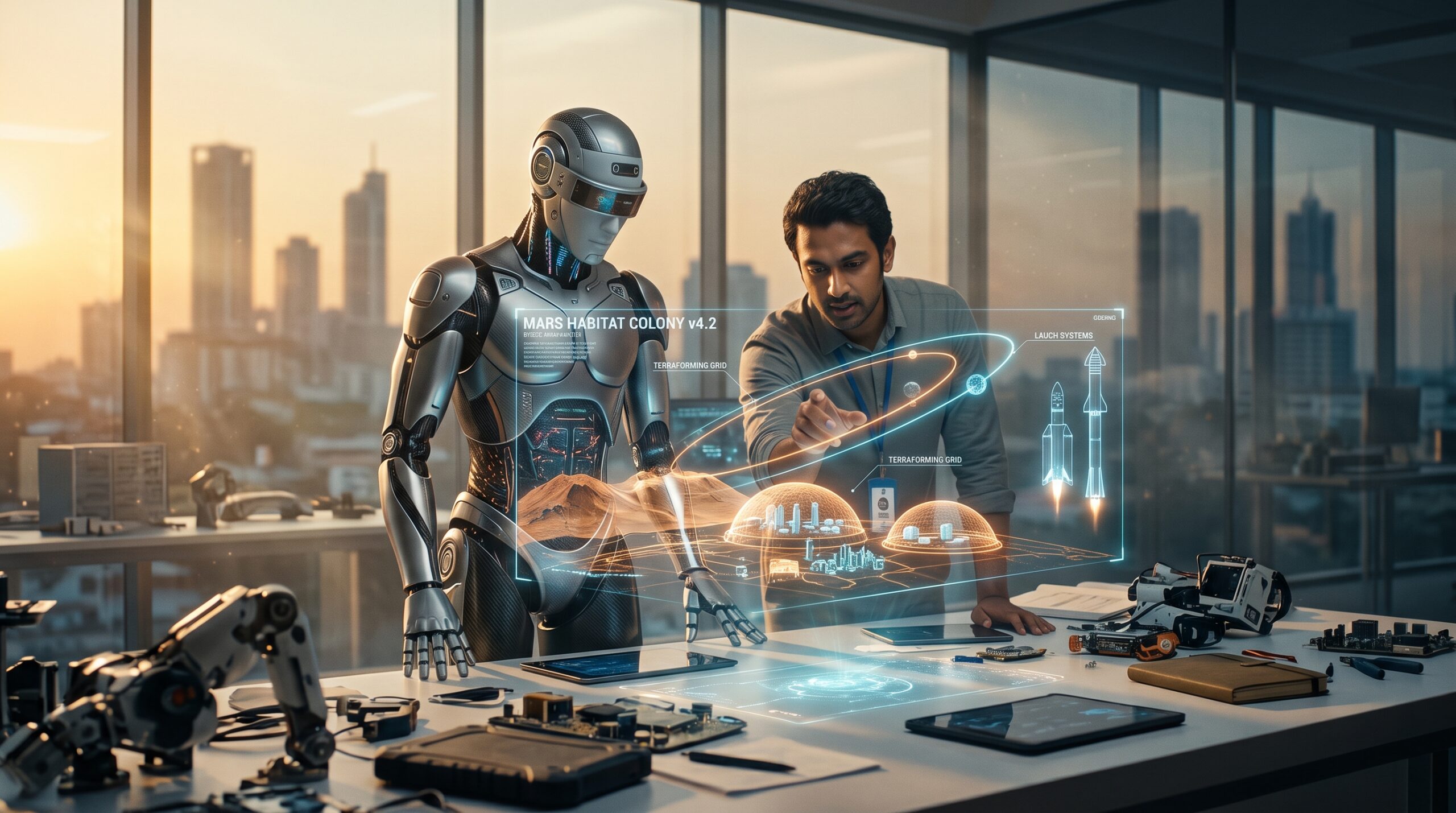
In a sweeping new interview at Tesla’s global engineering headquarters, CEO Elon Musk outlined an accelerating timeline for artificial general intelligence, humanoid robotics, and global infrastructure. His vision suggests an impending “age of abundance,” driven by near-infinite productivity, though tempered by serious geopolitical and infrastructural bottlenecks.
For professionals navigating the emerging tech sector, Musk’s insights provide a roadmap for where compute power, AI engineering, and human-machine integration are headed over the next decade.
1. The Accelerating Timeline for AGI and Hardware Evolution
The pace of artificial intelligence development continues to outstrip legacy forecasting models. Musk notes that software improvements are occurring so rapidly that major breakthroughs are announced on an almost daily basis. Tesla is actively releasing new models, like Grok 4.7, every month or two, steadily closing the gap with frontier models through the unique application of real-world engineering data derived from SpaceX and Tesla operations.
While competitors have excelled at software engineering, the next major AI frontier is physical engineering. Musk projects that within 10 years, the global population of humanoid robots will easily surpass 1 billion. Because robots do not require 20 years of maturation, 20 years of retirement, or standard biological downtime (sleep, meals), a single humanoid robot operating 168 hours a week can generate the productivity of roughly five humans.
2. The Geopolitics of Compute and Energy Infrastructure
The rapid scaling of AI and robotics is fundamentally an infrastructure challenge. Addressing global shortages in compute and electricity, Musk highlighted a major geopolitical shift: earlier this year, China’s electricity output surpassed that of the United States, Europe, and India combined.
Furthermore, despite current limits on compute hardware, Musk praised the efficiency of Chinese AI models, noting they are achieving the best performance per unit of compute globally. He projects that China will fully overcome its current lithography and chip-making constraints within two to three years, setting the stage for massive parallel advancements in AI output. To manage this, he advocated for a joint US-China working committee to establish fair, global AI safety regulations.
3. Neuralink and the Bandwidth Bottleneck
Looking ahead to the next ten years, the biggest limitation may not be the intelligence of AI, but the communication bandwidth between humans and machines.
Musk emphasized that while human input bandwidth (vision) is reasonably high, our output bandwidth is severely constrained to roughly 100 bits per second. In contrast, AI systems process terabytes per second. To an AI, speaking with a human is comparable to communicating with a tree. Advancements in biological enhancement, such as neural interfaces, will be critical to solving this bandwidth constraint and ensuring alignment between human intentions and machine execution.
4. Navigating the Future: Broad-Based Education
In a future characterized by extreme abundance—where robots run out of human requests and money may lose its traditional utility—how do humans retain purpose?
The answer lies in “prompt engineering” on a macro scale. To effectively direct super-capable AI systems, humans will need the broadest possible education spanning arts, sciences, and humanities. The value of human intellect will pivot from specialized execution to creative conceptualization and direction.
Leave a Reply