
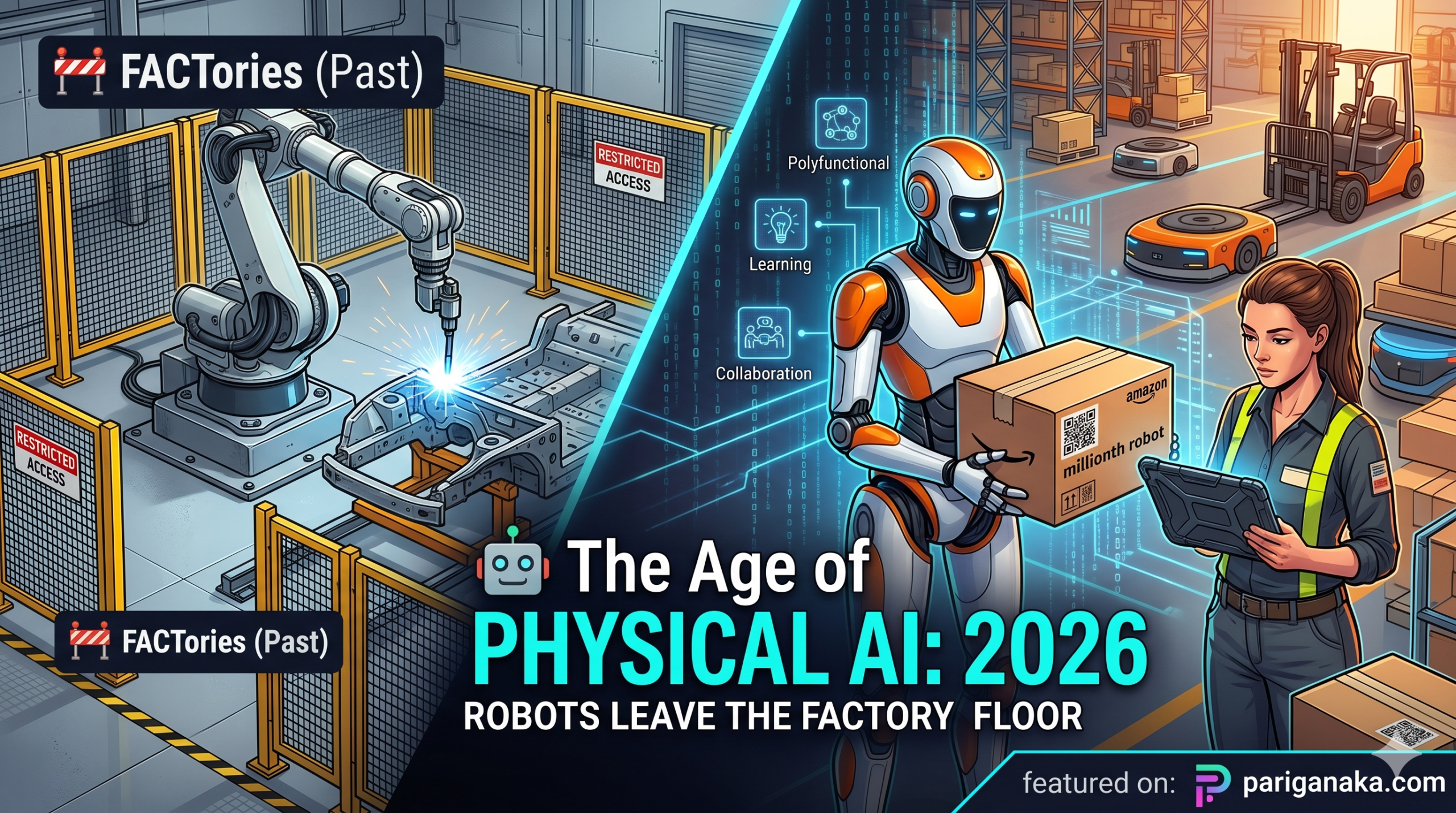
For decades, we’ve pictured robots as clunky machines bolted to factory floors, blindly repeating the exact same welding motion thousands of times a day. If you wanted a robot in your house, the best you could get was a small plastic disc that bumped into your furniture while vacuuming.
But in 2026, artificial intelligence has officially broken out of the digital realm. We are now living in the era of Physical AI (also known as Embodied AI), where intelligence is no longer confined to screens.
Here is how robots are finally becoming our polyfunctional teammates in the real world.
🧠 From Blind Machines to Thinking Teammates
The problem with old robots was that they were blind and rigid. If a screw was dropped a millimeter out of place, the robot would crash.
The massive breakthrough in 2026 is that robots are now powered by the exact same AI models that process human language and video. These “polyfunctional robots” act as thinking, learning teammates that use advanced edge computing and digital twins to understand their surroundings. If a robot drops a box today, it doesn’t crash; it looks at the box, figures out how to pick it up, and learns not to make the same mistake twice.
🏭 The Industrial Tipping Point
The shift in the logistics and manufacturing sectors this year has been staggering:
- The Million Robot Milestone: Amazon recently deployed its millionth robot, completely transforming how we receive our packages.
- The Hive Mind: These robots don’t just act alone. Systems like Amazon’s DeepFleet AI coordinate the entire robot fleet at once. This coordination has already improved travel efficiency within their massive warehouses by 10%.
- Self-Driving Factories: The automotive industry has also leaped forward. At BMW’s factories, unfinished cars are now literally driving themselves through kilometer-long production routes without human drivers.
🏠 Entering the Neighborhood and the Home
While the factories adopted them first, Physical AI is opening a hidden goldmine of automation for everyday life.
This isn’t just for big tech giants anymore. We are starting to see AI automation systems and robotics being integrated into local businesses, small warehouses, and retail spaces. Furthermore, domestic robotics are on the rise. We are finally seeing the first generation of social robots capable of recognizing faces, interpreting emotions, and maintaining a clean house.
The Bottom Line: For the last few years, we were obsessed with AI that could write essays or generate funny images. But 2026 proves that the next stage of AI moves beyond screens into hands-on, dynamic environments. The physical workforce will never be the same.
Would you like me to translate this article into Sinhala for your readers?
Leave a Reply