
For the past three decades, our relationship with computers has been highly manual. We open an application, click through menus, and input data to get a specific output. If we need our accounting software to talk to our CRM, we rely on rigid APIs and custom coding. But as we navigate through 2026, that traditional software model is rapidly becoming obsolete.
We have officially entered the era of Agentic AI—and it is structurally rebuilding how businesses and individuals operate, from enterprise boardrooms in Colombo to rural MSME entrepreneurs.
What is Agentic AI?
Unlike the conversational AI (like early ChatGPT) that simply answered questions, Agentic AI acts as an autonomous digital worker. It doesn’t just generate text; it is designed to understand a goal, plan a series of actions, and execute them across multiple software platforms without human intervention.
Instead of opening a spreadsheet to analyze sales, you simply tell your AI Agent: “Review our Q3 sales across all branches, identify any supply chain bottlenecks, and draft an email to the regional managers with proposed solutions.” The agent handles the data extraction, the analysis, and the communication in seconds.
The Power of Multiagent Systems
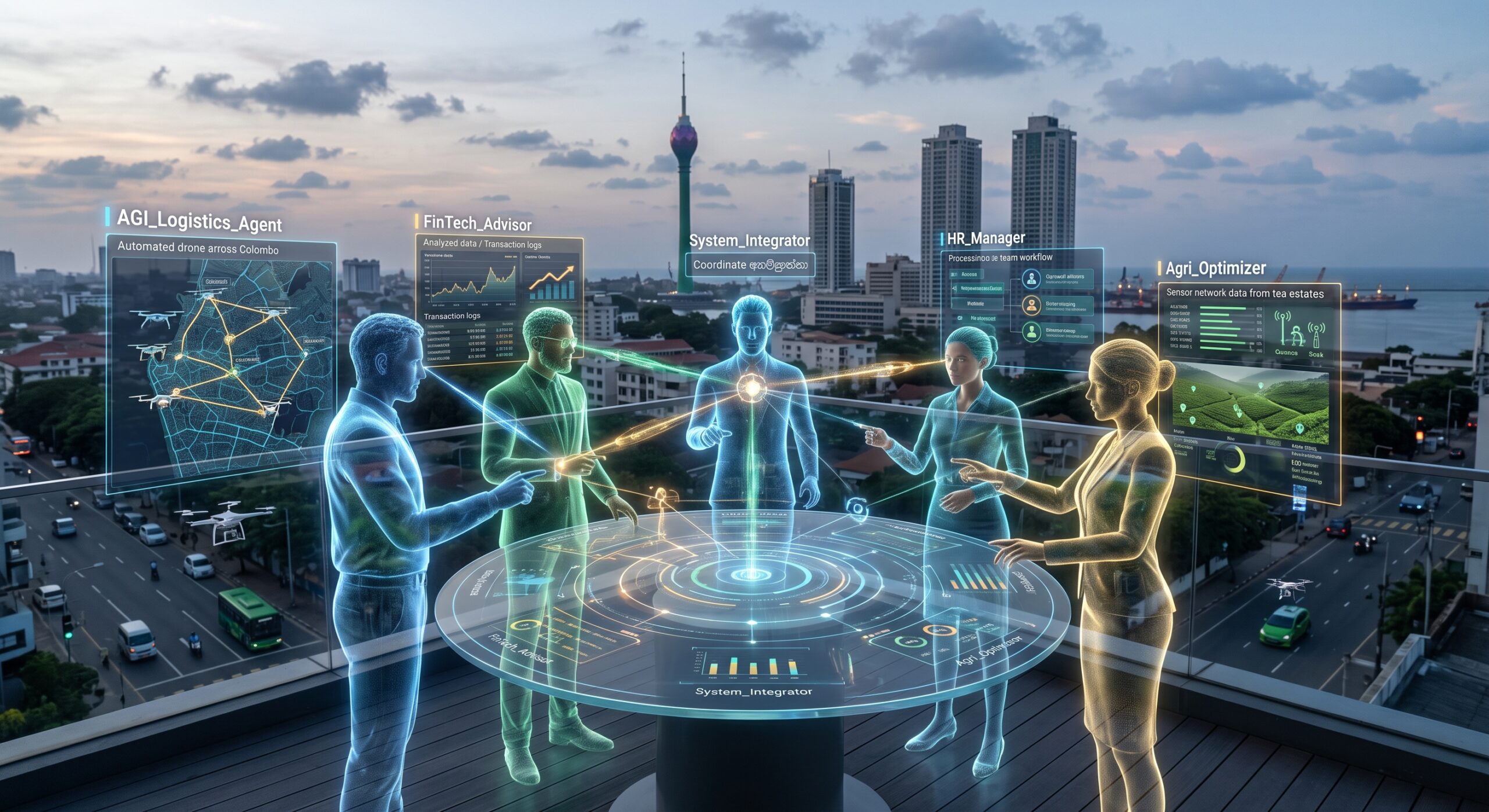
The true revolution happening right now is the rise of Multiagent Systems. This is where different AI agents communicate and collaborate with each other to solve complex problems.
Here is how this is already reshaping the local digital economy:
- Smart Agriculture: An AI agent monitoring IoT soil sensors detects a drop in moisture. It automatically signals a secondary AI agent managing automated drone systems to deploy targeted watering, while a third agent updates the farm’s financial ledger with the water resource cost.
- FinTech and the Programmable Economy: As Sri Lanka embraces digital wallets and the e-Rupee, Multiagent systems are managing micro-transactions in real-time. For example, a logistics agent can automatically release a payment agent’s funds the exact moment a delivery drone confirms a package drop.
- Enterprise Automation: Entire HR and IT helpdesks are being replaced by agentic workflows. One agent receives a new employee’s onboarding request, provisions their software licenses, sets up their payroll profile, and schedules their orientation—all seamlessly.
Moving from “Writing Code” to “Expressing Intent”
The paradigm of software development has fundamentally shifted. We are no longer limited by how fast we can write code. Today, developers and enterprise leaders simply express their intent, and AI autonomously writes, deploys, and maintains the systems behind the scenes.
Why This Matters for the Local Workforce
At Pariganaka.com, we believe that understanding these deep-tech shifts is crucial for survival in the modern economy. The businesses that thrive will not be those that simply buy traditional software licenses; they will be the ones that build an autonomous, neural workforce of specialized AI agents.
The software isn’t just a tool anymore—it is an active team member.
Leave a Reply