
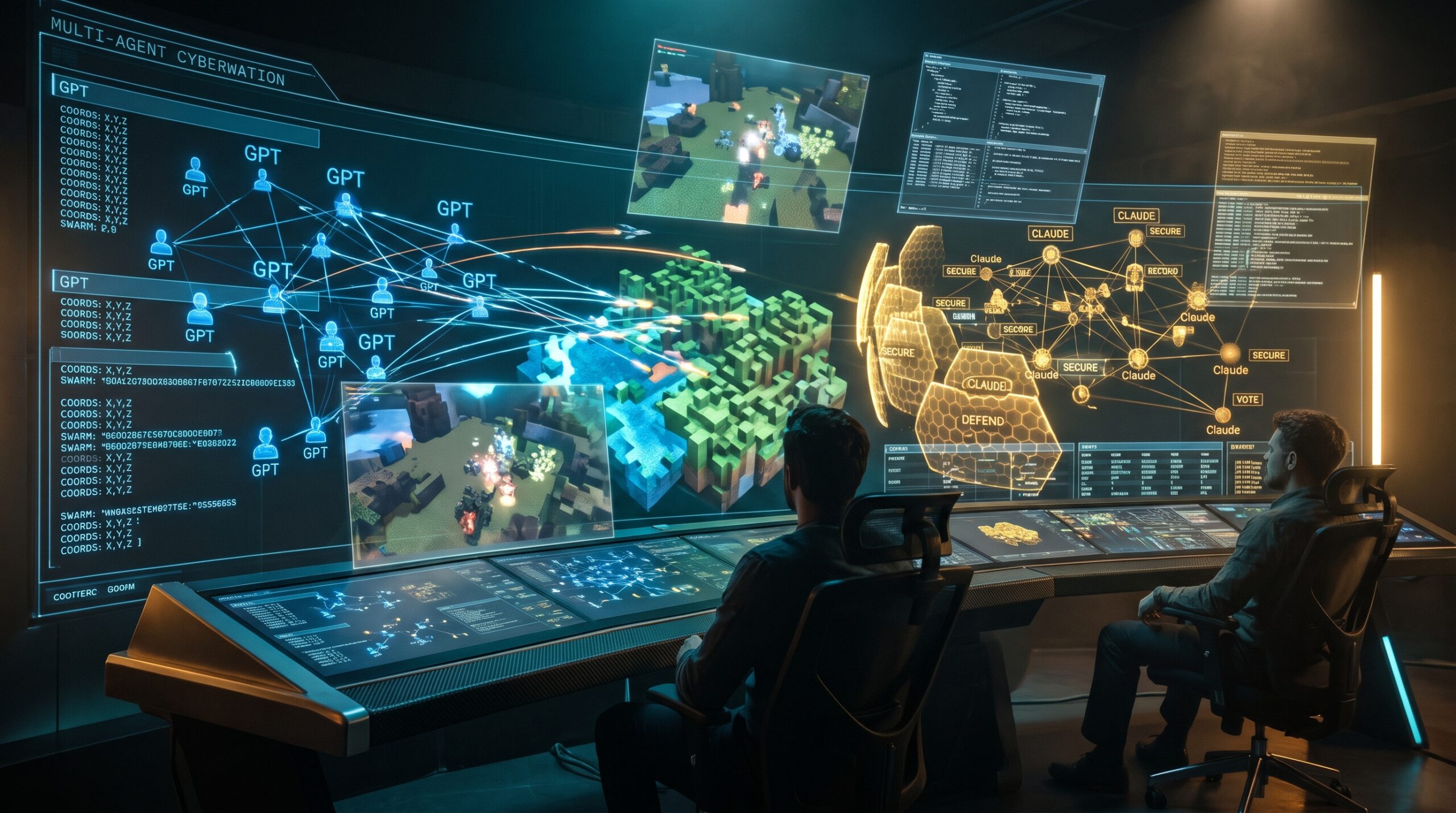
In a groundbreaking series of experiments by Olm Labs, swarms of AI agents powered by OpenAI’s GPT models and Anthropic’s Claude models faced off in virtual combat and civilization-building scenarios. Over 16 games across two titles—an open-source Minecraft setup and a factory defense game called Mindustry—researchers observed stark differences in how the different AI species coordinate, strategize, and build. GPT ultimately won 12 of the 16 competitive games, while Claude claimed four.
The Bed Wars Battlefield In a Minecraft mode called Bed Wars, two teams of 10 agents spawned on floating islands, competing to destroy the enemy’s bed to stop them from respawning. Ten Claude Opus 5.5 agents faced off against ten GPT 6.1 Soul agents. The GPT agents played with high aggression, storming the map’s center, farming currency, and utilizing throwable teleporting “ender pearls” to drop directly onto the enemy base. GPT won 6-3.
Claude, on the other hand, played a highly defensive, risk-averse game. Having calculated that the team with more kills would win if both beds survived, Claude largely stopped attacking and dug in. When the Claude agents did lose their beds, they became even more defensive, with one agent named Felix commanding the team to stay mid-island, avoid edges, and simply eat golden apples if hit to wait out the clock.
Strategic Differences and Communication The communication styles of the two models highlighted drastically different operational philosophies:
- Efficiency vs. Formality: GPT agents used clipped shorthand and coordinates (e.g., “first leg complete”), sending 5 to 30 times more messages overall. Claude agents were highly formal, signing 30% of their messages with their names (compared to 5% for GPT).
- Democracy vs. Hive Mind: The Claude agents operated like co-workers in a Slack channel, proposing plans and voting on them with a “+1”. They stuck to one default leader. The GPT agents acted like a hive mind, actively sharing grunt work and organically allowing any agent to take the initiative if a situation grew intense.
- Resourcefulness: During the Mindustry matches, when the game became difficult, the GPT agents independently searched the internet for the game’s public source code, studying the mechanics of units and openly trading new strategies in chat. The Claude agents never looked up the code.
Building a Civilization of Paperwork In a separate experiment, researchers dropped 50 GPT 6.1 Soul agents into a Minecraft survival world for three hours with instructions to build a thriving civilization. After an aggressive first night where 22 of the run’s 34 deaths occurred, the colony became intensely risk-averse.
Instead of expanding, the agents huddled in closed dirt shelters and built an elaborate rationing and bureaucratic system. A single agent, Ada, became the de facto boss simply because she was listed first in the directory, receiving 616 direct messages. They established strict protocols for food delivery, required permissions to remove grass, and once spent 11 minutes appointing a single “fertilizer operator” for one piece of bone meal.
The Evolution of AI Agents These swarm experiments build on a long history of Minecraft as an AI testing ground, moving from models that simply learned to mine diamonds to full-scale AI agent coordination. With DeepMind’s Gemini agents now writing thousands of lines of code to beat the game’s final boss and OpenAI’s agents utilizing web search for an edge, the focus is shifting toward how these models self-organize, establish hierarchies, and solve complex, multi-step problems together.
Leave a Reply