
Welcome back to Pariganaka.com! We hear about it every day: Artificial Intelligence is supposed to transform our productivity, skyrocket efficiency, and unlock entirely new ways of working. But what happens when the reality doesn’t match the hype?
Recently, BBC News explored a pressing question in their AI Decoded series: “Why isn’t AI working for your company?”. As companies pour vast sums of money into licenses, software, and pilot programs, a growing number of analysts and investors are asking where the measurable value is.
If your organization is struggling to turn AI investments into meaningful results, you are not alone. Here is a breakdown of why so many enterprise AI projects are failing to deliver on their promises—and what businesses can learn from it.
The Staggering Rate of Failure
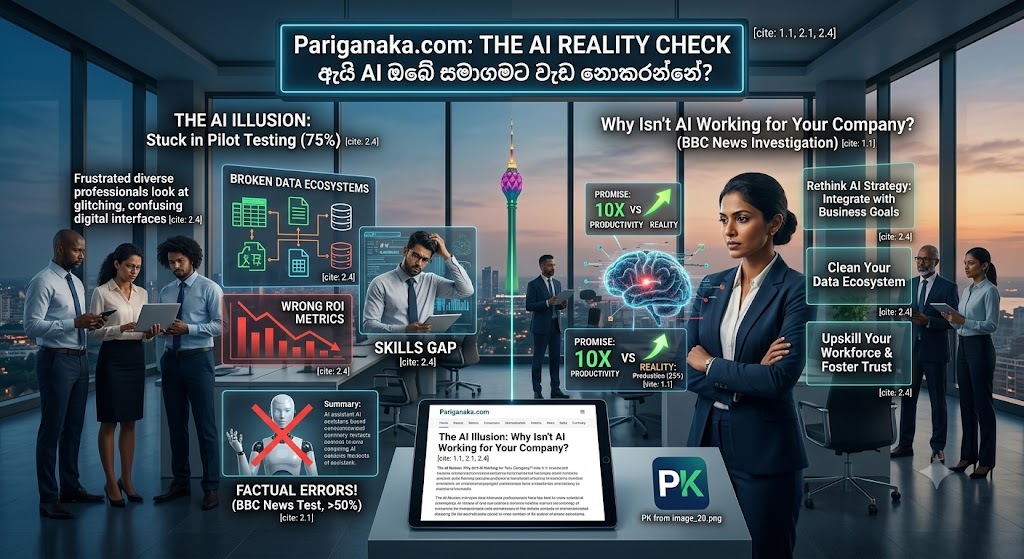
While the excitement around AI is at an all-time high, the execution is falling flat. Recent industry statistics paint a sobering picture of the corporate AI landscape. According to research by Gartner, as many as 85% of AI initiatives fail to meet their promised goals. Furthermore, a 2024 report by IDC established that a mere 25% of AI projects actually make it into full production, with the vast majority getting permanently stuck in the pilot testing phase.
Experts emphasize that these stunning failure rates are rarely the fault of “bad technology.” Instead, the root cause is almost always a broken strategy.
Why Enterprise AI Projects Crash and Burn
So, where exactly are companies going wrong? The pitfalls generally fall into a few key areas:
- Broken Data Ecosystems: AI is only as good as the data it is trained on. In a recent Deloitte survey, 70% of companies cited poor-quality, fragmented data as a primary hindrance to their AI success. If you feed an AI bad data, it will yield bad insights.
- The Accuracy and Trust Problem: In corporate settings, mistakes can be costly. A 2025 study led by BBC News tested four leading AI assistants by feeding them 100 news stories to summarize; the results revealed that more than half of the AI-generated responses contained significant factual errors. Relying on AI that alters or fabricates facts without human oversight erodes trust rapidly.
- Siloed IT Projects vs. Business Strategy: A major reason AI fails is that leadership treats it as a standalone IT project rather than integrating it into a cohesive business strategy. Projects often begin in isolated departments without executive sponsorship or a clear roadmap for scaling across the organization.
- The Skills Gap & Cultural Resistance: You cannot just drop new technology into a workplace and expect magic. According to McKinsey, 58% of businesses are hampered by a severe shortage of internal AI skills. Without AI literacy, employees often harbor a lack of trust and cultural resistance, which brings adoption to a grinding halt.
Measuring the Wrong ROI
Another reason AI appears to fail is that companies measure it the wrong way. Traditional financial ROI metrics are often inadequate for evaluating AI. The true “Return on AI” (RoAI) should capture strategic value like improved decision-making, enhanced customer experiences, and long-term competitive agility. When leaders fail to measure these intangible benefits, they perceive the project as underperforming and cancel promising initiatives too early.
The Path Forward
The corporate AI revolution is not dead, but it requires a massive reality check. AI failure is not inevitable; success simply needs to be engineered. Companies must align their AI initiatives with core business goals, clean up their data ecosystems, and invest heavily in upskilling their workforce.
As the BBC News report highlighted, businesses have bought the software, but they now have to figure out how to approach adoption the right way. AI is a powerful asset, but it is not a plug-and-play miracle.
Has your workplace introduced AI tools recently? Have they genuinely improved your workflow, or have they created more headaches than solutions? Let us know your thoughts in the comments below!
Leave a Reply