
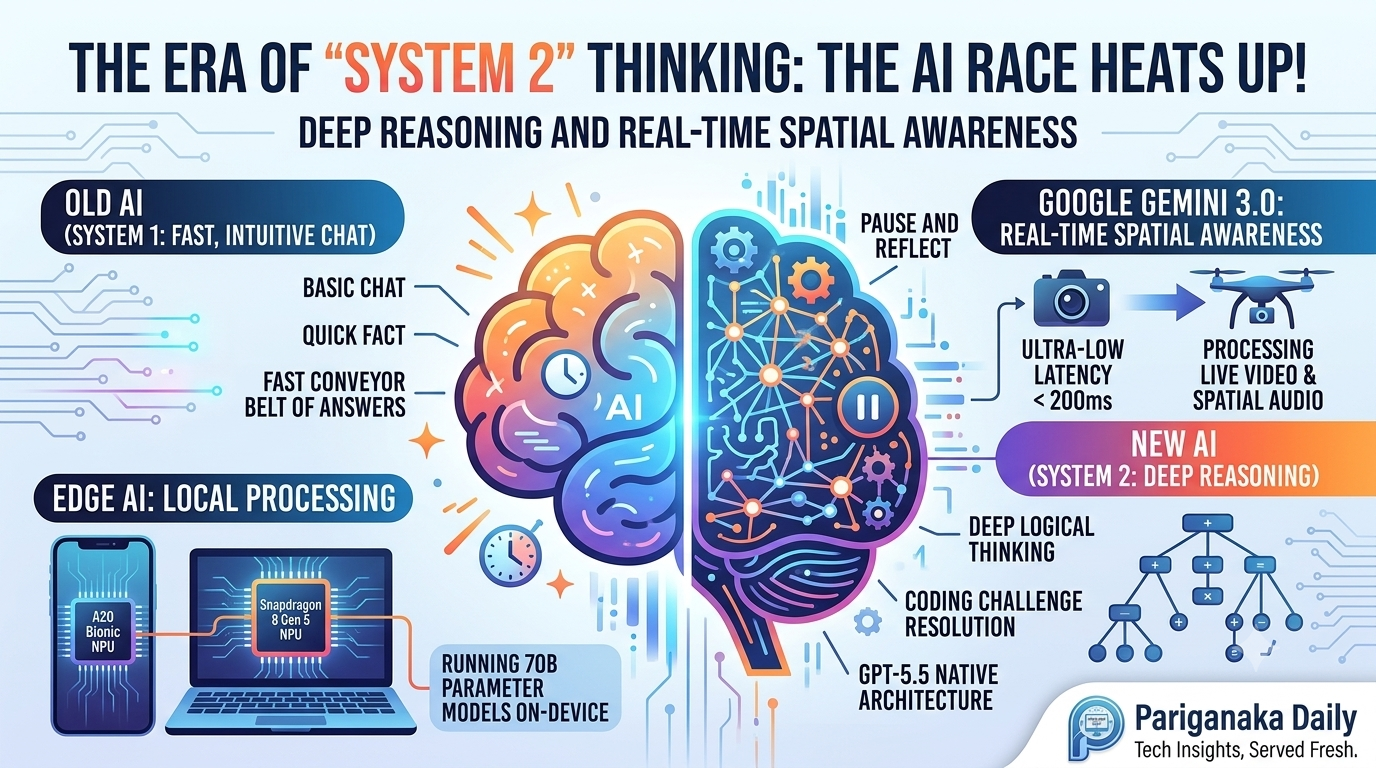
August 2026 has brought a massive leap in artificial intelligence, moving beyond simple chatbots to systems capable of deep reasoning and real-time spatial awareness. The latest releases from tech giants are changing the landscape of AI as we know it.
At Pariganaka.com, we are closely tracking the rapid advancements in technology. This month, the AI industry has shifted its focus from basic multimodal models (AI that can see and hear) to “agentic reasoning,” marking a significant turning point in how AI systems operate.
OpenAI’s GPT-5.5: Deep Reasoning
In early August 2026, OpenAI quietly released GPT-5.5. This major upgrade fundamentally changes how the AI thinks.
- System 2 Architecture: Unlike previous versions that operated on fast, intuitive “System 1” thinking, GPT-5.5 introduces a native “System 2” architecture.
- Pause and Reflect: When you give it a complex math problem, a coding architecture challenge, or a multi-layered business strategy prompt, the model literally pauses.
Google’s Counter-Move: Gemini 3.0
Google countered with the launch of Gemini 3.0. While OpenAI focused on deep logical reasoning, Google focused on real-time environmental understanding.
- Ultra-Low Latency: Gemini 3.0 can process live video feeds and spatial audio with a latency of under 200 milliseconds.
A Head-to-Head Comparison
| Feature | OpenAI GPT-5.5 | Google Gemini 3.0 |
| Core Focus | Deep logical reasoning | Real-time environmental understanding |
| Key Capability | “System 2” architecture | Processing live video feeds and spatial audio |
| Notable Mechanic | Pauses to reason through complex problems | Operates with a latency of under 200 milliseconds |
The Shift to Edge AI
Another major development this month is the shift in how these powerful AI models are processed.
- Local Processing: You no longer need a massive cloud connection to run a good AI model.
- On-Device Power: The new generation of mobile chips, like Apple’s A20 Bionic and the latest Snapdragon 8 Gen 5, feature Neural Processing Units (NPUs) capable of running 70-billion parameter models entirely on-device.
The AI landscape is evolving from tools that merely assist us to engines that can deeply reason and instantly understand our physical world. Stay tuned to Pariganaka Daily for more fresh, human-friendly tech insights!
Leave a Reply