
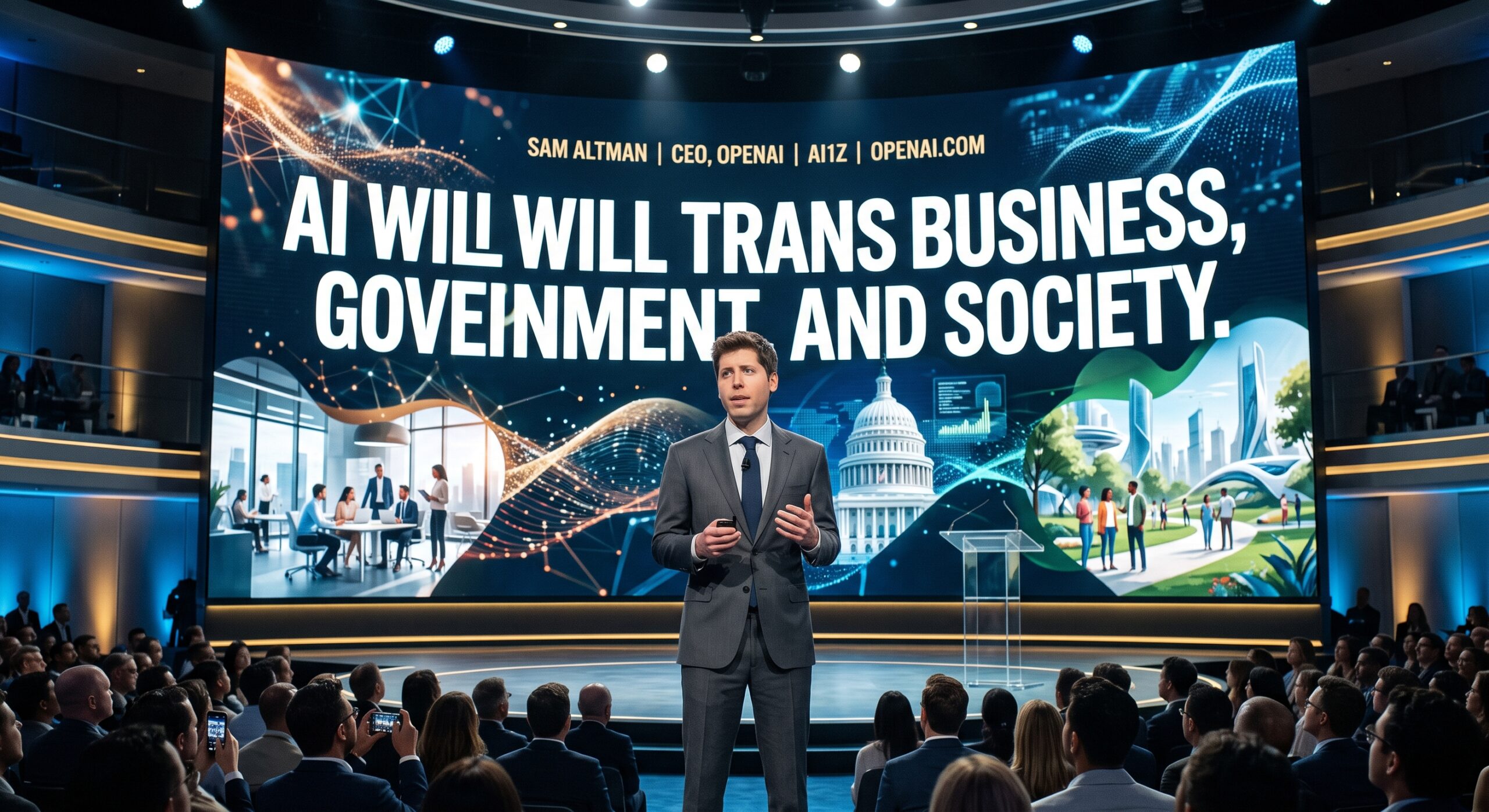
Artificial intelligence is not just a technology; it is the infrastructure for the next phase of human evolution. Speaking recently on the transformative potential of artificial intelligence, OpenAI CEO Sam Altman articulated a sweeping vision of the coming decade, describing an era where synthetic intelligence deeply reconfigures the foundational pillars of business, government, and society itself.
The underlying premise of this shift is that compute capability—specifically, the availability of energy to power massive AI infrastructure—will become the defining resource of the 21st century.
The Revolution of Business: From Manual Code to Macro Orchestration
The most immediate disruption will occur within corporate structures and software engineering. We are moving toward what Altman has previously termed a “zero marginal cost of code.”
In this landscape, the mechanical act of writing syntax loses its competitive premium.
- The traditional coder—focused on language specifics and standard boilerplate—must transition into an AI Orchestrator.
- Value concentration shifts from the ability to create the digital tool to the strategic ownership of the system architecture, product vision, and the underlying AI compute infrastructure.
- The highest-leverage skill of the next generation will be the ownership of the AI models themselves and the energy pipelines required to run them.
Government as a Utility: Data Governance and Sovereign Compute
Altman’s forecast places immense pressure on traditional governance models. If AI is the digital engine, the regulatory framework must adapt to manage its output without stalling its progress.
Governments will need to evolve into active participants in the digital infrastructure race, focusing on Sovereign Compute. A nation’s competitiveness will no longer be measured solely by physical assets, but by its domestic capability to generate, secure, and govern high-density compute capacity, ensuring it has ownership over the tools training its citizen-facing AIs.
This transformation demands agile, pro-innovation policies that keep emerging tech “default legal” while enforcing transparent audits on critical infrastructure.
The Societal Rebalancing: Transitioning from ‘Holder’ to ‘Manager’
The deepest impact will be psychological and cultural. The coming era effectively ends the long reign of the “Knowledge Holder”—the professional whose value lay in memorizing rare pathological diagnostics, complex legal case studies, or architectural standards. In a world of ubiquitous synthetic intelligence, being a walking data repository is obsolete.
Value is moving definitively to Knowledge Managers. This requires a new cognitive toolkit:
- Contextual Architecture: The ability to translate messy, ambiguous human problems into precise prompts and systemic constraints that AI can execute.
- Information Curation and Filtering: Mastering the art of filtering noise, hallucination, and bias from a torrent of synthetic data to isolate high-signal truths.
- Validation and Audit: Specializing in the formal verification, deterministic behavior validation, and boundary testing required to audit autonomous systems.
Altman describes not a threat, but a profound re-calibration. The organizations and societies that thrive will not be those caught in existential dread, but those actively preparing their workforces, grids, and legal systems to manage the unprecedented abundance of intelligent, synthetic output.
Leave a Reply