
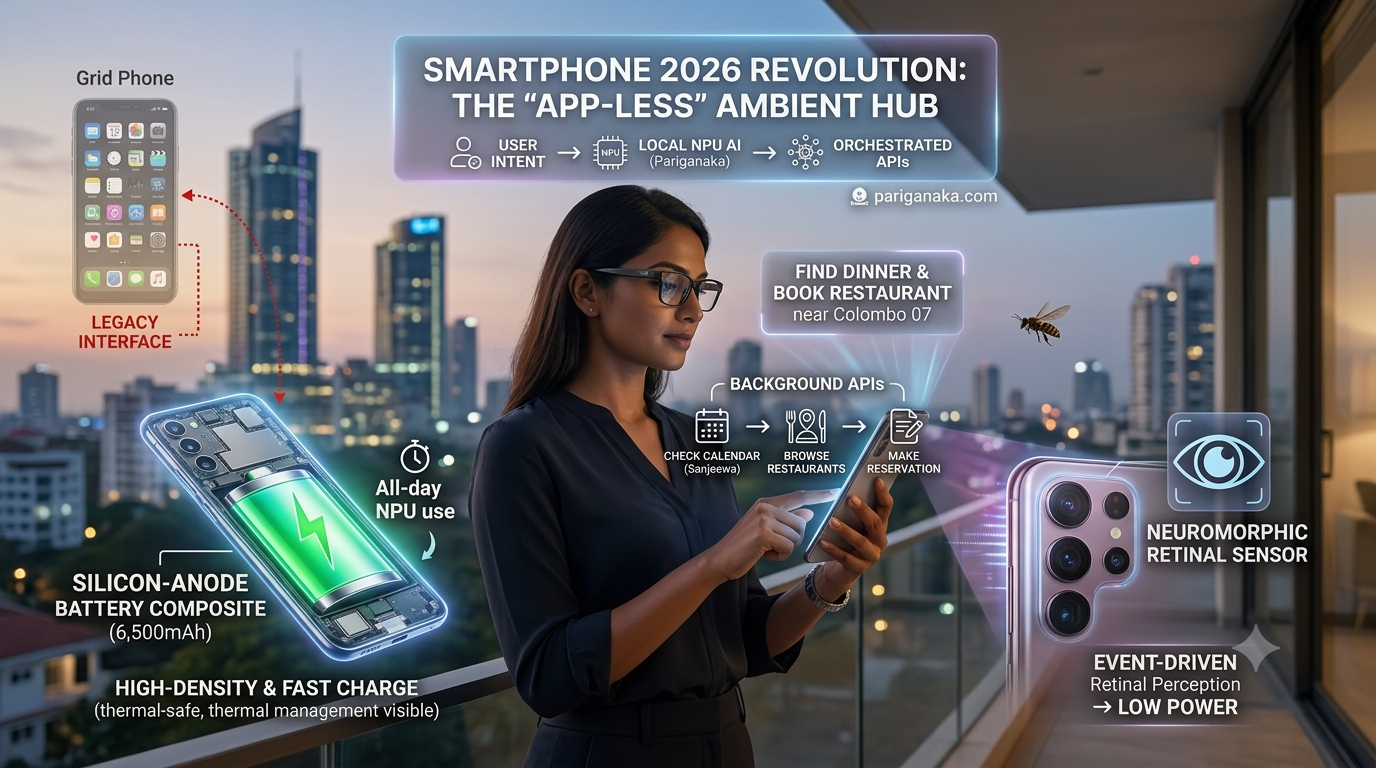
For over fifteen years, the smartphone experience remained fundamentally unchanged: a grid of rectangular app icons sitting on a glass slab, waiting for you to tap, open, and navigate individual applications manually. While camera megapixel races and minor display refresh rate upgrades dominated annual launch events, 2026 marks the arrival of a true structural evolution in mobile technology.
The smartphone is transitioning from a passive tool running isolated apps into an active, intent-driven ambient companion. Powered by breakthroughs in high-density battery chemistry and localized neural processing, this shift is redefining what mobile hardware can do.
1. The Death of the Grid: Intent-Driven “Zero-App” OS
The biggest user experience shift this year is the decline of app-centric navigation. Instead of toggling between five different apps to coordinate a dinner with friends—checking calendars, browsing restaurants, messaging group chats, and booking ride-shares—2026 operating systems utilize OS-level intent layers.
Powered by local Small Language Models (SLMs) and on-device NPUs, the phone parses your intent directly from voice or text commands:
- Old Workflow: Open App A $\rightarrow$ Copy link $\rightarrow$ Open App B $\rightarrow$ Send invite $\rightarrow$ Open App C $\rightarrow$ Book slot.
- 2026 Ambient Workflow: You state your goal (“Find a free slot for dinner with Sanjeewa on Friday and book a quiet restaurant near Colombo 07”). The OS orchestrates background APIs, executes the search, presents a single confirmation prompt, and finalizes the reservation.
Apps aren’t disappearing entirely, but they are increasingly functioning as headless backend services while the operating system provides a unified, fluid dynamic canvas.
2. Silicon-Anode Batteries: The Energy Density Breakthrough
Running continuous, on-device AI models and context-aware sensors consumes massive amounts of power. Standard graphite-anode Lithium-Ion batteries hit a physical capacity ceiling, leaving devices struggling to last a full day.
In 2026, mainstream smartphone manufacturers have adopted Silicon-Anode Battery Technology. By replacing traditional graphite anodes with silicon-nanotube composites, battery manufacturers achieved two critical milestones:
- 25%–35% Increase in Energy Density: Flagship devices can now fit 6,000mAh to 7,000mAh capacities into slim 8mm profiles without increasing weight.
- Thermal-Safe Ultra-Fast Charging: Silicon-anode cells handle higher power throughput with significantly lower heat generation, enabling 0-80% charges in under 12 minutes while preserving battery health over thousands of cycles.
This chemical breakthrough is the invisible foundation making real-time, all-day mobile AI processing technically viable.
3. Neuromorphic “Event-Based” Camera Sensors
Smartphone cameras are moving beyond standard frame-based image capture. Traditional sensors capture entire frames 30 or 60 times a second, generating huge amounts of redundant data and consuming significant battery power during video processing.
2026 flagships are integrating Neuromorphic Event-Based Sensors. Inspired by how the human retina perceives light, these sensors do not capture static frames; they only record individual pixel changes in brightness when movement occurs.
- Zero Motion Blur: Motion is tracked instantaneously at the microsecond level, eliminating high-speed action blur entirely.
- Fractional Power Consumption: By ignoring unchanged background pixels, sensor processing power is cut by up to 80%, allowing continuous ambient visual tracking for augmented reality and local AI perception.
Traditional Grid Phones vs. 2026 Ambient Smartphones
| Feature | Legacy Smartphone (2020–2024) | 2026 Ambient Smartphone |
| Primary Interface | Static grid of application icons | Intent-driven dynamic interface & voice canvas |
| Data Processing | Cloud-dependent API calls | On-device NPU processing (Zero-latency) |
| Battery Tech | Graphite Lithium-Ion (4,500–5,000mAh) | Silicon-Anode Composite (6,000–7,000mAh) |
| Camera Tech | Frame-by-frame computational photography | Neuromorphic event-driven retinal sensors |
| App Model | Monolithic standalone applications | Headless background micro-services |
What This Means for Mobile Developers and Tech Professionals
For software engineers and digital creators in the Pariganaka community, this hardware evolution requires a mindset shift in mobile application design:
- API-First, UI-Second: Mobile apps must expose rich, structured API endpoints and intent schemas so that ambient operating systems can interact with their services natively.
- Designing for NPU Acceleration: Mobile code optimization now heavily relies on leveraging hardware-level NPU features, such as low-bit quantization and direct memory access (DMA), to execute background intelligence efficiently.
- Privacy as a Core Metric: With operating systems continuously parsing personal context, local encryption and zero-knowledge data pipelines are no longer optional—they are mandatory baseline requirements for user trust.
The era of the smartphone as a simple app launcher is officially behind us. In 2026, mobile devices have matured into proactive personal intelligence hubs, powered by smarter silicon, denser energy, and human-centric software design.
Leave a Reply