
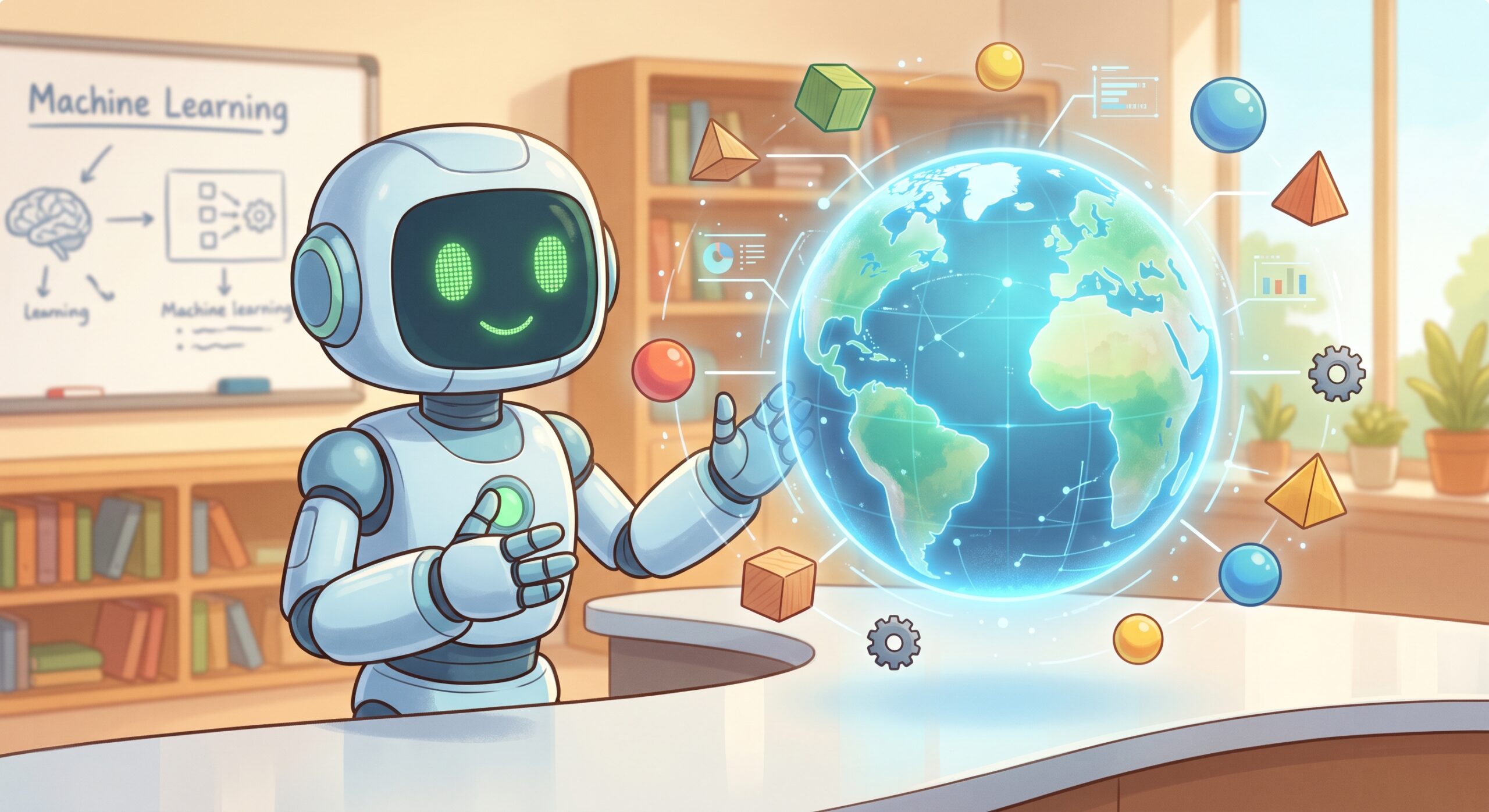
A world model in artificial intelligence is a machine learning system that builds an internal representation of an environment to predict how that environment changes over time in response to actions. Instead of merely classifying data or predicting the next word in a sequence, these systems simulate dynamics such as physics, object interactions, and causality. By maintaining an internal causal structure, world models enable AI agents to plan, reason, and act without relying on constant real-world trial and error. This approach represents a massive shift from pattern matching to simulating reality itself, unlocking advanced capabilities for autonomous systems.
Moving Beyond Traditional Machine Learning
Historically, physical AI agents relied on traditional reinforcement learning (RL) or behavioral cloning, which required direct interaction with the environment to learn. For robotics and autonomous systems, this traditional approach presents severe limitations:
- Time Constraints: AI agents are bound by real-time physical constraints and cannot accelerate the learning process.
- High Costs and Risks: Physical wear and tear on hardware are expensive. Learning through failure means agents must experience dangerous physical scenarios to know how to avoid them.
- Lack of Intuition: Traditional RL agents often develop opaque behaviors without an explicit understanding of environmental mechanics.
World models solve this by allowing agents to “dream” or simulate possible futures. Instead of crashing a real car to learn what happens when braking fails, an autonomous vehicle can rehearse the scenario inside its learned simulator. This ability to learn from imagined experiences delivers sample efficiency gains that are 10 to 100 times better than traditional physical AI applications.
Core Architecture: How World Models Function
World models process raw sensory data, such as video frames or lidar scans, and compress this massive input into compact latent representations. Rather than attempting to reconstruct a future scene pixel-by-pixel, the system predicts how these compressed representations will evolve.
The Joint Embedding Predictive Architecture (JEPA), proposed by AI pioneer Yann LeCun, serves as the conceptual foundation for many modern world models. This architecture generally consists of three distinct components:
- Encoder: This module maps the current observation (such as an image or a video frame) into a latent representation.
- Predictor: By taking the current latent representation and combining it with a proposed action or context variable, this module predicts the latent representation of the future state.
- Target Encoder: This module produces the actual future representation from real observations, allowing the predictor to train by minimizing the distance between its prediction and the actual outcome.
Because JEPA does not force the system to reconstruct every visual detail of a future scene, it mimics biological intelligence. Humans maintain a compact model of a scene’s structure rather than a photographic memory of every pixel.
In action-oriented frameworks like DreamerV3, the world model is paired with a “Critic” that judges the value of the imagined outcomes and an “Actor” that chooses the best actions to execute. This clean separation of perception, dynamics modeling, and policy learning enables end-to-end learning directly from pixels to physical actions.
World Models vs. Large Language Models (LLMs)
While generative LLMs power highly capable chatbots and code assistants, they operate fundamentally differently from world models:
- Token Space vs. Representation Space: LLMs are trained on text corpora to predict the most likely next token. World models operate in representation space, mapping sensory inputs to predict physical state changes.
- Physical Grounding: LLMs generate fluent text but lack an internal causal model of non-linguistic environments, often failing at consistent physical predictions. Proponents of world models note that because LLMs are trained strictly on text, they struggle to accurately predict real-world physical events.
- Action Evaluation: World models are explicitly designed to evaluate hypothetical physical actions against environmental outcomes.
Real-World Applications
Generative world models have transformative applications across physical AI and interactive software.
- Robotics: Companies use world models to train agents inside simulations, allowing them to transfer robust skills to the physical world. This allows robots to understand object permanence, manipulate complex geometry, and generalize their mechanics to entirely new environments.
- Autonomous Driving: Vehicles use world models to compress multi-sensor data into latent states and roll them forward under hypothetical driving actions. This allows planners to safely test responses to rare events—like unusual pedestrian behavior or extreme weather—without risking lives on public roads.
- Video Generation and Simulation: Foundation models like OpenAI’s Sora and DeepMind’s Genie act as generalized world simulators. Genie allows users to generate fully playable, interactive environments from simple text descriptions or spatial layouts.
By moving away from rote memorization and toward a foundational intuition of physics, causality, and spatial dynamics, AI world models provide the critical infrastructure required for truly autonomous machine intelligence.
Leave a Reply