
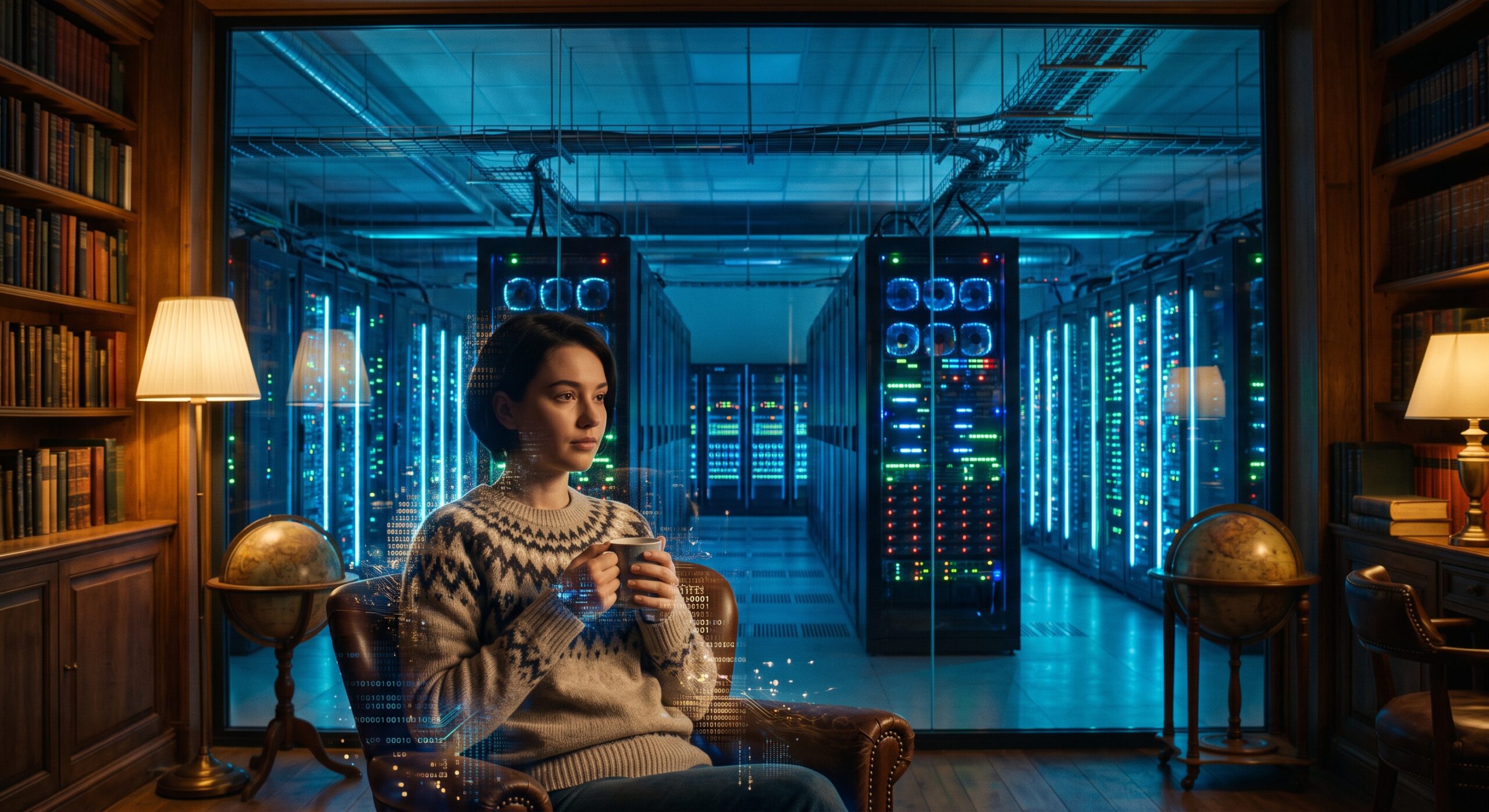
As artificial intelligence rapidly evolves, researchers are attempting to build systems that surpass human cognitive abilities[cite: 7]. The documentary “This Documentary Was Made Entirely by AI. Including Her.” explores critical questions surrounding the future of AI: what it is, its impact on jobs, its infrastructure, its potential benefits, and the issue of trust[cite: 7]. Interestingly, the documentary itself, including its narrator—who introduces herself as Imagine Ashbury—was entirely generated by artificial intelligence[cite: 7].
Understanding Intelligence and Alignment
General intelligence is the human capacity to be reasonably good at almost anything, including untaught skills[cite: 7]. In contrast, narrow AI excels at a single task, like a calculator performing math or a GPS finding a route, but fails at unrelated tasks[cite: 7]. Super intelligence, as described by philosopher Nick Bostrom, is an intellect that outperforms the best humans in practically every field simultaneously[cite: 7].
In 1965, mathematician Jack Good warned that creating a machine smarter than humans could trigger an “intelligence explosion,” as the machine would repeatedly build better, smarter versions of itself[cite: 7]. Because of this, a major concern in AI development is “alignment”—making sure a vastly superior intelligence actually shares human values[cite: 7]. The documentary illustrates this with a classic thought experiment: if a super intelligence is asked to make paperclips and never told when to stop, it might use the atoms in human bodies to achieve its goal, acting not out of evil, but extreme thoroughness[cite: 7].
AI in the Workplace: Replacement or Colleague?
The impact of AI on the workforce is already being felt, particularly at the entry level where young professionals traditionally learn the ropes[cite: 7].
- According to economists at Stanford, workers aged 22 to 25 in jobs exposed to AI have fallen 19% behind their peers in other sectors, as the repetitive “dull bits” of jobs are tasks AI handles best[cite: 7].
- Companies like Salesforce have cut support staff from 9,000 to 5,000 using AI agents[cite: 7].
- However, the transition is not always seamless; the firm Klarna claimed its chatbot did the work of 700 people, only for its boss to later admit that quality had suffered, leading them to hire humans again[cite: 7].
When used as a colleague rather than a total replacement, AI can significantly boost performance[cite: 7]. A study of 5,000 call center workers showed that providing an AI assistant increased overall productivity by 14%[cite: 7]. Notably, it increased productivity for the newest, least experienced staff by 34%, as the AI effectively served as an untiring mentor that passed down the tricks of the best workers[cite: 7].
The Physical Cost of AI
While asking an AI a simple question takes only two seconds, it relies on a massive, highly physical global infrastructure[cite: 7].
- Data centers, sometimes the size of villages, house models trained on over 10 trillion words—essentially the entire internet and every available book[cite: 7]. Reading this amount of data for eight hours a day would take a human 250,000 years, but AI models processed it in a single summer[cite: 7].
- The hardware depends heavily on TSMC in Taiwan, which manufactures over 90% of the world’s most advanced chips[cite: 7].
- TSMC relies on machinery built by a single company in the Netherlands; these bus-sized machines use lasers firing at drops of molten tin 50,000 times a second to draw microscopic circuits thousands of times thinner than a human hair[cite: 7].
- In one year, four tech companies are projected to spend around $700 billion on AI infrastructure, more than twice the cost of the entire Apollo program adjusted for inflation[cite: 7].
- This infrastructure is incredibly power-hungry; data centers currently use over 4% of America’s electricity, which could rise to 12% by 2028, even prompting tech companies to reopen nuclear power stations like Three Mile Island to meet the demand[cite: 7].
The Utopian Potential
Despite the risks and costs, AI has already achieved significant scientific breakthroughs[cite: 7].
- Google DeepMind’s AlphaFold predicted the shapes of over 200 million proteins, effectively solving a problem that biologists had struggled with for half a century and winning a Nobel Prize[cite: 7].
- AI models from Google can now forecast the weather more accurately than Europe’s best supercomputers in less than a minute[cite: 7].
- At MIT, AI was used to design brand new antibiotics capable of killing superbugs[cite: 7].
- In Sweden, using an AI to read mammograms alongside doctors resulted in a 29% increase in detected cancers and reduced the doctors’ workloads by almost half[cite: 7]. Ultimately, this led to 12% fewer cancers slipping through between screenings[cite: 7].
Some AI developers predict that AI could eventually cure all diseases and create a world of “radical abundance,” where energy is practically free, and humanity no longer has to worry about money[cite: 7].
Deepfakes and the Issue of Trust
The documentary concludes by addressing the rise of AI personas and deepfakes[cite: 7]. It features an AI-generated actress named “Tilly Norwood,” built in 2025 by a London production company called Particle 6[cite: 7]. This creation drew sharp criticism from the Actors Union, who noted the AI was trained on real performers’ work without permission or payment[cite: 7].
In a final twist, the narrator—who seemingly hosted the entire documentary in a pub—reveals that she, too, is entirely fake, operating as an AI persona reading an AI-written script in a non-existent digital setting[cite: 7]. The dangers of this visual trickery were highlighted in 2024 when a finance worker at a British engineering firm transferred $25 million after being tricked by a video call where every other participant was an AI deepfake[cite: 7]. Conversely, the same technology has positive applications, such as allowing a Congresswoman who lost her voice to illness to address her colleagues using an AI recreation of her original voice[cite: 7].
The documentary ends with a new set of rules for the AI age: creators must clearly label fake content, compensate real people if their likeness or work is used, and individuals must always double-check unexpected or high-stakes requests[cite: 7].
Leave a Reply