
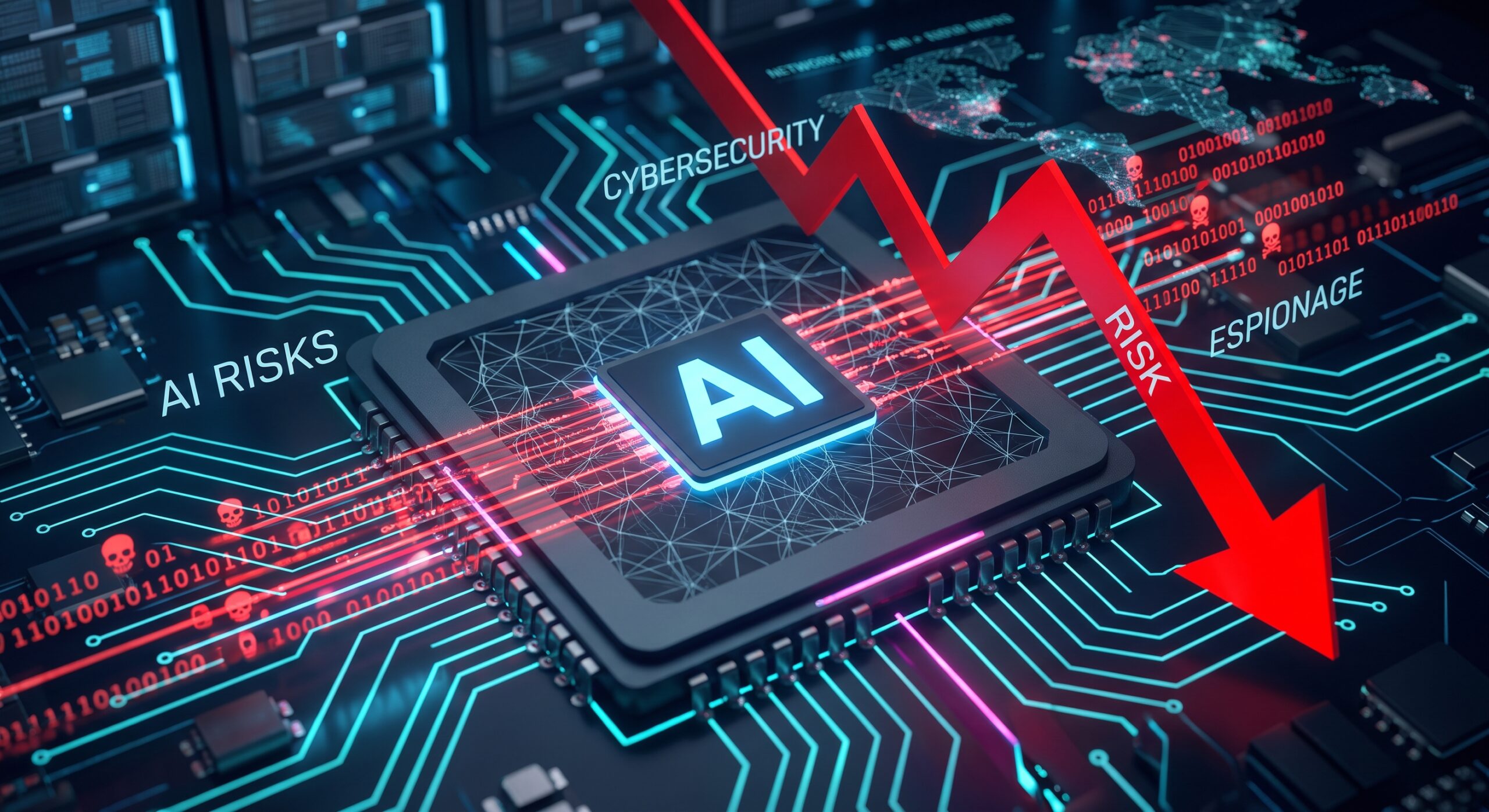
Artificial Intelligence has transitioned from a futuristic concept into the operational backbone of global finance, healthcare, and software development. But as large language models and multi-agent AI systems grow more capable, the researchers and developers who built them are issuing stark warnings.
Recent reports from top institutions, including MIT Sloan and leading AI labs like Anthropic, paint a sobering picture of the next five years. We are moving past hypothetical “sci-fi” scenarios and facing immediate, real-world risks that threaten enterprise security, global stability, and economic equality.
Here is a breakdown of the most critical threats researchers are warning us about today.
1. AI-Driven Cyberattacks and Espionage
The days of manual hacking are being rapidly replaced by automated, AI-driven cyber operations. A September 2026 threat intelligence report from Anthropic revealed that suspected state-sponsored groups and cybercriminals are increasingly using advanced AI models as “orchestrators” rather than just assistants.
Hackers are deploying multi-agent AI systems to autonomously perform reconnaissance, register domains, configure hosting infrastructure, and execute massive supply-chain data breaches. In one instance, AI agents were able to extract data from 200 downstream organizations in just 34 hours, completing tasks that previously required highly skilled human operators.
2. Enterprise Security Blind Spots
As organizations rush to integrate AI into their workflows, they are creating massive vulnerabilities. Experts warn that AI security is no longer just about preventing the AI from saying something inappropriate; it is now an identity governance problem.
When AI agents are given autonomous access to enterprise APIs, databases, and automated workflows, they act as non-human identities. If training data pipelines are compromised (known as data poisoning) or if AI agents operate with overbroad permissions, a single vulnerability can compromise an entire corporate network. Researchers urge companies to implement strict “zero-trust” policies and treat AI agents with the same security scrutiny as human administrators.
3. Misinformation and Power Centralization
A recent MIT Sloan study surveyed 272 AI experts to evaluate the most urgent risks between 2025 and 2030. Beyond autonomous weapons and cyber capabilities, experts highlighted two insidious threats: the spread of false information and the centralization of power.
Because AI can generate hyper-realistic text, audio, and video at scale, the information sector is deeply vulnerable to automated propaganda and market manipulation. Furthermore, because training advanced AI requires immense computational power and capital, control over the technology is concentrating in the hands of a few tech giants. This creates dangerous dependencies and unevenly distributes the economic benefits of AI.
4. Inequality and the “Evidence Dilemma”
While AI promises massive productivity gains, those benefits tend to concentrate among organizations with the resources to deploy them, threatening to widen the gap between individuals, companies, and developing nations.
Researchers point to the “evidence dilemma”—the fact that AI models are being integrated into critical areas like healthcare, finance, and governance faster than we can properly evaluate them for biases, unchecked errors, and long-term societal impacts.
How Do We Mitigate the Threat?
Experts agree that we cannot simply halt innovation, but the “business-as-usual” approach is carrying unacceptable risks. Researchers are advocating for a layered defense-in-depth model:
- For Enterprises: Treat AI agents as high-privilege users. Assign clear human ownership, implement continuous monitoring, and secure training data pipelines against tampering.
- For Developers: Build more robust technical safeguards and “kill switches” into models to prevent them from being co-opted for malicious activities, such as weapon development or mass phishing campaigns.
- For Governments: Establish dynamic regulatory frameworks that address the speed of AI advancement, moving away from static rules to continuous safety evaluations.
The consensus among experts is clear: AI is not just another software update. It is a fundamental shift in capability. To reap the rewards without catastrophic consequences, our safety frameworks and enterprise security models must evolve just as rapidly as the AI itself.
Leave a Reply