
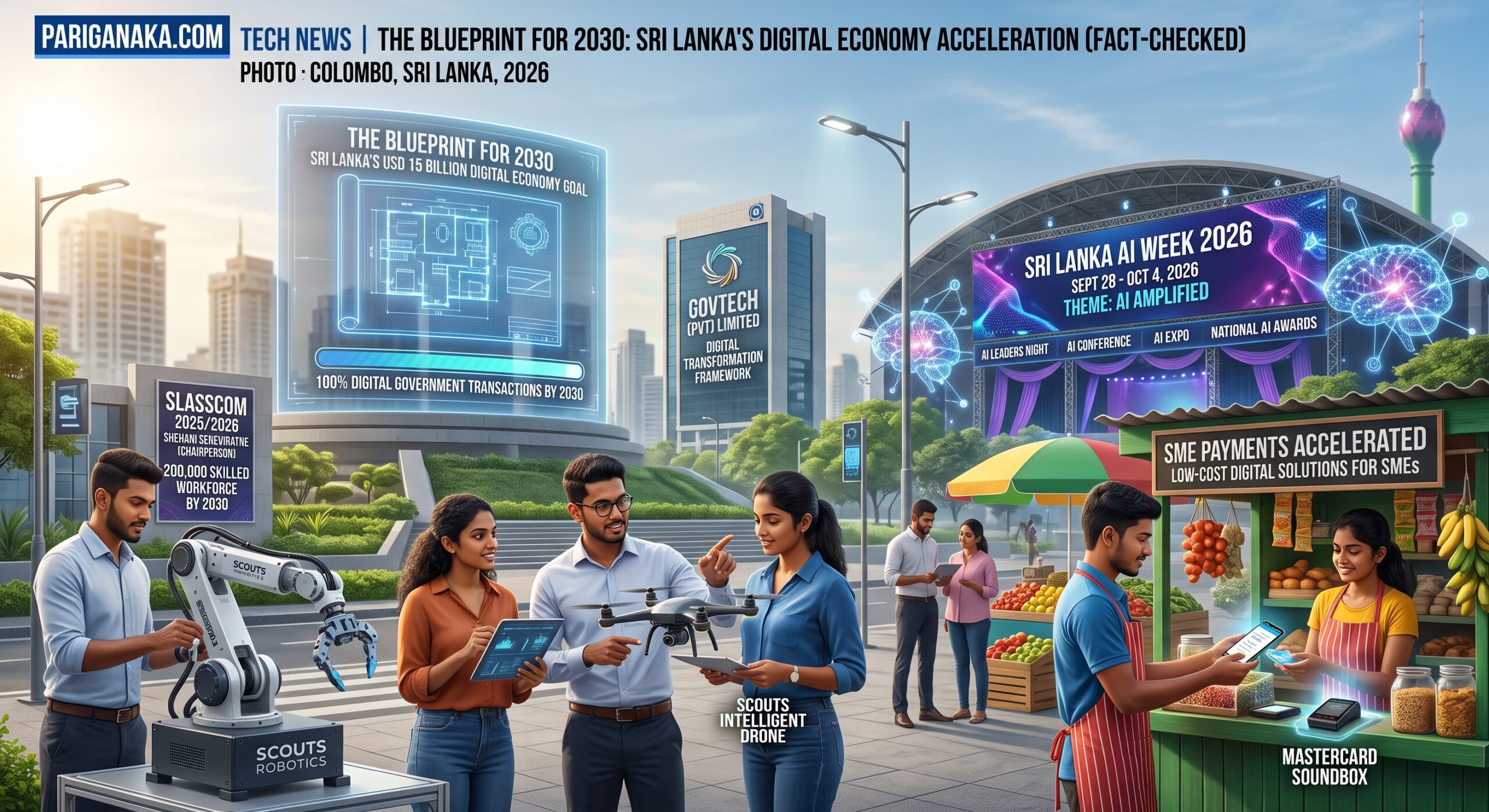
As we navigate through 2026, Sri Lanka’s digital transformation is no longer just a distant horizon; it is an active, rapidly accelerating reality. The tech sector is seeing an unprecedented alignment between government policy, private enterprise, and grassroots innovation. From overhauling national digital strategies to embracing AI and hardware startups, the nation is actively laying the groundwork to become a formidable digital hub in South Asia.
Here is a fact-checked look at the major tech milestones, policies, and events shaping Sri Lanka’s digital landscape in 2026.
1. The $15 Billion Ambition and a 100% Digital Government
The national strategic roadmap has set incredibly ambitious targets to modernize how citizens interact with services and how the economy generates revenue.
- Massive Economic Growth: The Government of Sri Lanka is pushing to build a massive digital economy worth USD 15 billion within the country by the year 2030.
- Fully Digitized Governance: A core pillar of this mission is the plan to digitize 100% of all government transactions by the year 2030.
- Institutional Overhaul: To smoothly implement these projects, the Cabinet approved the establishment of “GovTech (Pvt) Limited”. This independent, state-owned company was designed to replace the existing Information and Communication Technology Agency (ICTA) and accelerate the digital transformation framework.
2. “AI Amplified”: Sri Lanka AI Week 2026
Following the success of the inaugural AI Expo, 2026 marks a historic juncture as the country shifts its focus from simply pursuing AI to actively amplifying its capabilities.
- The Premier Event: Pioneered by the Ministry of Digital Economy and SLT-MOBITEL, “Sri Lanka AI Week 2026” is scheduled to take place from September 28 to October 4, 2026, across multiple venues in Colombo.
- Core Theme: The overarching theme for the 2026 event is “AI Amplified”.
- Key Highlights: The week will feature four major landmark events to position Sri Lanka as a regional AI leader: the AI Leaders Night, the AI Conference, the AI Expo, and the National AI Awards.
3. Scaling the IT Workforce and Startup Ecosystem
The digital sector currently earns about $1.2 billion in foreign revenues, but industry leaders are aggressively preparing the workforce for the next leap in growth.
- SLASSCOM’s Vision for 2030: To achieve the projected $5 billion in sector revenue by 2030, the goal is to increase the current 85,000 ICT professionals to a 200,000-strong highly skilled workforce.
- New Leadership: Steering this phase of global competitiveness is the newly appointed SLASSCOM Board for 2025/2026, led by Chairperson Shehani Seneviratne (99x Chief Operating Officer).
- Hardware Innovation Takes Flight: It is not just software making waves. Sri Lanka’s pioneering intelligent drone and robotics company, “Scouts,” recently closed an investment round at a remarkable LKR 1.6 billion valuation. This milestone proves that local engineering talent can build commercially viable, high-value robotics locally instead of exporting that talent abroad.
4. Modernizing Digital Payments for SMEs
Financial inclusion is a critical component of the national strategy, and 2026 has seen significant upgrades to how local merchants handle money.
- Access Unlocked V2.0: Hosted under the patronage of the Ministry of Digital Economy, the “Access Unlocked V2.0” program highlighted the need for low-cost digital payment methods for small and medium-sized enterprises (SMEs).
- South Asian Firsts: In a major leap for retail tech, innovative solutions like the Mastercard SoundBox and SoftPOS were introduced for the first time in South Asia at this forum. These services allow small business owners to accept digital payments easily and at an incredibly low cost.
Final Thoughts
The narrative surrounding Sri Lanka’s tech industry is rapidly evolving. By streamlining state institutions like GovTech, aggressively promoting AI literacy, and supporting grassroots startups, the blueprint for a highly competitive 2030 digital economy is officially in motion.
Leave a Reply