
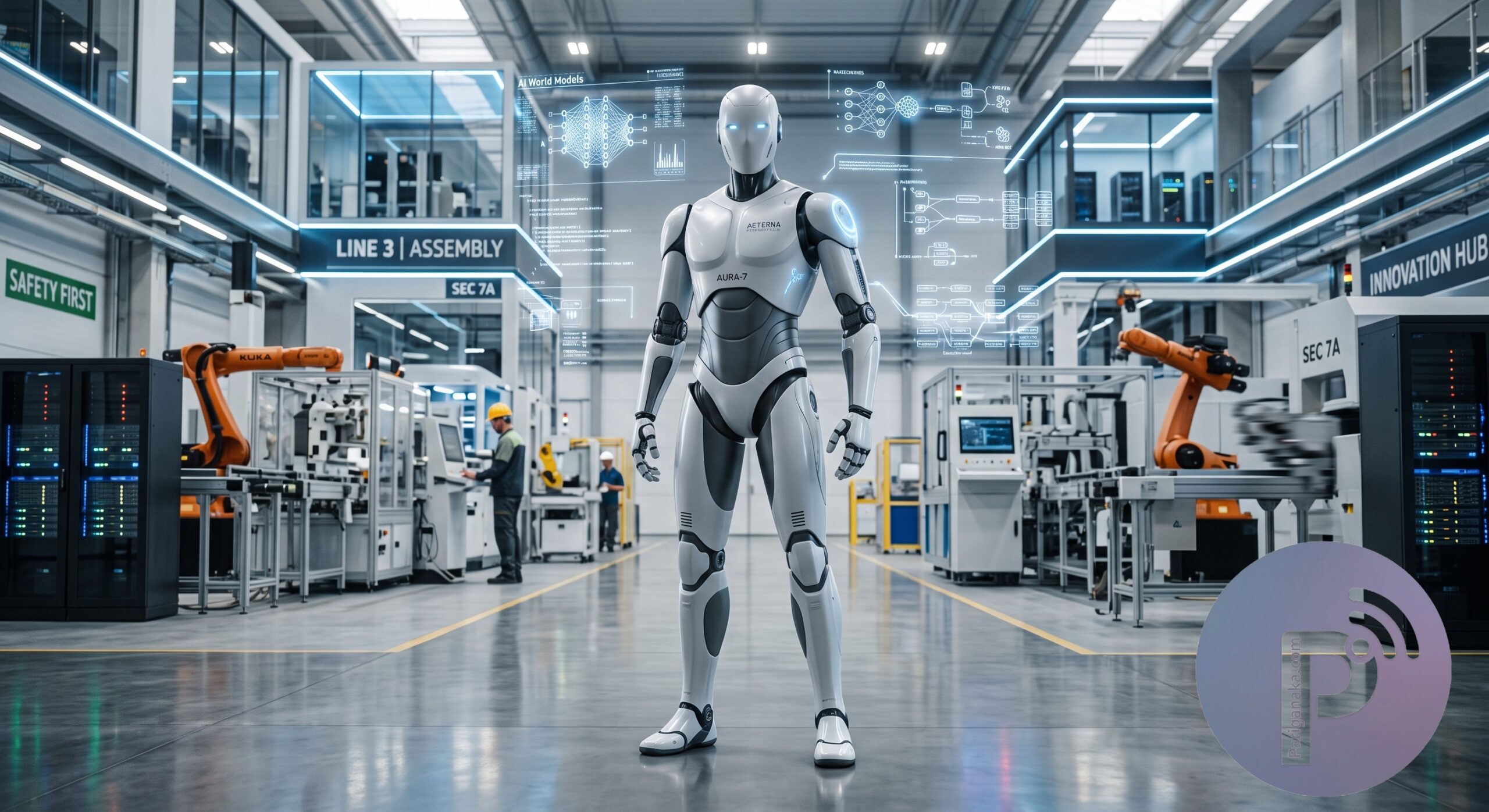
The effort to bring humanoid robots into everyday environments relies on cracking two massive challenges simultaneously: manufacturing scalable hardware and developing generalizable software. Robotics company 1X has set a staggering goal to mass-produce 50,000 humanoid robots, an ambition that requires abandoning traditional engineering and machine learning paradigms entirely.
Reimagining Manufacturing for Scale
Scaling hardware while maintaining safety is notoriously difficult. Prototypes are straightforward to build, but mass production exposes statistically rare failures that ruin yields. To achieve massive scale, the physical architecture of a robot must be radically simplified.
A common, yet flawed, comparison equates manufacturing robots to manufacturing cars. An automobile is a 4,000-pound machine consisting of roughly 50,000 individual parts. In contrast, a well-designed, human-safe robot should weigh under 70 pounds and contain roughly 1,000 parts.
To achieve this minimalist architecture, 1X abandoned traditional, heavily geared motors. Standard gear systems introduce complex, artificial dynamics that nature does not have, requiring a web of sensors and high-speed controls to mask the friction. Instead, utilizing in-house developed tendon drives strips away this artificial complexity. A simpler drive means fewer moving parts, looser tolerances, fewer required sensors, and vastly superior manufacturability.
The Brain of the Machine: Escaping Traditional ML
Perfect hardware is useless without adaptable intelligence. Traditional machine learning in robotics has heavily relied on narrow specialization, often utilizing Behavioral Cloning or Reinforcement Learning.
In a traditional setup, if a robot needs to fold a t-shirt, its neural network is fed thousands of hours of data showing exactly how to fold a t-shirt. The system maps a specific visual input to a specific physical output. While the robot becomes a master at that single chore, it learns nothing about the broader physical universe. It remains entirely brittle outside of its programmed distribution; if handed a delicate object like an egg, it lacks the contextual physics to know that dropping it will cause a mess.
To achieve autonomy at scale, robotics is pivoting away from chore-specific programming toward AI world models.
World Models: Building Intuition
A world model approaches learning the way a toddler does. Before a human child learns to perform complex chores, they spend their early development simply observing the world—dropping toys to understand gravity, squishing objects to understand compliance, and watching adults to pick up social cues.
An AI world model replicates this by consuming massive amounts of generalized data—primarily millions of hours of internet video, first-person footage, and simulated physics.
Instead of being explicitly instructed to complete a task, the AI is asked: “Based on this current frame of video, predict what the next frame will look like.”
To successfully predict the next frame across millions of diverse videos, the AI is forced to develop an internal representation of the laws of physics. It naturally learns object permanence, material properties (glass shatters, cloth folds), and even social dynamics. For example, if a human hands a world-model-powered robot a bag, the robot intuitively knows to let go the moment it feels the human grasp the handle—not because it was programmed with a “handoff script,” but because that behavior naturally emerged from studying human interaction.
The Data Diversity Bottleneck
To train a truly autonomous robot, developers need more than algorithmic power; they require an immense diversity of data. General intelligence in robotics emerges only after hundreds of millions of hours of real-world data collection.
The industry is not just data-bound; it is diversity-bound. Feeding an AI millions of hours of a robot doing the exact same task in a static environment yields diminishing returns. To build a highly capable machine, the robot must experience edge cases, unpredictable environments, and varied tasks.
This is the strategic imperative behind shipping 50,000 units. By deploying a massive fleet of robots into enterprise settings, research labs, and homes, a self-reinforcing flywheel is created. More robots in the real world generate infinitely more diverse data, which trains smarter world models, which in turn makes the hardware capable of even more complex tasks.
Leave a Reply