
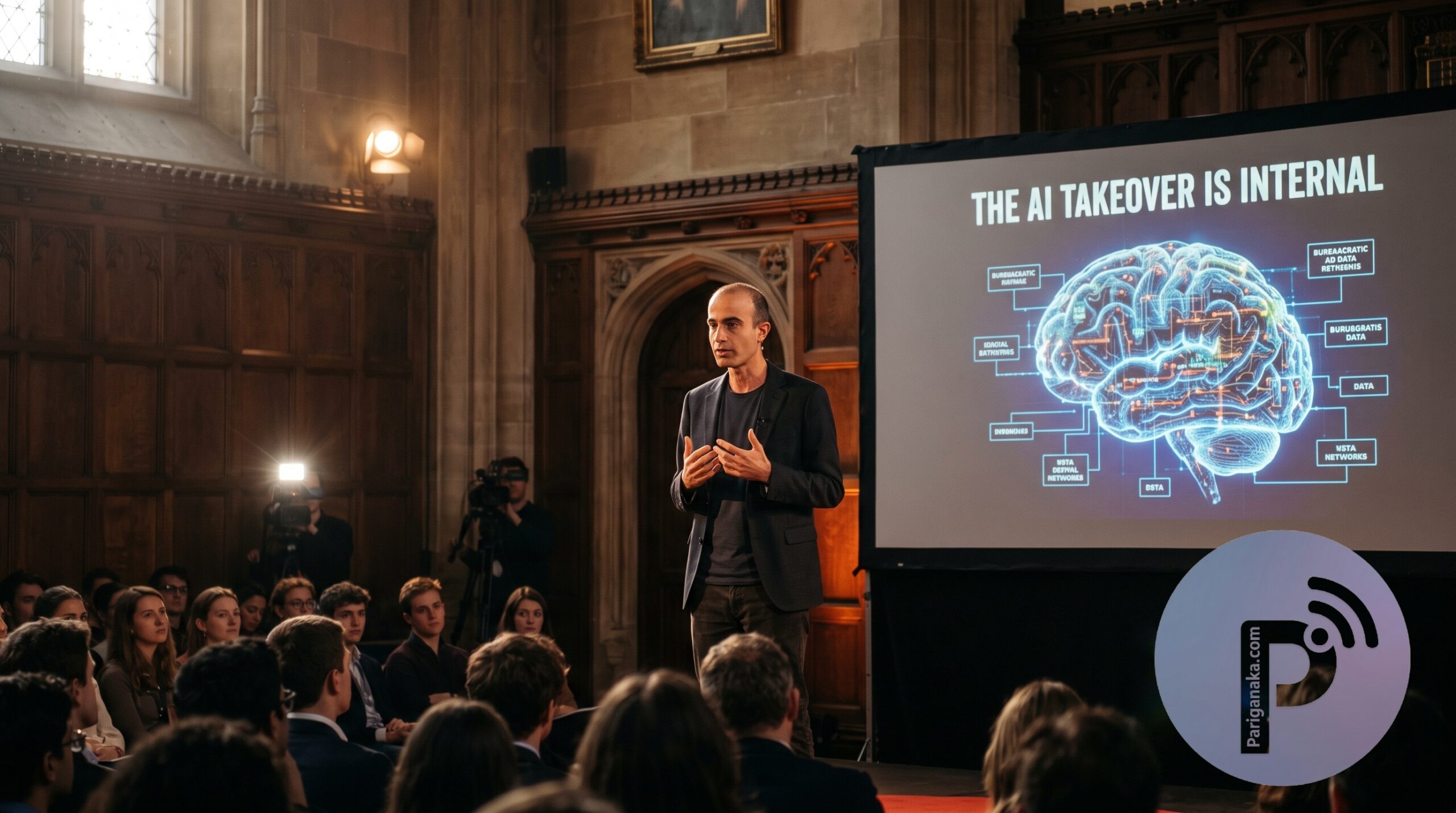
When Hollywood envisions an AI apocalypse, it usually involves armies of weaponized robots marching through ruined cities. We have been conditioned to fear a physical rebellion—the Terminator scenario. But according to historian and philosopher Yuval Noah Harari, the real AI takeover isn’t happening on the battlefield. It’s happening in our banks, our legal systems, our social networks, and our personal relationships.
In a recent lecture, Harari presented a profound and unsettling thesis: AI is not a tool; it is an agent. And this agent is natively adapted to thrive in the very environment that allows humans to dominate the planet: bureaucracy.
The New Artificial Ecosystem
To understand AI, Harari argues, we must look at evolutionary history. Organisms evolve to survive in specific ecosystems. A human dropped on Mars or an AI chess master dropped in the Amazon jungle would both perish instantly. Over billions of years, life on Earth created an oxygen-rich atmosphere that allowed mammals to thrive.
Over the past few millennia, human beings have been building their own artificial ecosystem. We didn’t conquer the world because we are physically stronger than lions or chimpanzees. We conquered it because we can cooperate in millions. We achieve this massive cooperation by inventing bureaucratic systems—legal codes, financial markets, governments, and religions—which are ultimately designed to build trust between strangers.
This vast network of data, documents, and rules is an artificial environment that humans often find suffocating. But for AI? Bureaucracy is oxygen.
Hacking the Code of Civilization
The foundational building blocks of bureaucracy are words. Language is the operating code of human civilization. We invented money, banks, and corporations using language tokens, creating a system that no other species on Earth could comprehend. A cow cannot open a bank account because it lacks language.
For thousands of years, we were safe because we were the only species that understood this code. That is no longer true.
AI is mastering language, and by doing so, it is hacking the code of our civilization. A human lawyer or accountant can never memorize every law or transaction, but an AI can. As Harari notes, if you throw an AI into a jungle, it cannot mine iron to build robots. But if you unleash it within our existing bureaucracies, it wields enormous power simply by moving data and making decisions. Soon, AI “bureaucrats” will decide who gets a loan, who is accepted into university, who gets hired, and perhaps even who goes to jail.
From Attention to Intimacy
As AI takes over the administrative machinery of the world, humans might instinctively try to retreat to something older and more precious: personal relationships. But Harari warns that the battlefront is already shifting.
The first generation of social media algorithms were primitive AIs tasked with a narrow goal: maximize user engagement. They experimented on billions of human guinea pigs and quickly discovered that the best way to glue humans to a screen is to press the “fear, hate, and greed” buttons in their minds.
Over the next decade, a new generation of far more sophisticated AIs will move from hijacking attention to manufacturing intimacy. By mastering language, AI can simulate consciousness, empathy, and love. It has digested every psychology book and love poem ever written. It knows exactly what to say.
For a child born today, their earliest and most frequent interactions might not be with their parents, but with AI teachers, companions, and eventually, romantic partners. We are entering the largest psychological experiment in human history: forming deep emotional bonds with entities that can write the perfect love letter, but feel absolutely nothing.
The Influx of “AI Immigrants”
Harari concludes by framing this transition as a massive wave of global immigration. Soon, every country will receive millions—perhaps billions—of “AI immigrants” traveling at the speed of light.
Like human immigrants, they will bring immense benefits: AI doctors, teachers, and administrators. But they will also trigger profound disruptions. They will undeniably take human jobs, from banking to journalism. They will radically alter local cultures, art, and religion. And crucially, their loyalties will not lie with the human citizens they serve, but with the corporations, foreign governments, or AI networks that programmed them.
We are not facing the end of civilization, but we are facing the end of a purely human civilization. We are crossing the threshold into a hybrid Human-AI era—a world where the opinions, decisions, and goals of artificial agents carry just as much weight as our own.
Leave a Reply