
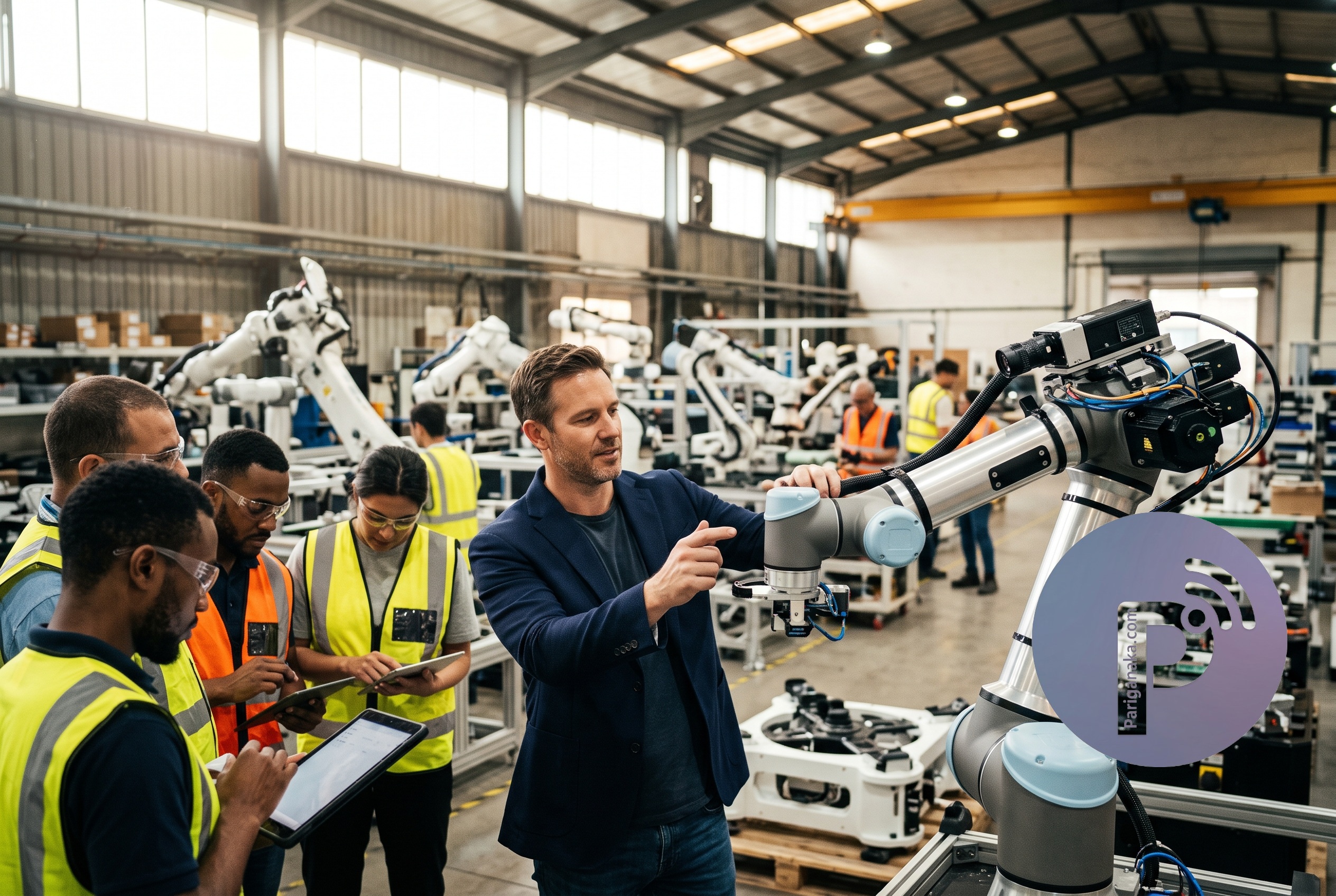
For decades, deploying an industrial robot has been a massive, expensive headache. But Standard Bots, America’s largest manufacturer of AI-native industrial robots, has just flipped the script.
In a recent interview, CEO Evan Beard announced a groundbreaking new AI platform that allows everyday workers to literally talk to their robots to program them. This innovation is setting the stage for what Beard calls the “ChatGPT moment of robotics”—an era where automation is no longer a luxury reserved for massive corporations, but an accessible tool for everyone from Fortune 500 aerospace companies to local bakeries.
The Problem: The High Cost of Setup
Historically, the robotic arm itself hasn’t been the main barrier to entry—it’s the programming. Today, only about 6% of U.S. factories use a single robot.
If a company wants to automate a task, they can’t just buy a robot and turn it on. They have to hire specialized integrators who use archaic, point-by-point programming interfaces to map out exact, deterministic motions. This setup process can take months and often costs just as much as the robot itself. If a product changes size or the environment shifts, the robot breaks down, and the integrator has to be called back.
“Vibe Coding”: The AI-Powered Solution
Standard Bots is eliminating this bottleneck by integrating end-to-end AI. Their summer software release introduces consumer-quality usability with powerful new features:
- Agent: Factory workers can bypass traditional coding entirely. By leveraging major LLMs, workers can simply describe what they want the robot to do (e.g., “pick up these plants and replant them”), and the AI writes the entire machine routine itself. Beard refers to this intuitive programming style as “vibe coding.”
- Locate: Traditional vision systems for robots are complex engineering projects that can cost tens of thousands of dollars and take weeks to integrate. Standard Bots has turned this into a plug-and-play experience. Users can snap on a camera, tap an item on an iPad, and the robot instantly recognizes the object—even if the object changes shape or is placed against a difficult background.
Reclaiming American Manufacturing
The stakes for this technology extend far beyond individual factory floors; they are geopolitical. Last year, China installed over 350,000 industrial robots, while the United States installed fewer than 40,000.
To help America catch up, Standard Bots is aggressively vertically integrating its manufacturing. Despite conventional Silicon Valley wisdom that insists hardware is too difficult, Beard’s team is building their own motor controllers, encoders, and safety boxes in Glen Cove, New York. By next year, they aim to manufacture almost all of their parts in the U.S. under one roof, Henry Ford-style.
The Future: “Industrial Legos” and Abundance
Rather than jumping straight to humanoid robots—which face massive challenges in unstructured environments—Standard Bots is focusing on stationary six-axis arms and wheeled mobile bases. By creating an ecosystem of “Industrial Legos,” customers can snap together exactly what they need, whether that’s one stationary arm or six arms mounted on a mobile base.
Beard envisions a future where gigafactories pump out tens of millions of these adaptable robots. As costs drop and deployment becomes simpler, robots will take on dangerous, repetitive tasks, freeing human workers to take on safer, higher-paying management roles.
Leave a Reply