
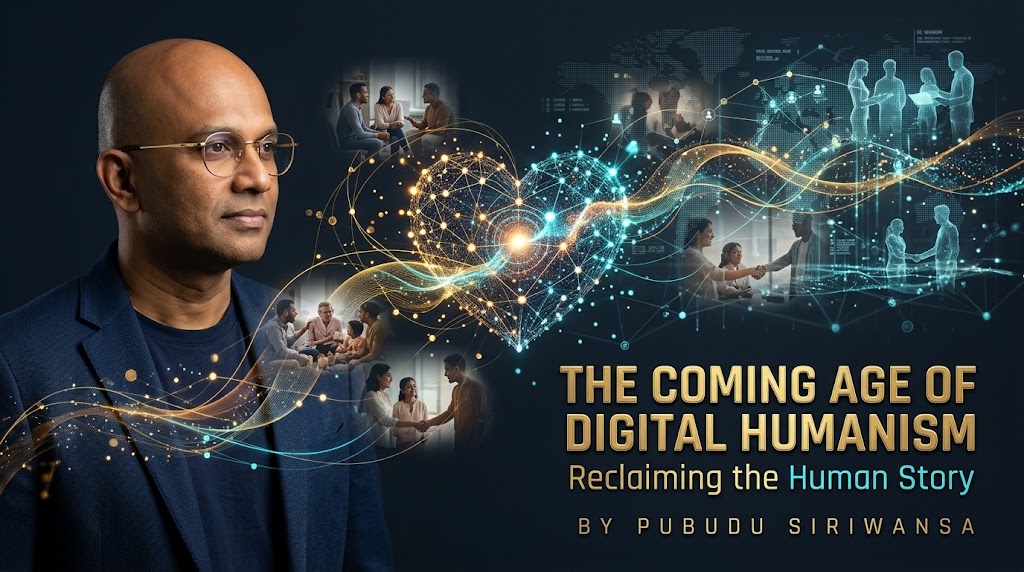
For the past two decades, we have been sprinting through an era defined by rapid technological acceleration. We have built algorithms that can predict our behavior, artificial intelligence that can generate art and text, and digital networks that connect opposite corners of the globe in milliseconds. Yet, amidst this breathtaking progress, a silent crisis has emerged. We are the most hyper-connected generation in history, but we are increasingly experiencing a profound sense of isolation.
As the “digital layer” transcends its technical boundaries to become the next cultural editor of the human story, a vital question demands our attention: Are we losing our humanity in the code?
The answer to this question is giving rise to the most important philosophical and technological movement of our time—The Age of Digital Humanism.
What is Digital Humanism?
Digital Humanism is not a rejection of technology; rather, it is a profound course correction. It is the belief that technology must serve human flourishing, rather than humans serving as mere data points for technological advancement.
For years, the tech industry has been driven by a “Tech-Centric” mindset—focusing on what a machine can do. Digital Humanism shifts this to a “Human-Centric” mindset, asking what a machine should do to elevate the human condition. It is the conscious effort to hardcode empathy, ethics, and compassion into our digital ecosystems.
The Shift from ‘Users’ to ‘Humans’
In the algorithmic age, we have been reduced to “users,” “consumers,” and “traffic.” Our attention is harvested, and our emotions are often manipulated to drive engagement. The coming age of Digital Humanism demands an end to this extractive relationship.
Future digital platforms will be judged not by how much time we spend on them, but by the quality of the time we spend. Are these tools making us more empathetic? Are they deepening our real-world relationships? Are they helping us understand one another better? A true Digital Humanitarian understands that no matter how intelligent a machine becomes, it can never replicate the warmth of a human heartbeat or the healing power of genuine empathy.
Empathy as the Ultimate Algorithm
As Artificial Intelligence takes on more cognitive tasks—planning, reasoning, and creating—human beings are freed to focus on what makes us uniquely human. The skills of the future will not just be coding and data analysis; they will be emotional intelligence, ethical reasoning, and creative collaboration.
In the coming years, the greatest technological innovations will not just be faster processors or larger AI models. The greatest innovations will be technologies designed to bridge the digital divide, eradicate biases in AI, and protect our mental well-being in virtual spaces. We will see the rise of “Compassionate Tech”—systems built to nurture the human spirit rather than exploit it.
Writing the Next Chapter
We are currently the authors of the most critical transition in human history. The technology we create today will dictate the social structures of tomorrow. If we allow technology to evolve without a moral compass, we risk creating a cold, automated world. But if we embrace Digital Humanism, we can build a future where technology acts as an amplifier for our greatest human virtues—love, kindness, and understanding.
The call of the hour is for each of us to become a “Digital Humanitarian.” We must step into the digital realm not just as consumers, but as mindful creators and empathetic participants. Let us ensure that as the digital layer edits the human story, it writes a chapter that we can all be proud of.
Leave a Reply