
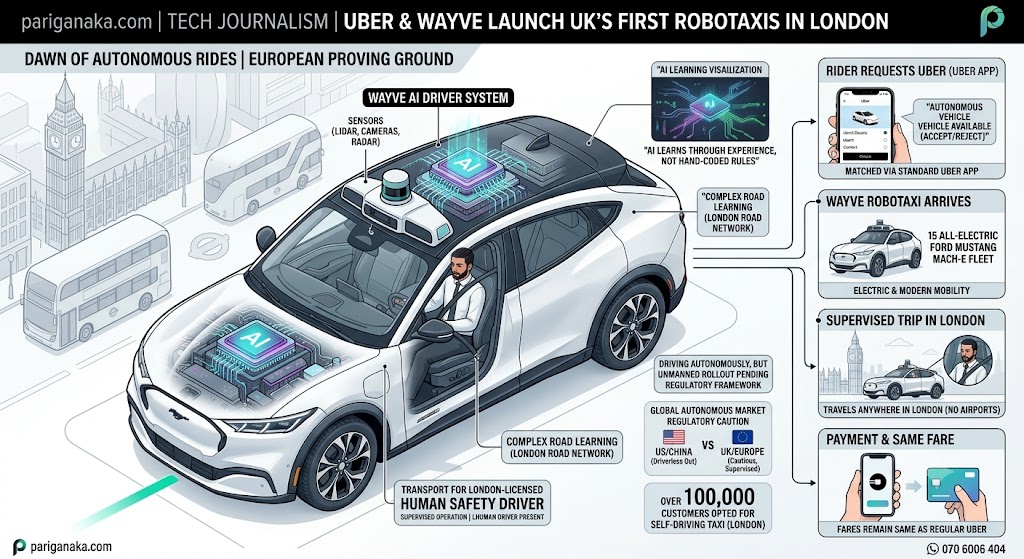
Uber has officially partnered with British artificial intelligence firm Wayve to launch London’s first supervised robotaxi service. This rollout marks the first time autonomous passenger trips are available in the United Kingdom, positioning London as a critical testbed for the wider European autonomous vehicle market.
How the Service Works Starting this week, passengers in London requesting an UberX, Uber Electric, or Uber Comfort ride through the standard Uber app may be matched with a Wayve autonomous vehicle.
- The Fleet: The initial rollout is small, featuring 15 all-electric Ford Mustang Mach-E vehicles equipped with Wayve’s AI Driver technology and surround sensors.
- Pricing and Choices: Riders will not pay extra for the autonomous trip; fares remain the same as regular Uber rides. Additionally, passengers have the option to accept or reject the robotaxi match before the vehicle arrives.
- Service Area: The robotaxis can travel anywhere within London, with the exception of airports.
A Supervised Rollout While the vehicles are driving autonomously, they are not completely unmanned. Because the UK’s regulatory framework for self-driving vehicles is still evolving, every Wayve vehicle currently operating on the Uber network includes a trained, Transport for London-licensed human safety driver behind the wheel, ready to take control or apply brakes if necessary.
Wayve, founded in London in 2018, specifically trained its AI technology on the capital’s complex and demanding roads. The company’s AI learns through experience—adapting to its environment much like a human driver would—without relying on traditional hand-coded rules or highly detailed HD maps.
The Road Ahead Europe has generally taken a much more cautious regulatory approach to autonomous passenger vehicles compared to the United States and China, where companies like Waymo, Baidu, and Pony.ai already operate fully driverless “driver-out” services in several cities.
Despite the caution, consumer interest in the UK is significant. According to Uber, more than 100,000 customers in London indicated through the app that they would opt for a self-driving taxi if given the choice. With competitors like Alphabet’s Waymo and Baidu’s Apollo Go also eyeing London for future launches, the city is rapidly becoming a primary European proving ground for the future of autonomous mobility.
Leave a Reply