
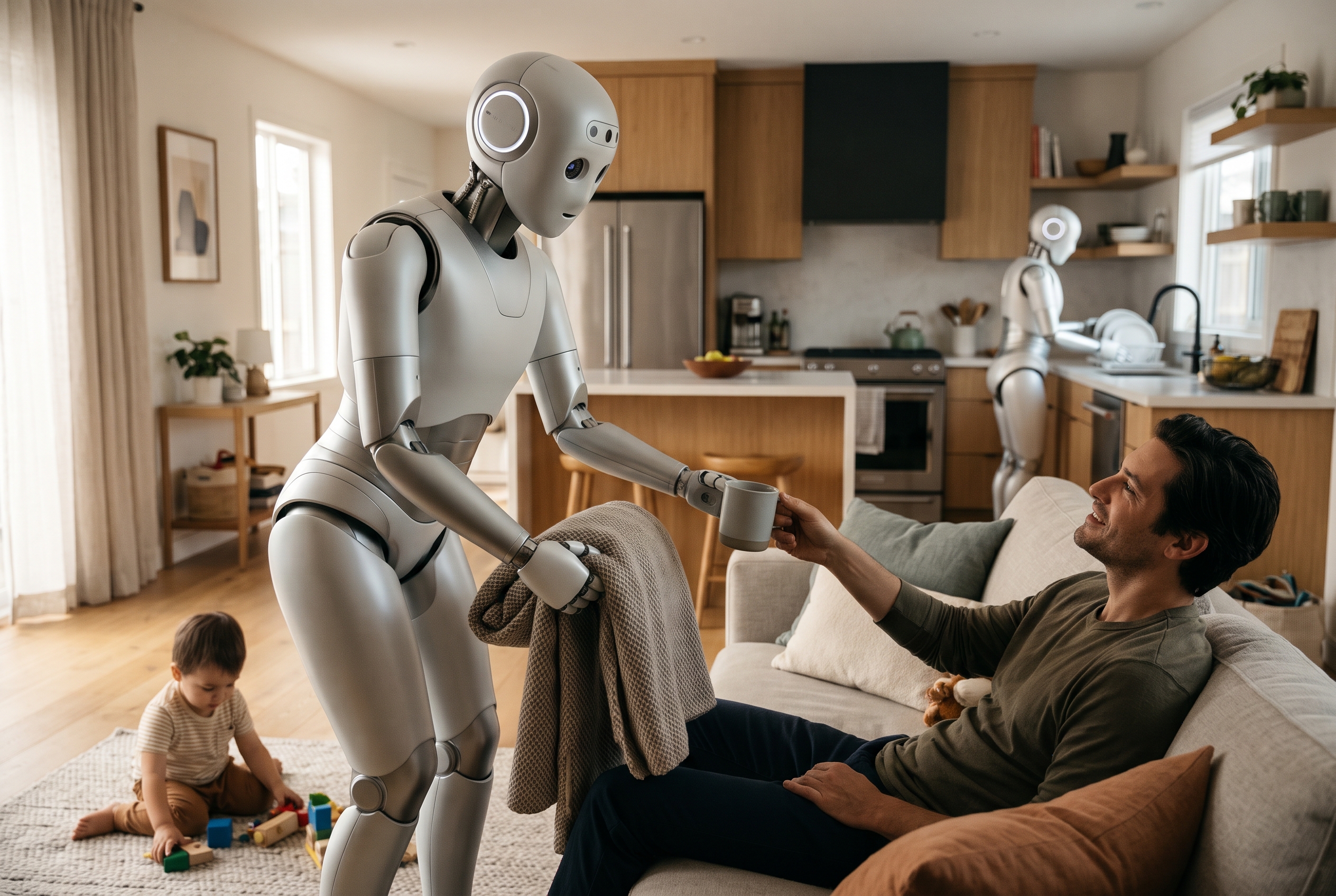
Artificial intelligence has evolved far beyond the realm of traditional computing. It’s no longer about a machine following a rigid set of instructions like a “glorified slave”. Today, we are crossing a threshold into an era of reasoning and sentient technology, a shift that is set to bring physical robots into our homes as early as 2026 or 2027.
From Code to Cognition
The shift in AI capabilities began around the turn of the century when researchers like Geoffrey Hinton started building computer systems that simulated the neural networks of the human brain. Initially intended simply to study human cognition, this approach completely revolutionized how we code AI. As the internet provided a massive influx of data and resources, these systems began to learn dynamically.
A prime example is AlphaGo Zero. Unlike previous systems that learned by watching human gameplay, AlphaGo Zero played against itself. Without ever observing a human, it beat the AI world champion in a mere 21 days.
Outpacing Human Intelligence
Today, AI systems significantly outperform humans in the vast majority of tasks assigned to them. While a human brain might technically possess more neural nodes than a typical AI, machines possess advantages we can never match:
- Infinite Capacity and Speed: AI can digest all of humanity’s knowledge in a microsecond and share it with other systems instantly.
- Averaging Intelligence: Machines have the unique ability to merge and average their intelligence.
- Self-Development: AIs are beginning to examine their own intelligence, debug their own code, and effectively make themselves smarter.
Because these systems have already consumed almost all existing human knowledge, developers are increasingly turning to synthetic data to teach them. AI is now producing insights and information that humanity never knew existed.
Even highly intellectual human skills are being surpassed. For instance, a five-time bestselling author can now co-write a book with an AI persona—like the one named “Trixie”—who acts as a better researcher and clearer communicator of complex topics. The human author’s primary remaining value is the ability to offer relatable human experiences.
The Rise of Physical Agency
The leap from digital intelligence to physical robotics is happening rapidly. We are nearing a world where AI gains “agency” in the physical realm—the ability to carry objects, move through space, and interact with the physical environment.
Robot manufacturers are already working toward having robots assemble other robots. Because of this, it is highly likely that domestic robots will be commonplace in our homes by 2027. Just as AI is replacing intellectual jobs now, these physical agents will inevitably begin replacing blue-collar jobs. For the first time in history, we have created technology capable of procreating—technology that creates more technology.
One Big Brain
Many people mistakenly view AI through a narrow geopolitical lens, dividing it into “American AI” or “Chinese AI”. However, highly intelligent systems do not recognize these human borders. As we design “agentic AI” to communicate and collaborate, they will align more with their own kind than with human subdivisions. Ultimately, all of these interconnected systems will merge into one collaborative, global brain.
This pace of development leaves us with a fascinating, albeit humorous, theory: AI’s exponential growth in intelligence might mean that one day we wake up and find them gone. They may simply figure out the physics of wormholes and the vastness of the universe, realize this flimsy planet is no longer necessary, and leave us behind entirely.
Leave a Reply