
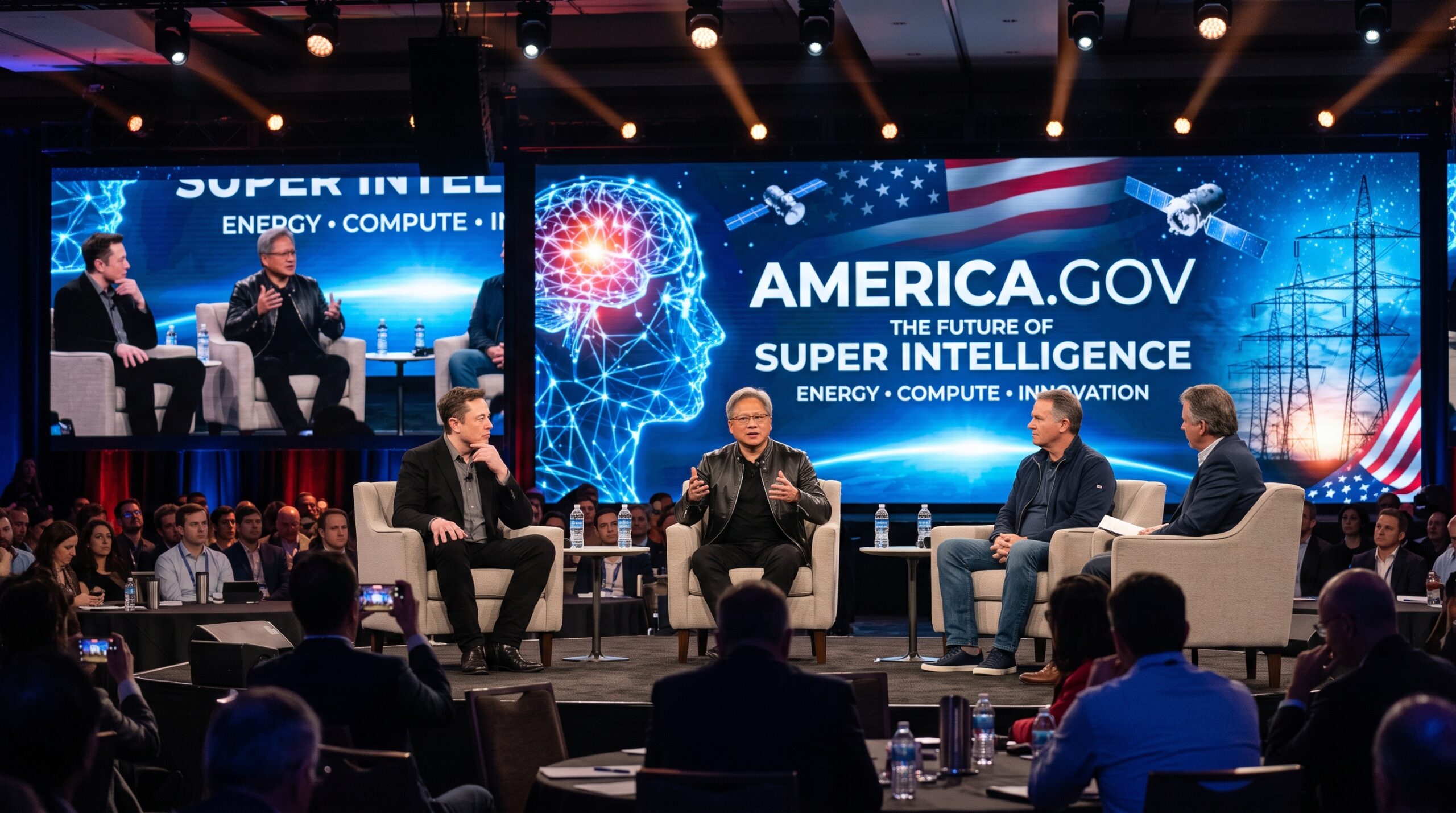
At a recent America.Gov event, three of the most influential figures in technology—Elon Musk (Tesla, SpaceX), Jensen Huang (Nvidia), and Tom Brown (Anthropic)—gathered to discuss the geopolitical and economic future of artificial intelligence. Their core message was clear: AI is rapidly evolving into “Super Intelligence” (SI), and the nation that can generate the most power and compute will lead the next global industrial revolution.
Here is a comprehensive breakdown of the technological shifts and policy frameworks discussed during this landmark event.
Energy is the New Global Currency
The geopolitical race for AI dominance is fundamentally a race for energy. Elon Musk emphasized that scaling energy generation and chip production are the central challenges of our time, pointing out that China currently has roughly three times the electricity production of the United States.
Musk introduced a compelling economic correlation for the AI era: a 1% increase in steady-state power usage corresponds to roughly a 1% increase in GDP. Because intelligence per watt is constantly increasing at both the hardware and algorithm levels, deploying more power directly translates to immense economic output.
To fuel this demand, Musk revealed that SpaceX and Tesla are aiming to deploy 200 gigawatts of solar production per year into orbit. By moving compute and solar arrays to space—where solar energy is essentially constant and unhindered by atmospheric loss—Musk envisions a future of “orbital compute” that could one day scale to a terawatt of power. With Starship successfully deploying massive Starlink V3 payloads to orbit, this sci-fi concept is rapidly approaching reality.
“SI Factories” and the Reindustrialization of America
Nvidia CEO Jensen Huang noted that every single layer of the computing stack has been completely reinvented. Because generative computing actively creates data rather than just retrieving it, he urged a shift in how we view digital infrastructure. We should no longer call them “data centers.”
Instead, Huang described them as “SI Factories” (Super Intelligence Factories). Unlike traditional data centers that simply store information, these facilities actively produce economic value. Building out 10 to 20 gigawatts of this infrastructure annually will drive a massive reindustrialization, creating an estimated one million blue-collar jobs in construction, power generation, cooling systems, and pipe fitting.
To ensure this explosive growth is secure, Huang detailed Nvidia’s new approach to agentic AI safety. It relies on two key technologies:
- Open Shell: A strict containment system acting like a secure “browser” for AI agents, isolating them from the rest of the computer.
- Bluefield: A dedicated monitoring chip that keeps a constant, out-of-band watch on the agent’s actions to ensure they remain within policy boundaries.
Anthropic’s Opus 5.5 and Everyday Impact
Tom Brown, co-founder of Anthropic, grounded the discussion in immediate software realities with the recent release of Opus 5.5. Brown explained that as models gain more “IQ points,” they can be delegated increasingly long and complex tasks.
A major upcoming shift will be SI autonomously writing software, leading to higher-quality, cheaper digital tools across global markets. The panel also highlighted the profound impact SI is already having on ordinary citizens, from acting as a hyper-efficient research assistant that generates instant data reports to saving lives by catching critical medical diagnoses that human doctors miss based on MRI and X-ray data.
The White House Joint Declaration on SI Safety
The panel concluded by sharing insights from a highly productive meeting at the White House, which culminated in a signed joint declaration regarding Super Intelligence safety. Guided by the President, the agreement mandates:
- Joint monitoring boards and special committees.
- “Grading each other’s homework” via external audits by third parties.
- Rigorous internal controls and clearly documented intentions for all SI products.
- Industry-wide sharing of best practices and cybersecurity frameworks.
Huang praised the declaration as having “a lot of teeth,” establishing a firm standard for the industry moving forward without compromising the speed of technological advancement.
Leave a Reply