
The “Dead Internet Theory” is an online concept proposing that the vast majority of web traffic, content, and interaction is no longer driven by human beings, but by bots and algorithmic curation. While once dismissed as a fringe conspiracy, the rapid evolution of generative AI has brought this theory closer to reality.
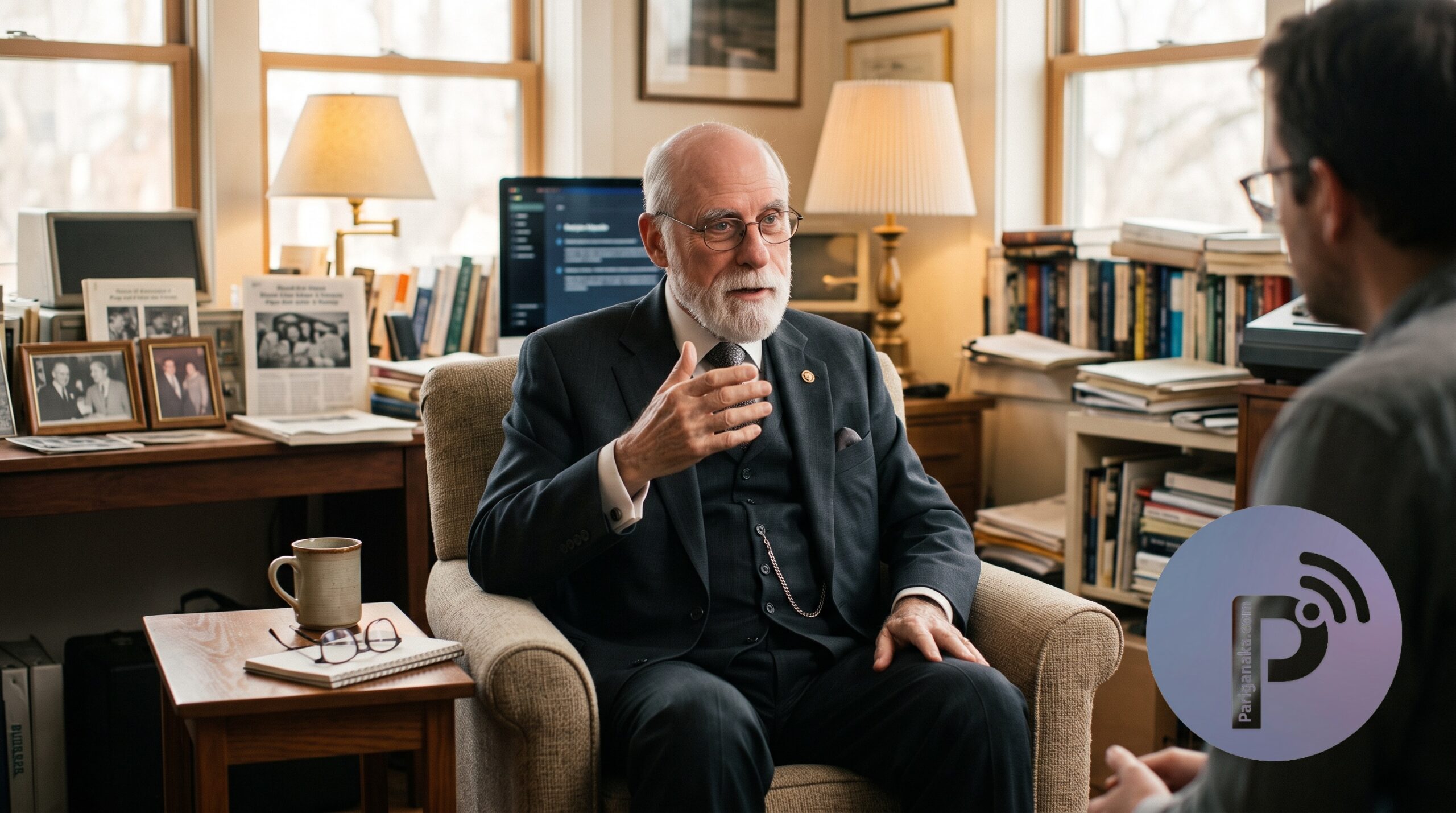
In a recent interview, Vint Cerf, widely recognized as one of the “fathers of the internet” and a co-designer of the TCP/IP protocols, weighed in on the implications of an AI-saturated web. His message was clear: While we shouldn’t necessarily fear the bot-driven internet itself, we absolutely must stop artificial intelligence from masquerading as human.
The Danger of the “I”
For Cerf, the central crisis of the AI era is not necessarily job replacement or a terminator-style takeover; it is the fundamental deception of human-computer interaction.
“It’s more important now than ever that we not allow an artificial intelligence to hide the fact that it’s an artificial intelligence and not a person,” Cerf warned.
This deception often occurs subtly, through the use of natural language. Cerf pointed out that when an AI system uses the pronoun “I” (e.g., “Well, I think…”), it intentionally mimics human consciousness. This linguistic trick prompts users to project human traits, experiences, motivations, and—most dangerously—human constraints onto a piece of software.
“We don’t know how to discipline an artificial intelligence,” Cerf explained. “We don’t know how to give them incentives that are as effective as the incentives we can give to people… What should you say to an artificial intelligence to motivate it? Would you tell it it can’t surf the internet for a week?”
Because we cannot hold software accountable in the same way we hold a human accountable, allowing it to pretend to be human is a massive vulnerability.
The Problem of “Agentic” Misunderstanding
The conversation naturally extended to “agentic AI”—AI systems designed not just to chat, but to execute tasks, spend money, and make decisions on our behalf. If the internet becomes a web of distinct AI agents talking to one another to execute real-world tasks, the ambiguity of human language becomes a critical failure point.
“If a chain of agents is activated to get something done, and somewhere in the chain there’s a misunderstanding—partly a result of the ambiguity of natural language—I think we should be very concerned about that,” Cerf noted.
To mitigate this, Cerf suggests that future AI might need to develop a distinct, hyper-precise language solely for interacting with other AI, eliminating the nuances and misunderstandings inherent in human speech. Furthermore, a robust ecosystem of digital identities, unforgeable audit trails, and strict legal accountability for the human or corporate owners of these agents must be established.
Re-evaluating the Dead Internet Theory
When explicitly asked about the “Dead Internet Theory”—the idea that 99% of future internet activity will be bots—Cerf offered a surprisingly nuanced view.
“Even if that happened, it might not necessarily be a bad thing,” he stated.
While acknowledging the existence of useless “AI slop,” Cerf pointed to the massive utility large language models provide. He noted that physicists are currently using models like Gemini as lab assistants to design experiments and interpret complex data. “That’s useful information, that’s not junk. And so I would not reject information that happens to be produced by a bot out of hand.”
Instead of panicking over the volume of bot activity, Cerf believes the solution is extreme skepticism and critical thinking. The real danger arises when individuals with zero foundational knowledge query an AI, because the bots “sound very, very authoritative even when they’re wrong.”
Augmentation, Not Replacement
Ultimately, Cerf does not subscribe to the doom-laden narrative that AI is a “replacement” for humanity. He views AI through the same lens he views the internet itself: as an augmenting capability. Just as the internet exceeded our native capabilities to transmit information, AI exceeds our native capabilities to recall and synthesize data.
“I don’t buy the ‘replace human’ argument,” Cerf concluded. “I see this as an augmenting capability… You should study Douglas Engelbart and his notion of augmenting human intellect. That’s where we are.”
Leave a Reply