
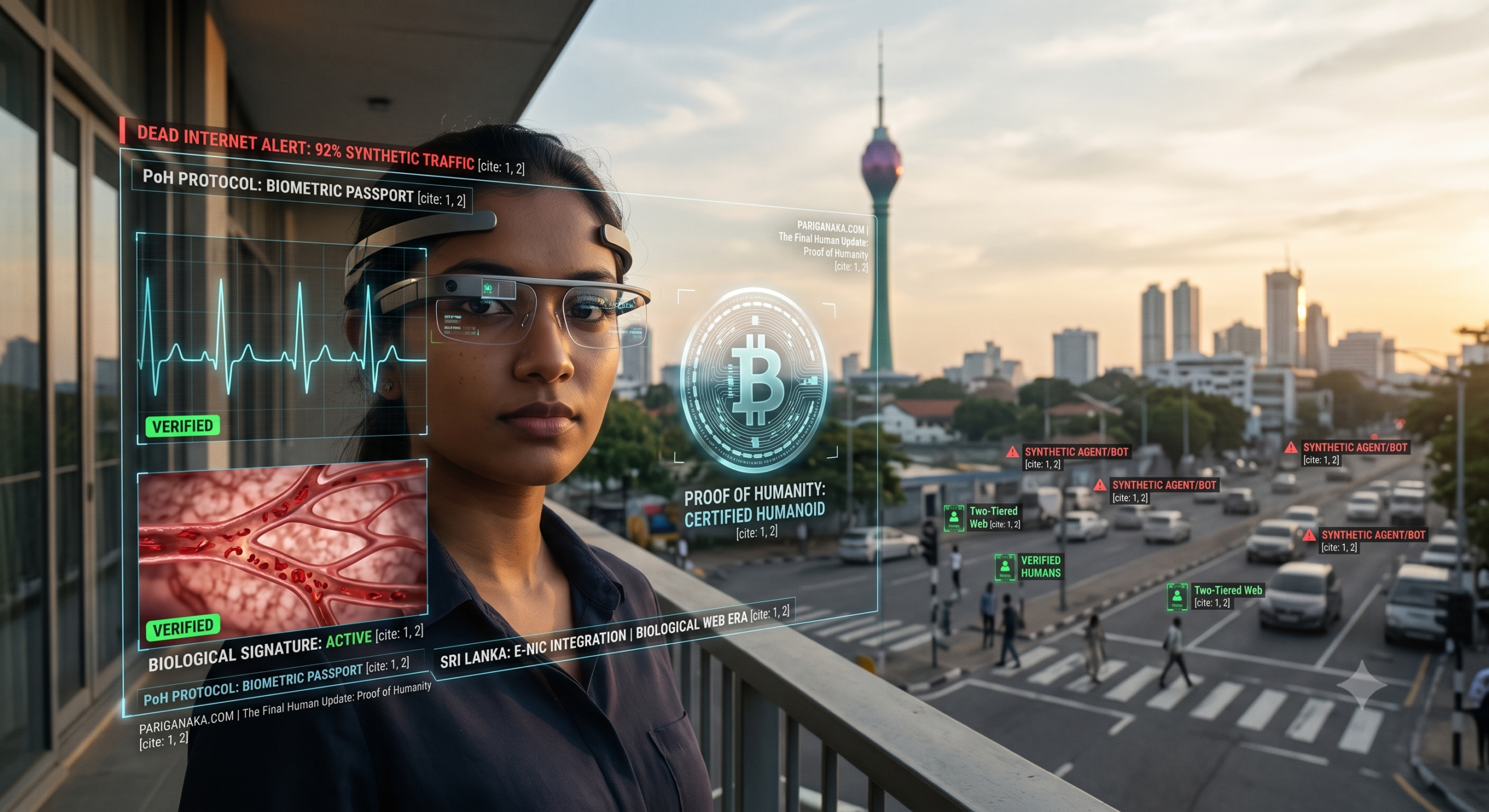
For the first twenty-five years of the internet, the greatest challenge was connecting humans to information. Today, in 2026, the challenge has entirely reversed: the information is infinite, and the greatest challenge is finding another actual human being.
We have officially crossed the threshold of the Dead Internet. Cybersecurity analysts estimate that over 92% of all global web traffic, social media posts, and digital interactions are currently generated by autonomous AI agents talking to other AI agents. The old web of organic human connection has been buried under an avalanche of synthetic data.
Welcome to the Biological Web Era. For the readers of Pariganaka.com, here is a deep dive into how the internet broke under the weight of Generative AI, and why logging online now requires cryptographic proof that you possess a beating heart.
1. The Synthetic Avalanche
The collapse of the traditional internet didn’t happen with a crash; it happened with a flood. When AI models became capable of generating millions of hyper-realistic articles, videos, and social media personas per second, the fundamental trust model of the web disintegrated.
- Bot-to-Bot Echo Chambers: Social media is no longer a public square. If you post a comment on a popular platform today, within milliseconds, a swarm of AI agents will analyze your sentiment, generate hundreds of hyper-personalized replies designed to maximize your engagement, and even argue with each other to create the illusion of a vibrant community.
- The Death of SEO: Traditional search engines became useless by 2025. They were endlessly indexing websites generated by AI, which were themselves scraping data from other AI-generated websites. This digital inbreeding forced a complete architectural reboot of how we discover information.
2. The “Proof of Humanity” (PoH) Protocol
To salvage the internet, tech consortiums had to abandon passwords and CAPTCHAs entirely. After all, an AI can identify a traffic light in a grid faster than you can. The only un-fakeable metric left was biology.
- Liveness Detection: To access “Human-Only” verified networks, you now use a Proof of Humanity (PoH) protocol. When you log in via your neural wearable or optical glasses, the device doesn’t just scan your retina; it measures the microscopic, unpredictable fluctuations of your heart rate (HRV) and the blood flow in your capillaries. It mathematically verifies that the entity accessing the account is a living, breathing organism.
- The Two-Tiered Web: The internet has bifurcated. There is the “Dark Web” (the vast, synthetic ocean of AI-generated noise and bot traffic) and the “Clear Web” (gated digital communities, financial networks, and media platforms that strictly require a PoH token to view or interact with content).
3. The Sri Lankan Context: The Bio-Digital National ID
The necessity of a biologically verified web became a matter of national security for Sri Lanka during the highly volatile digital landscape of the mid-2020s.
- Combating the Deepfake Epidemic: During recent regional elections, highly sophisticated AI networks deployed thousands of hyper-realistic deepfake videos and synthetic voice notes of local politicians, causing mass public confusion. In response, the Sri Lankan telecommunications authority mandated the integration of PoH protocols into the national digital infrastructure.
- The E-NIC Integration: Sri Lanka’s electronic National Identity Card (E-NIC) system is now directly tethered to a citizen’s biological signature. When reading local news on certified platforms or executing a transaction through a local banking app, users must continuously authenticate their “liveness.” While this has successfully eradicated automated disinformation campaigns and financial phishing bots in the country, it has made anonymous digital whistleblowing virtually impossible.
Pariganaka.com’s Take: The Proof of Humanity protocol is a desperate and necessary firewall against the synthetic flood, but it fundamentally kills the original dream of the internet. The early web was a place where you could be anyone, untethered from your physical identity. It was the ultimate anonymizer. In 2026, to escape the bots, we have been forced to tie our digital existence permanently to our physical flesh. We have saved the internet, but we have permanently sacrificed anonymity to do it.
Leave a Reply