
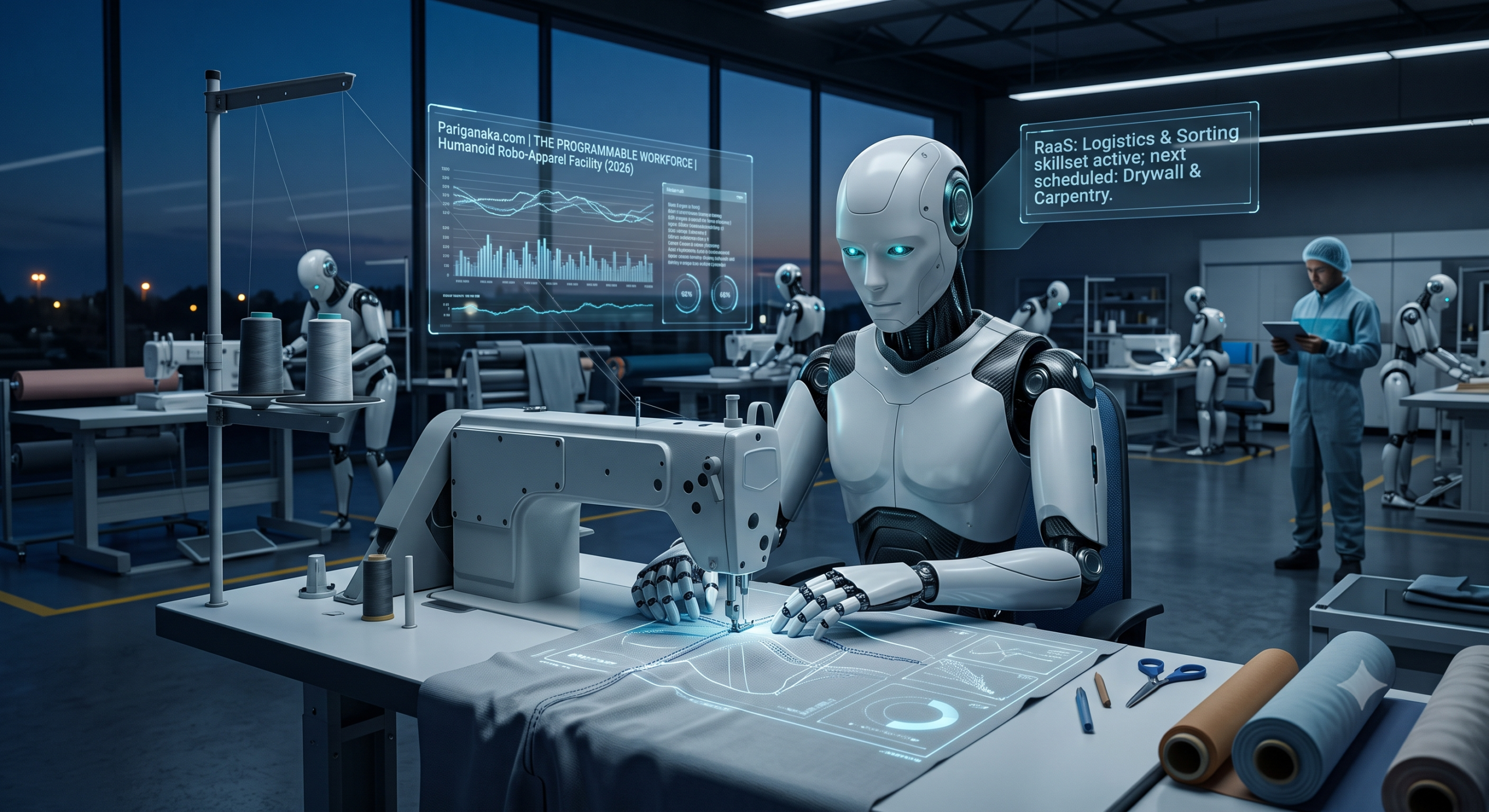
For decades, robotics was defined by heavy, blind machinery bolted to factory floors. They were perfect for welding car chassis, but completely useless if you asked them to fold a shirt, navigate a cluttered room, or fix a leaky pipe. This was known as Moravec’s Paradox: high-level reasoning was easy for computers, but basic sensorimotor skills were incredibly difficult.
In 2026, that paradox has officially been solved. The same generative AI that revolutionized text and code has been successfully merged with bipedal titanium frames. General-purpose humanoid robots have finally stepped out of the laboratory cages and into our construction sites, warehouses, and homes.
Welcome to the Programmable Workforce Era. For the readers of Pariganaka.com, here is a deep dive into how Artificial Intelligence finally conquered the physical world, and why the global blue-collar economy is undergoing the most radical shift since the Industrial Revolution.
1. The “Brain-Body” Convergence
The breakthrough wasn’t in creating stronger motors or better batteries; the breakthrough was spatial intelligence. We stopped programming robots with rigid, line-by-line instructions and started training them the same way we trained language models—through massive, generalized neural networks.
- Embodied AI: Today’s humanoids, like the Atlas-Gen3 or Tesla Bot Prime, do not follow a pre-written script. They are powered by “Vision-Language-Action” (VLA) models. They look at a messy construction site, understand the physics of the objects scattered around, and dynamically calculate how to walk across uneven terrain to carry a stack of bricks without losing their balance.
- Zero-Shot Physical Learning: If a robot encounters a door handle it has never seen before, it doesn’t crash. It accesses the cloud, cross-references millions of hours of simulated human interaction data, and figures out how to turn the knob in real-time. They learn by simply observing the physical world.
2. RaaS: Robotics-as-a-Service
You don’t buy a $50,000 humanoid robot in 2026; you subscribe to its labor. The commercialization of humanoids operates entirely on a cloud-based rental model, democratizing access to unlimited physical labor.
- Skill Downloading: A humanoid chassis is essentially a blank slate. If a logistics company needs warehouse workers on a Monday, they rent ten humanoids and download the “Logistics & Sorting” neural package into their brains. By Friday, if that same company needs to renovate their office, they simply wipe the robots’ memory and download the “Drywall & Carpentry” package.
- The 24/7 Shift: Humanoids do not require lighting, air conditioning, or safety breaks. They work in total darkness, charging themselves incrementally on magnetic floor pads without ever stopping production. They are fundamentally rewriting the mathematics of operational overhead.
3. The Sri Lankan Context: The “Robo-Garment” Revolution
Sri Lanka’s economy has long relied on its highly skilled, blue-collar apparel workforce. With the arrival of humanoids, the Free Trade Zones in Katunayake and Biyagama are undergoing a massive, sometimes painful, digital transformation.
- Hyper-Automated Apparel: The intricate fine-motor skills required to stitch delicate fabrics were previously the exclusive domain of human hands. In 2026, specialized multi-armed humanoids equipped with haptic-feedback sensors are capable of cutting, stitching, and folding complex garments at five times the speed of a human worker, with zero margin of error.
- The Transition Strategy: To remain competitive against automated mega-factories in the West, Sri Lankan apparel giants have heavily invested in humanoid fleets. However, this has triggered a national labor pivot. The human workforce is rapidly upskilling from “machine operators” to “robot fleet technicians”—monitoring, maintaining, and providing edge-case physical guidance to the mechanical swarms.
Pariganaka.com’s Take: The arrival of the humanoid workforce forces a deeply uncomfortable economic reckoning. For the last century, if you lacked academic or digital skills, you could always trade your physical labor for a living wage. In 2026, that safety net is dissolving. We have created a world where manual labor is infinitely scalable and dirt cheap. While this promises an era of unprecedented manufacturing abundance, it rapidly accelerates the urgent need for a Universal Basic Income (UBI). We have successfully built machines in our own image, but we must now decide what it means to be human in a world that no longer needs our hands.
Leave a Reply