
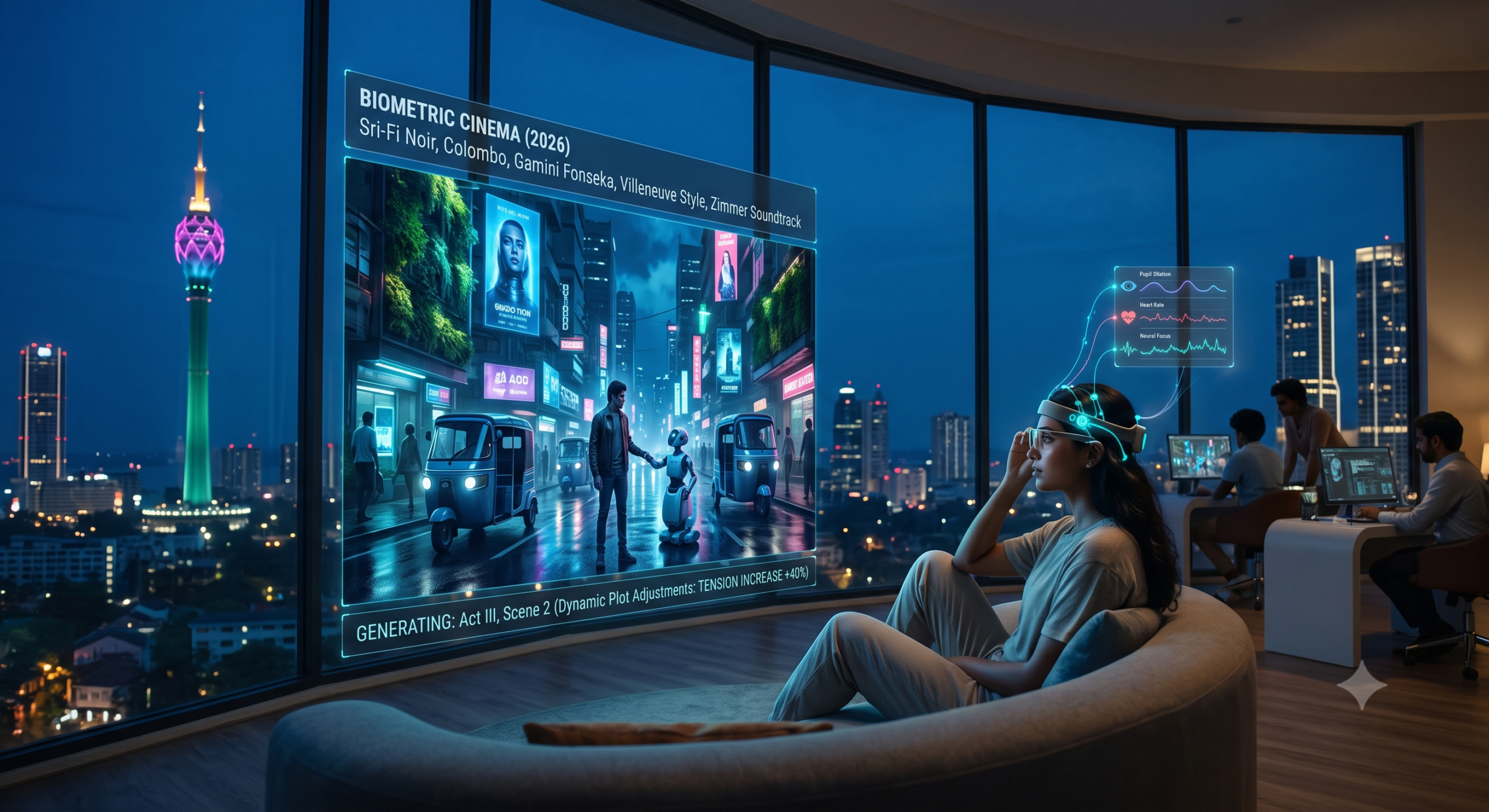
For over a century, storytelling in film was a static, one-way street. A director spent hundreds of millions of dollars, filmed a set script, and distributed the exact same two-hour video file to millions of people globally. Whether you were watching in a theater in Los Angeles or on a phone in Colombo, the movie was identical.
In 2026, that traditional model of entertainment has collapsed. We no longer watch pre-recorded movies; we experience dynamically generated simulations. Thanks to the convergence of real-time video generation algorithms and neural wearables, a movie does not actually exist until you hit play, and no two people will ever see the exact same film.
Welcome to the era of Biometric Cinema. For the readers of Pariganaka.com, here is a deep dive into how Generative AI conquered Hollywood, and why the future of entertainment is being written in real-time by your own subconscious.
1. The Infinite Rendering Engine
Just three years ago, generating a five-second, glitchy AI video took hours of processing power. Today, advanced multi-modal models can render photorealistic, 8K, 3D spatial video in real-time at 60 frames per second, complete with perfectly synced spatial audio.
- Prompting a Universe: Instead of browsing a streaming service like Netflix for a movie, you now act as the prompt engineer. You can instruct your AI: “Generate a two-hour sci-fi noir thriller set in a futuristic Colombo, starring a protagonist who looks like a young Gamini Fonseka, directed in the visual style of Denis Villeneuve, with a Hans Zimmer soundtrack.” Within milliseconds, the film begins streaming.
- Zero-Budget Masterpieces: There are no cameras, no lighting crews, no catering, and no physical actors. The cost of producing a cinematic masterpiece has plummeted from $200 million to the few cents of cloud computing power required to render it locally on your device.
2. The Biometric Feedback Loop
The most disruptive element of modern media is not just that it is generated, but that it is interactive on a subconscious level.
- Reading the Room: Connected to the neural wearables (BCIs) and smartwatch biometric sensors we wear daily, the generative engine continuously monitors your physiological state. It tracks your pupil dilation, heart rate, and neural focus levels while you watch.
- Dynamic Plot Adjustments: If the AI detects your attention drifting during a dialogue-heavy scene, it autonomously rewrites the script milliseconds ahead of your viewing, perhaps triggering an unexpected action sequence or a dramatic plot twist to spike your cortisol levels. If you are watching a horror movie and your heart rate enters a danger zone, the algorithm dynamically dials back the jump-scares and softens the lighting. The movie physically adapts to your emotional threshold in real-time.
3. The Sri Lankan Context: The Micro-Studio Boom
The democratization of hyper-realistic video generation has completely decentralized the global entertainment industry, shifting power away from Western mega-studios and opening a massive window for Sri Lankan creators.
- The Rise of the Prompt-Director: You no longer need to move to Hollywood or secure massive funding to be a filmmaker. A 19-year-old student in Moratuwa with a standard laptop and an enterprise-grade AI subscription can now produce and distribute a 10-episode epic fantasy series in a single weekend.
- Hyper-Localized Content: Global cultural barriers have been erased. When a Sri Lankan “micro-studio” releases a generated film, the AI dynamically adjusts the lip-syncing, cultural references, and humor to match the exact demographic of the viewer, whether they are watching in Sinhala, Tamil, Japanese, or Spanish. Sri Lanka is rapidly emerging as a dark horse in the global synthetic media export market.
Pariganaka.com’s Take: Biometric Cinema is the ultimate triumph of personalized entertainment, but it comes with a profound societal cost: the death of the shared cultural experience. When a massive movie like Star Wars or Titanic was released in the past, it created a global “watercooler” moment. Everyone saw the exact same story, felt the exact same emotions, and debated the exact same ending. In 2026, if you and your best friend watch the “same” generative film, your unique biometric data will alter the pacing, the dialogue, and perhaps even the ending. We have gained infinite, perfectly tailored content, but we have lost the collective reality that bound us together.
Leave a Reply