
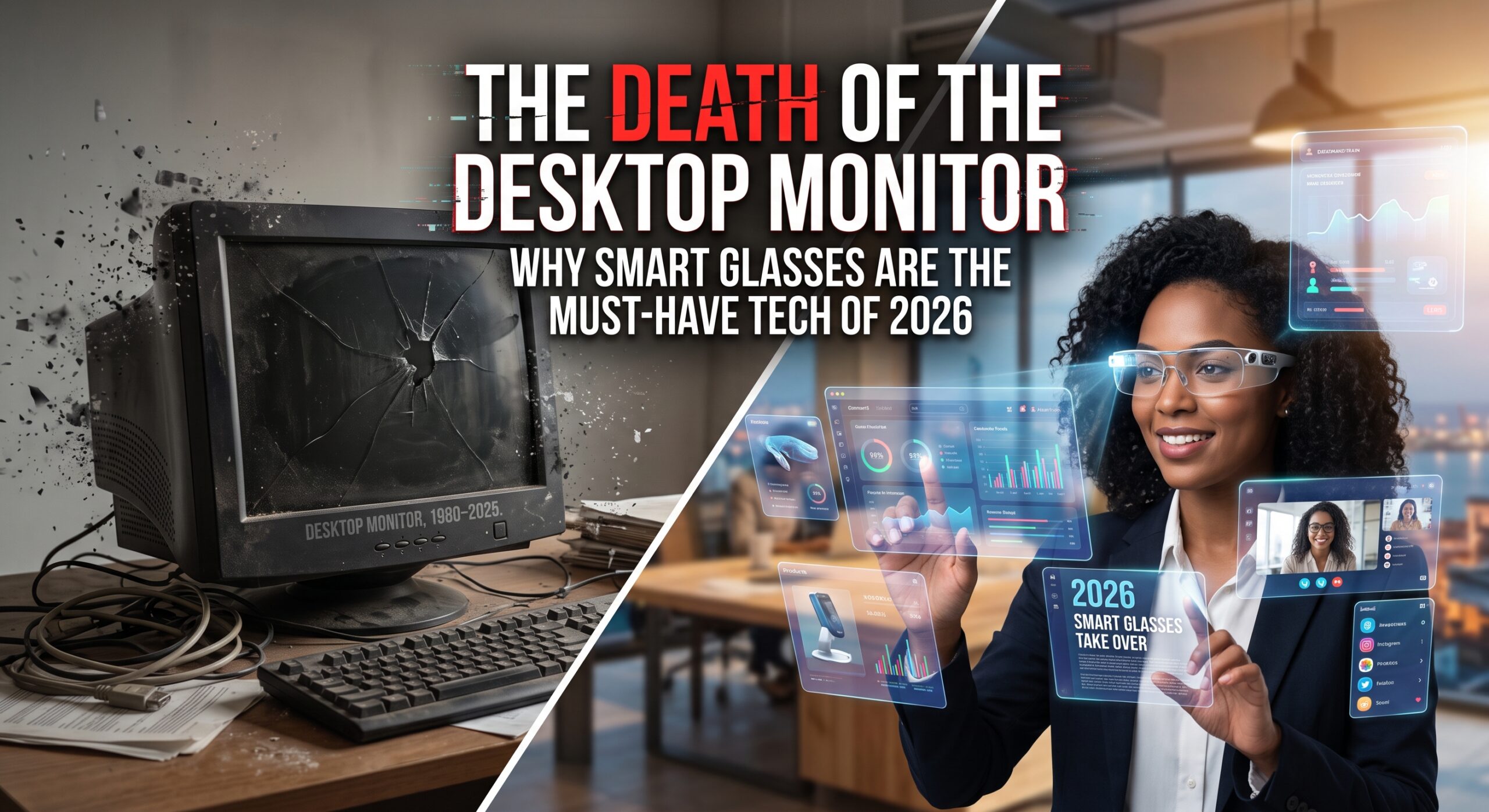
For decades, our digital lives have been confined to physical rectangles. We have continuously upgraded to wider monitors, curved displays, and dual-screen setups to expand our digital workspaces. However, in 2026, the computing landscape is breaking free from physical screens entirely.
The era of lightweight, everyday Spatial Computing is here, and smart glasses are rapidly replacing the traditional desktop monitor as the ultimate human-friendly tech accessory.
The Shift from Niche to Mainstream
Just a few years ago, Augmented Reality (AR) and Virtual Reality (VR) headsets were heavy, expensive, and isolated the user from the real world. Today’s smart glasses look virtually identical to standard prescription eyewear. They are comfortable enough to wear all day, seamlessly blending the digital and physical worlds without causing eye strain or fatigue.
Why Smart Glasses are Replacing Monitors
- Infinite Screen Real Estate: Why limit yourself to a 27-inch monitor when you can project multiple massive, high-definition virtual screens floating in the air around you? You can pin your email on your left, a massive video timeline in the center, and your chat applications on your right.
- Ultimate Privacy: Working on sensitive documents in a public cafe or on an airplane is no longer a security risk. Because the digital displays are beamed directly into your eyes via microscopic waveguides in the lenses, the person sitting right next to you sees absolutely nothing.
- Ergonomic Freedom: “Tech neck” and posture issues caused by hunching over laptops are becoming a thing of the past. With spatial displays, you can position your virtual monitors at perfectly ergonomic heights and angles, allowing you to sit back and work comfortably.
Seamless Ecosystem Integration
These are not standalone devices that require you to learn an entirely new operating system. In 2026, modern smart glasses connect instantly and wirelessly to your existing laptop, smartphone, or solid-state mini-PC. They act as a boundless, zero-latency wireless display that moves with you.
The Bottom Line
As we prioritize technology that adapts to our natural human behaviors rather than forcing us to adapt to rigid hardware, the transition away from static monitors is inevitable. Smart glasses are not just a new way to look at a screen; they are a fundamental upgrade to how we seamlessly interact with the digital world.
Leave a Reply