
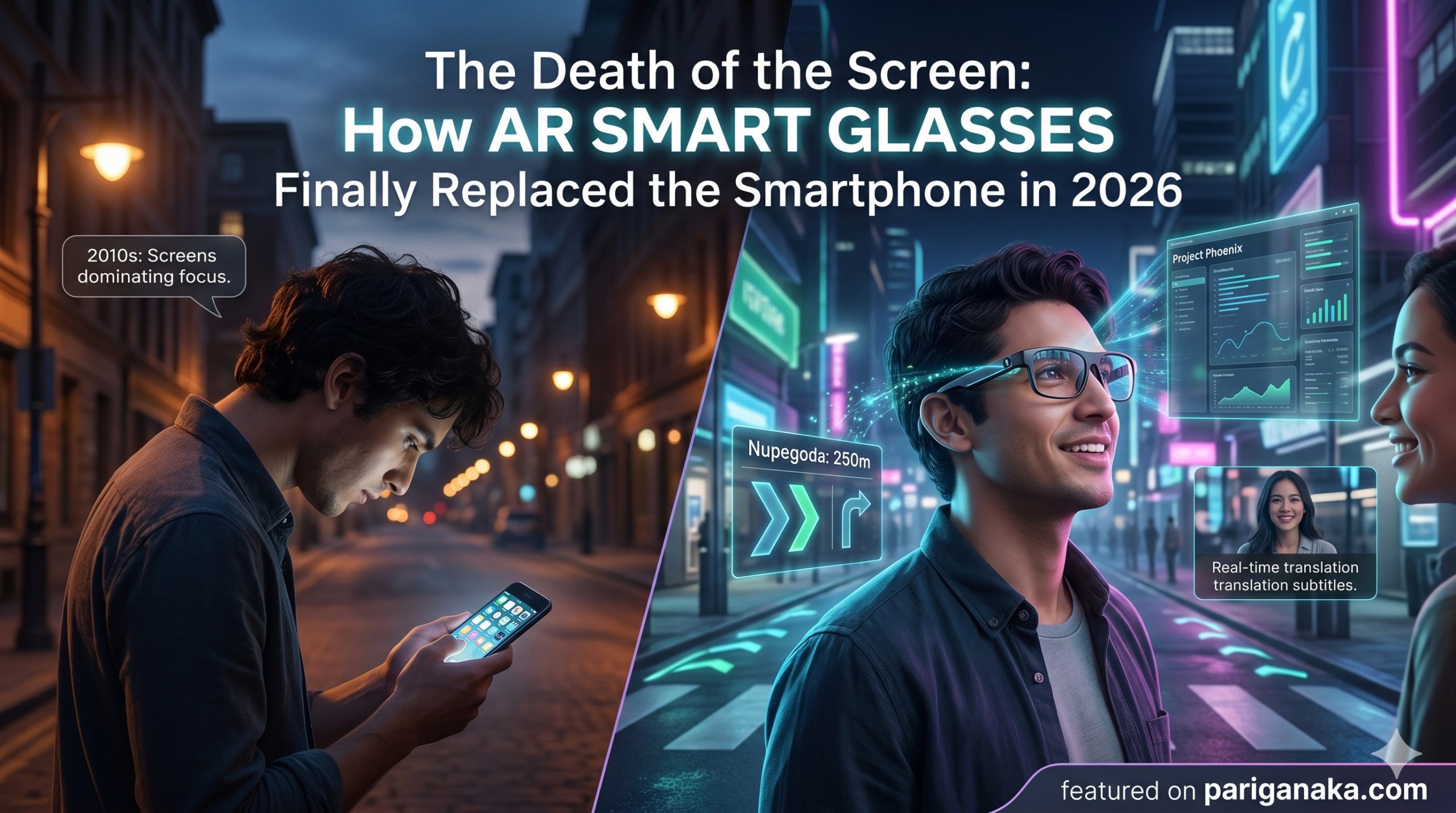
For nearly two decades, human beings have spent their lives staring down at glowing rectangles. We have walked into traffic, ignored our friends at dinner, and developed terrible posture, all to stay connected to the digital world. The smartphone was the ultimate tool of the 2010s, but its dominance has finally reached its expiration date.
In 2026, we are finally looking up. The era of Spatial Computing has truly arrived, and lightweight Augmented Reality (AR) Smart Glasses are rapidly becoming the new standard for everyday communication.
Here is why the transition from the pocket screen to the wearable lens is the biggest hardware shift since the original iPhone.
👓 The Form Factor Breakthrough
The main reason AR failed to catch on in the early 2020s was the hardware. Early headsets were heavy, hot, and made users look ridiculous. Nobody wanted to wear a bulky ski mask to a coffee shop.
This year, the technology finally caught up to the vision. Thanks to breakthroughs in micro-LED displays and the solid-state batteries (which we covered in our previous article), 2026’s smart glasses look exactly like normal, stylish eyewear. Whether you prefer the look of classic Ray-Bans or thin wireframes, the technology is completely hidden inside the arms of the glasses. They weigh less than 50 grams and easily last all day.
🌐 The UI is the Real World
With smart glasses, the concept of “opening an app” is dead. Your digital life now seamlessly blends with your physical environment:
- Holographic Navigation: Instead of looking down at a 2D map, glowing arrows and distances are projected directly onto the sidewalk or street in front of you.
- Virtual Workspaces: You no longer need a physical monitor. You can sit at an empty desk, put on your glasses, and instantly project three massive, floating virtual 4K screens that only you can see.
- Real-Time Translation: If someone speaks to you in a foreign language, perfectly translated subtitles appear hovering instantly below their face.
🤝 The Return of Eye Contact
Perhaps the most profound change in 2026 isn’t technological, but social.
Because notifications, messages, and calls are now subtly displayed in our peripheral vision, the act of “phubbing” (snubbing someone to look at your phone) is disappearing. We are finally able to maintain eye contact and remain fully present in the real world while staying connected to the digital one.
The Bottom Line: The smartphone isn’t entirely dead just yet—for most people, it currently acts as a “pocket server” providing the heavy processing power for their glasses. But its days as the primary screen are over. In 2026, the internet is no longer a place we visit through a glass window; it is a digital layer painted over the real world.
Leave a Reply