
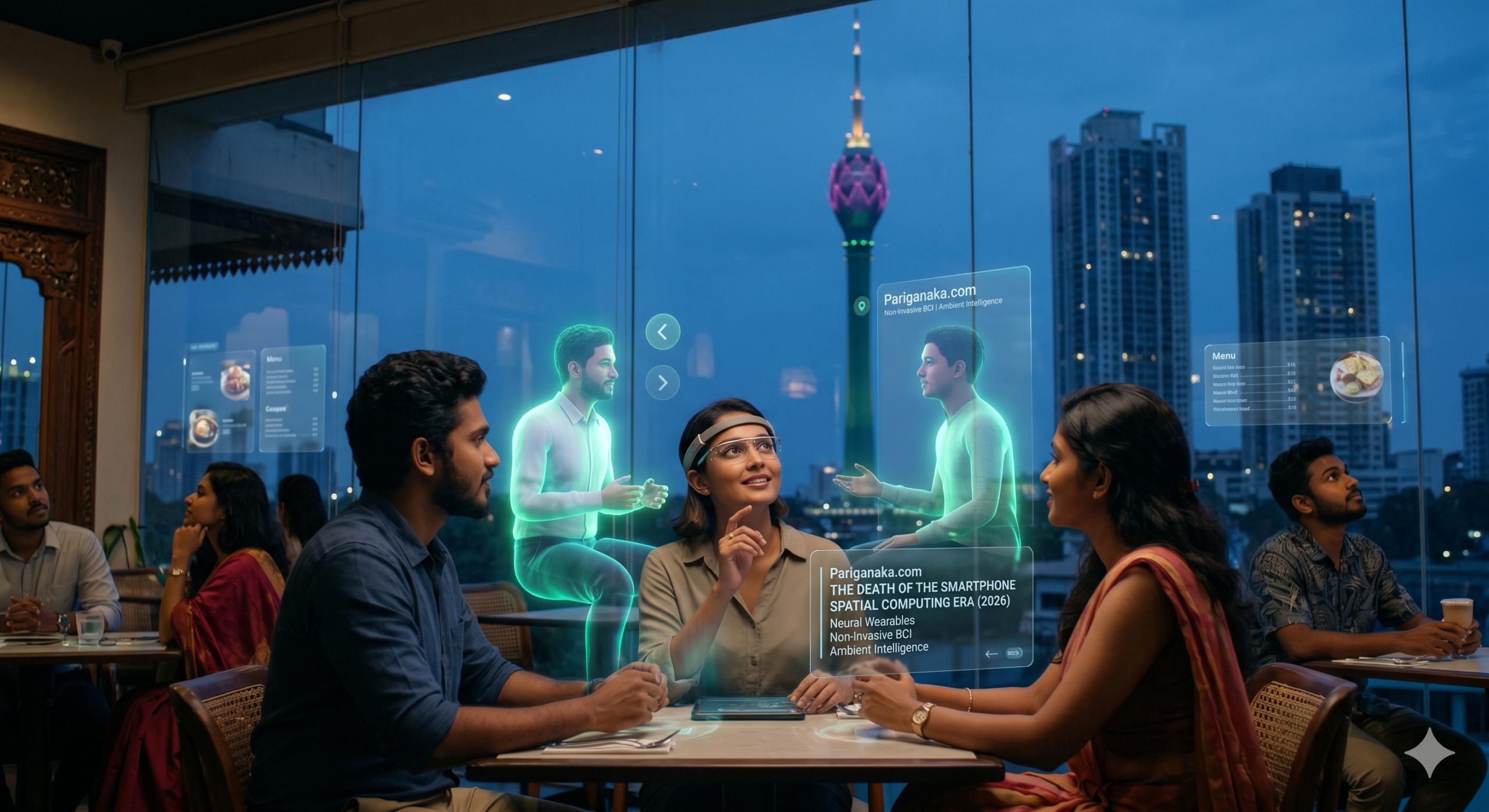
For the last twenty years, humanity has been captivated by a glowing black rectangle. The smartphone dictated how we walked, how we talked, and how we experienced the world—mostly by forcing us to look down. But if you observe the tech landscape in 2026, you will notice a rapid and fundamental shift. The smartphone is dying.
We have not stopped consuming digital information; rather, the hardware has simply vanished into our environment. The long-awaited promise of Spatial Computing and Neural Wearables has finally reached mass-market maturity, rendering the physical screen obsolete.
Welcome to the era of Ambient Technology. For the readers of Pariganaka.com, here is a look at how computing broke free from our pockets and integrated seamlessly into our natural field of vision, and why typing with our thumbs is officially a relic of the past.
1. The Invisible Screen: Smart Contacts and AR Glasses
The bulky, heavy VR headsets of the early 2020s were merely stepping stones. In 2026, the display tech has shrunk down to the size of standard prescription glasses, and in some advanced cases, micro-LED contact lenses.
- Holographic Overlays: Instead of pulling out a phone to check a map, glowing directional arrows are projected perfectly onto the physical street in front of you. When a friend calls, their life-sized 3D volumetric avatar appears sitting on the couch next to you. The digital world now co-exists completely with the physical world.
- Audio Augmented Reality: Visuals are only half the story. Discreet bone-conduction earpieces, practically invisible to the naked eye, provide continuous, context-aware audio. Your personal AI whispers reminders, reads out urgent messages, and translates foreign languages in real-time, directly into your inner ear.
2. Non-Invasive Neural Control
If we do not have a physical screen, how do we type, scroll, or click? The answer lies in the most significant breakthrough of the decade: non-invasive Brain-Computer Interfaces (BCIs).
- Subvocalization and Intent-Sensing: You no longer need to speak out loud to activate your AI, nor do you need to wave your hands in the air. Lightweight neuro-bands—worn discreetly like a watch or hidden in the arms of AR glasses—detect the motor-cortex signals traveling from your brain to your hands or vocal cords.
- The “Thought-Click”: If you want to reply to a message, you simply “think” the words (subvocalization), and the neuro-sensor types it out with zero lag. You navigate menus by simply focusing your eyes on a digital icon and consciously intending to select it. The mind is the new mouse.
3. The Sri Lankan Context: A Leapfrog in Connectivity
Just as Sri Lanka leapfrogged landlines directly to mobile phones in the 2000s, the country is rapidly bypassing expensive desktop setups in favor of spatial computing.
- Augmented Tourism: The Sri Lankan tourism industry is experiencing a massive spatial upgrade. Tourists wearing AR glasses walking through the ruins of Sigiriya or Polonnaruwa no longer look at guidebooks. Instead, they see the ancient palaces digitally reconstructed in full 3D over the ruins, complete with virtual, AI-driven avatars of ancient kings explaining the history in the tourist’s native language.
- The Virtual “Kade” and Commerce: Local retail is transforming. Small business owners in Colombo are using spatial computing to set up infinite virtual storefronts. A customer can stand in an empty room, browse a holographic catalog of furniture or clothing, visualize exactly how it fits, and authorize the digital payment with a simple neural “click.”
Pariganaka.com’s Take: The smartphone era was characterized by a severe disconnection from reality; we ignored the people around us to stare at a screen. The ultimate irony of 2026’s Spatial Computing revolution is that technology is forcing us to look up again. By removing the physical screen and blending the digital directly into the physical, computing has become “ambient.” It is there exactly when we need it, and completely invisible when we do not, finally allowing us to be present in the real world once more.
Leave a Reply