
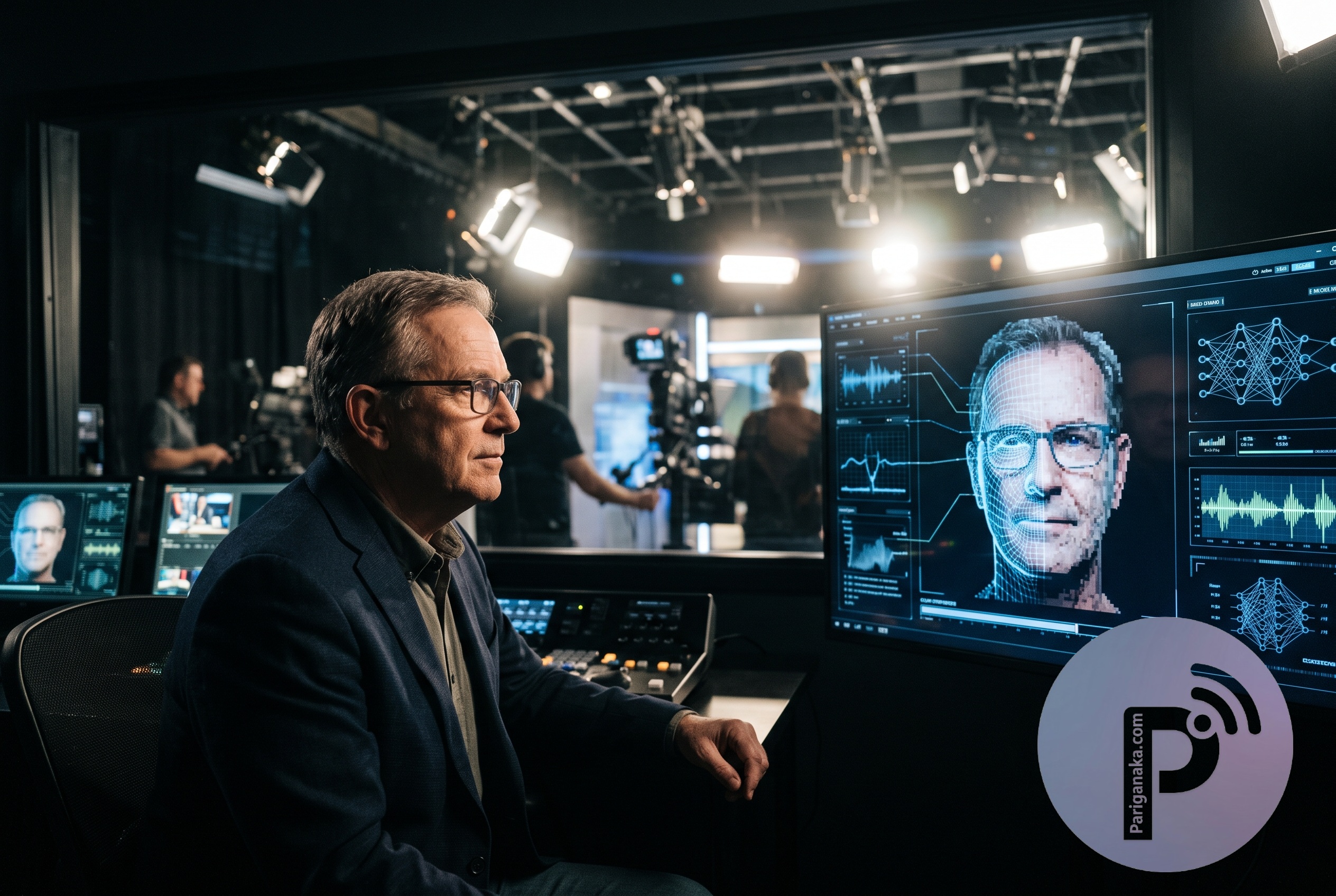
What happens when the technology meant to assist creatives becomes advanced enough to replicate them?
In a recent exploration into the future of work and the rapid evolution of generative artificial intelligence, CBS’s 60 Minutes set out to answer this question by doing the seemingly impossible: they cloned their own correspondent.
Partnering with Runway, a prominent AI company based in New York City, the 60 Minutes production team created a fully synthetic, incredibly realistic AI version of veteran journalist Jon Wertheim. The experiment serves as both a stunning technical demonstration and a stark warning about the new realities of digital media, verification, and the workforce.
Predicting the Next Frame
The technical process behind “AI Jon” is a leap forward from traditional deepfakes. To create the synthetic correspondent, Runway didn’t require weeks of motion capture in a green-screen studio. Instead, they relied on remarkably limited input: a single screenshot of Wertheim and a short, pre-existing video clip of him reporting.
From these basic inputs, Runway generated an AI “character sheet”—producing full-body, front, back, and close-up references.
The underlying technology mirrors how Large Language Models (LLMs) like ChatGPT or Gemini operate. However, instead of predicting the next word in a sequence of text, Runway’s model predicts the next frame in a sequence of video. By combining the reference data of Wertheim with the model’s broader understanding of human physics and environments, producers can essentially “direct” a synthetic video in real-time. They can change the lighting, manipulate the camera angles, dictate the script, or even turn the correspondent into a dog—all entirely generated by AI.
The Verification Crisis in the Newsroom
While the demonstration is visually impressive, it introduces a severe cybersecurity and informational risk for the digital media industry.
60 Minutes producers were quick to clarify a crucial editorial boundary: they will not be using AI correspondents or synthetic video in actual news segments. The purpose of the demonstration was strictly to show audiences how far the technology has advanced and to spark a conversation about the future of work.
However, as the executive producer of the broadcast noted, this level of realism creates a massive challenge for news organizations. The line between reality and synthetic generation is now so blurred that major networks, including CBS, have had to establish dedicated verification groups. These teams exist solely to forensically examine photos, audio clips, and videos to determine if they are authentic or AI-generated before they ever reach the public.
The Future of Work: Replacement or Evolution?
Does an AI that can perfectly mimic a journalist mean the end of human jobs in broadcasting?
According to Runway, the technology is built for artists and professional creatives, functioning as an “additive tool” rather than a wholesale replacement. They note that the rise of generative video is already creating high demand for talent who understand how to leverage these models within existing studio workflows.
The real Jon Wertheim, watching his digital twin from the control room, pointed out the inherent irony of the experiment. The segment, which playfully questioned who needs humans anymore, ultimately required a room full of human producers, directors, and technicians to execute.
Ultimately, AI can simulate a broadcast, but it cannot simulate journalism. While parts of the media production industry will inevitably be disrupted and automated by these tools, the core function of a reporter—sitting across from another human being, reading their emotions, and asking pressing questions—remains an exclusively human domain.
The AI revolution in video is no longer a science fiction concept slated for decades down the line. It is here today, and the media industry is racing to adapt.
To stay updated on the latest shifts in AI, cybersecurity, and emerging tech, keep reading Pariganaka Daily.
Leave a Reply