
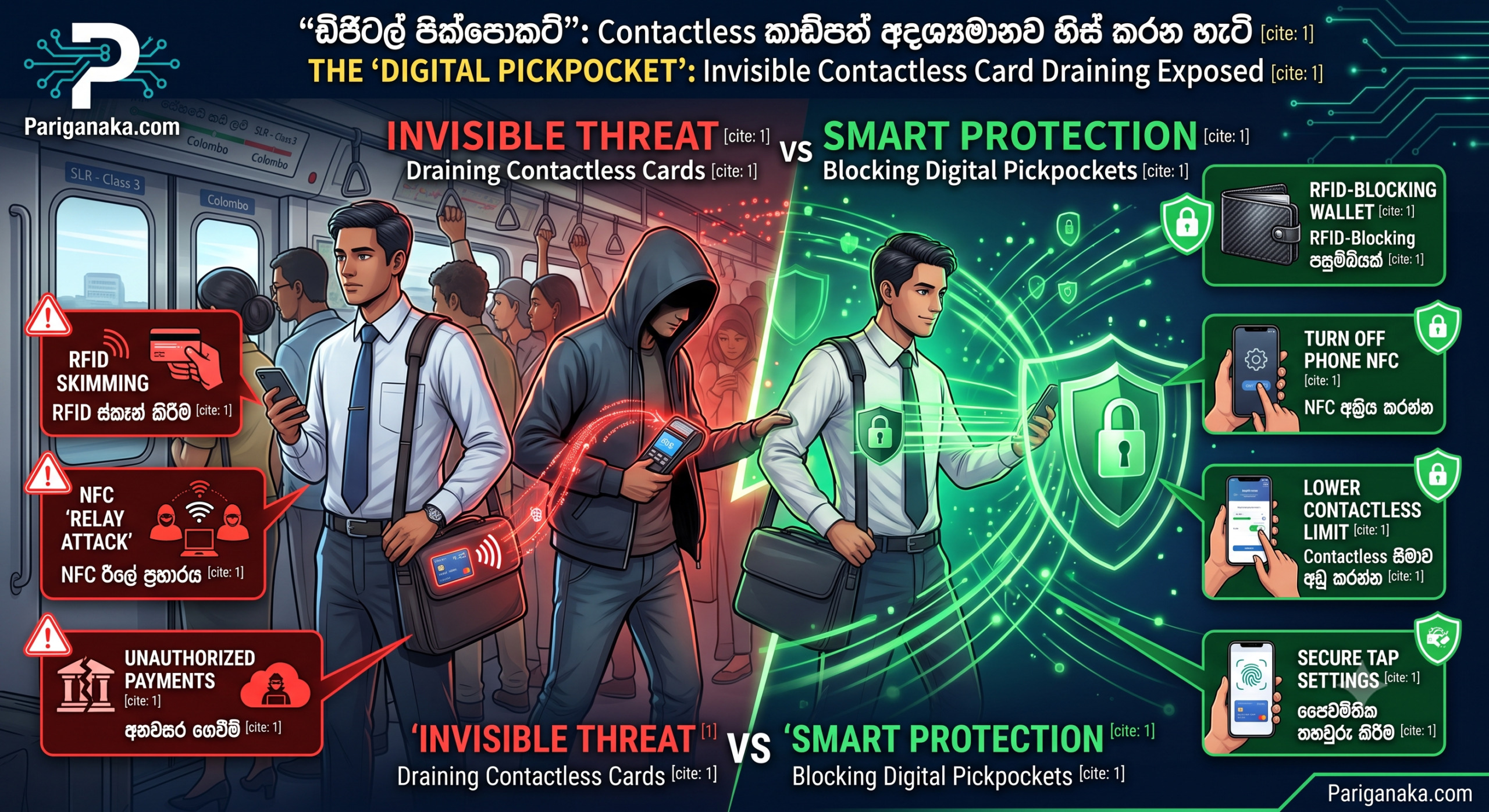
You are standing on a crowded bus or train during rush hour. Someone brushes past you, bumping into your pocket or handbag. You reach down to check—your wallet is still there, and your phone is safe. You breathe a sigh of relief.
But a few minutes later, your phone buzzes with an SMS from your bank: “Rs. 5,000 has been deducted from your account.” Welcome to 2026, where thieves no longer need to steal your physical wallet to take your money. Here at Pariganaka.com, we are exposing the terrifying reality of Digital Pickpocketing (RFID/NFC Skimming) and showing you exactly how to block these invisible thieves.
1. How the Invisible Theft Works
Contactless “Tap-to-Pay” cards and NFC-enabled smartphones are built for convenience. They use radio frequencies to process payments instantly when near a card reader. Cybercriminals have weaponized this exact feature.
- The Weapon: The scammer carries a portable Point of Sale (POS) terminal, a modified smartphone, or a powerful RFID scanner hidden inside a backpack or jacket.
- The Bump: They walk through a crowded area—like a train station, a busy market, or a concert—and simply brush their hidden scanner against people’s pockets and handbags.
- The Theft: If the scanner gets within a few centimeters of your contactless credit card or unlocked NFC phone, it instantly triggers a payment. Because transactions under a certain limit do not require a PIN or OTP, the money is instantly transferred to the scammer’s dummy merchant account.
2. The Smartphone “Relay Attack”
It is not just physical credit cards that are at risk; your smartphone is also a target if you use Apple Pay, Google Pay, or local banking tap features.
- The Always-On Mistake: Many people leave their phone’s NFC (Near Field Communication) sensor turned on 24/7.
- The Relay Trap: Scammers use a “Relay Attack.” One scammer stands near you with a scanner to activate your phone’s NFC, while their partner stands miles away at an expensive electronics store. The signal from your phone is beamed over the internet to the partner’s device, fooling the store’s payment terminal into thinking your phone is tapping their machine.
3. Smart Ways to Bulletproof Your Wallet
The good news is that stopping a digital pickpocket is incredibly easy and does not require complex software. You just need to block the radio waves.
- Invest in an RFID-Blocking Wallet: This is the most effective physical defense. RFID-blocking wallets or card sleeves contain a thin layer of carbon fiber or metal that completely blocks the radio frequencies used by scanners. If a hacker bumps into an RFID wallet, their machine will read absolutely nothing.
- Turn Off NFC on Your Phone: If you use an Android device, pull down your quick settings menu and turn off the “NFC” icon when you are not actively making a payment. For iPhone users, ensure that “Express Transit” or double-click-to-pay features require FaceID or TouchID before activating.
- Lower Your Contactless Limit: Call your bank or use your mobile banking app to lower the maximum limit for contactless payments without a PIN. If a scammer does manage to scan your card, they will only be able to take a very small, restricted amount.
Quick Defense: Vulnerable vs. Secure Setup
| Payment Method | Vulnerable Setup ❌ | Secure Setup ✅ |
| Physical Credit Card | Loose in a regular leather wallet | Inside an RFID-blocking sleeve/wallet |
| Android Phone | NFC setting left “ON” all day | NFC turned “OFF” until at the cashier |
| Apple/Google Pay | Pre-authorized without biometrics | Requires FaceID/Fingerprint to scan |
The Bottom Line:
As payment technology gets faster and more frictionless, it also becomes easier for criminals to exploit. Treat your digital cards with the same caution you would a wad of cash in your pocket. By investing in a simple RFID-blocking wallet and managing your phone’s NFC settings, you can completely shut down the digital pickpockets.
Keep your hard-earned money safe, and stay tuned to Pariganaka.com for more modern tech survival guides!
Leave a Reply