
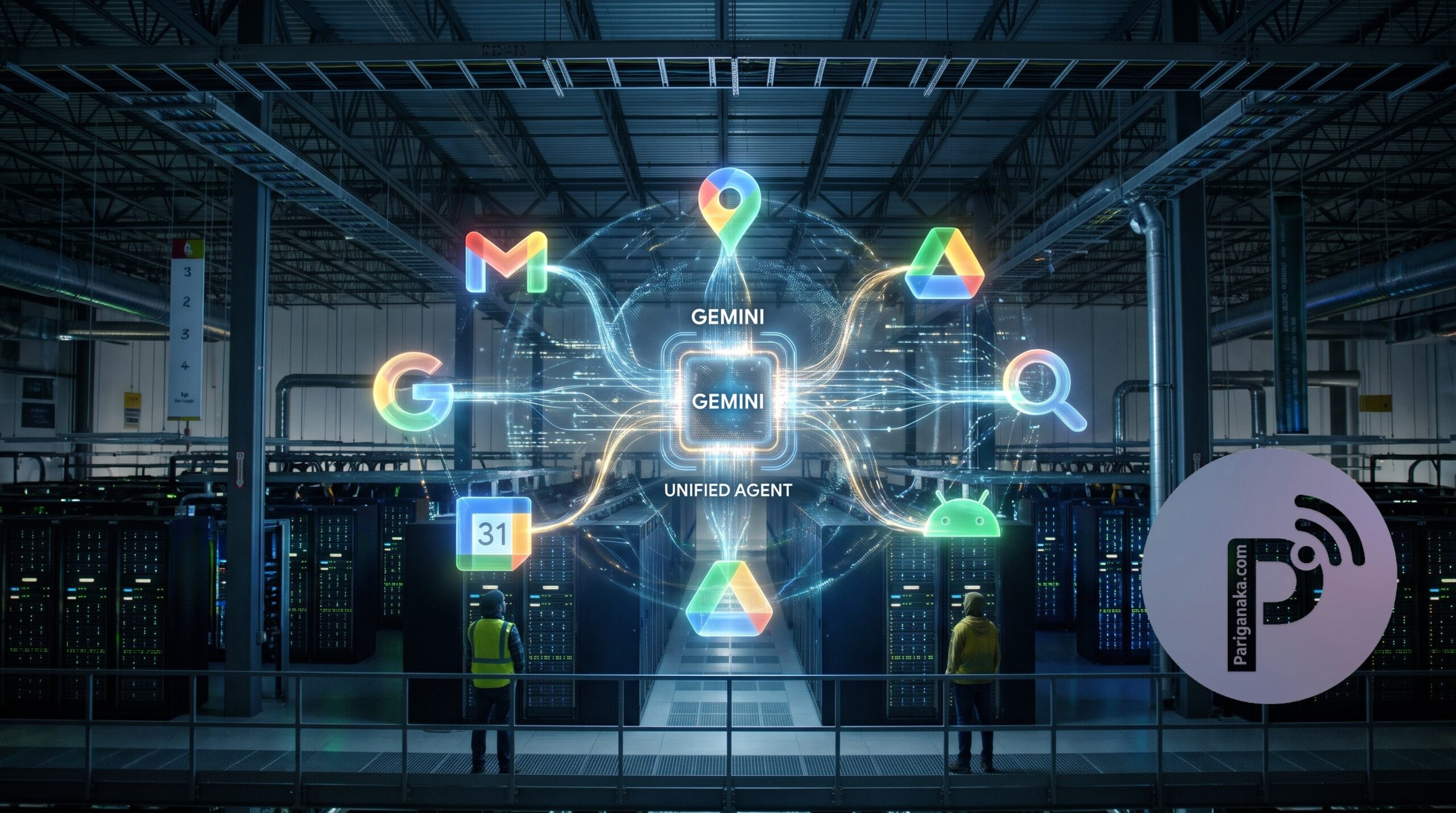
For over a decade, Google’s most persistent organizational weakness has been its highly fragmented product ecosystem. While the company boasts billions of users across Search, Gmail, Calendar, Drive, Maps, and Android, these platforms have historically operated as isolated silos. Today, an AI-native competitor like ChatGPT can often search and synthesize a user’s Google Workspace data more effectively than Google’s own native tools.
However, according to recent insights from Google CEO Sundar Pichai, the company is not just trying to patch these individual apps; instead, they are shifting toward a single, unified “Agentic AI” designed to bridge the entire ecosystem.
The Move to a “Headless” 24/7 Agent
In a recent interview, Pichai was asked a pointed question: Why hasn’t Large Language Model (LLM) search been perfected natively inside Gmail?.
The answer lies in Google’s shifting priorities and resource allocation. Rather than focusing purely on making individual, point-service applications better with AI, Google is prioritizing a “unified Gemini agent”. Initially built for enterprise and now moving toward consumers, this AI operates as a persistent, cloud-based entity.
Pichai described the architecture as a “headless service” running 24/7, operating effectively like a “microVM” (virtual machine) spun up for every user query. Because it sits above the individual applications, this agent carries your personal context with you whether you are actively working in Workspace, browsing Search, or interacting with the Gemini interface directly.
Agent-Centric vs. App-Centric Workflows
This strategy highlights a massive paradigm shift in digital humanism and how we interact with software. The future Google envisions is not one where you open gmail.com to find an email; it is one where you query a unified agent that fluidly pulls from Gmail, Calendar, and Drive without you ever needing to navigate the distinct apps.
While Google admits that moving fast across a broad product portfolio inevitably leaves some areas lagging behind others, the ultimate goal is to ensure this new agentic experience feels seamless across all their surfaces.
The Open Ecosystem and the Agent Race
The race to build the ultimate unified agent is highly competitive, with Anthropic (Claude), OpenAI (ChatGPT), and Meta all pushing aggressively into this space. Many of these third-party platforms already use API connectors to plug directly into Google’s ecosystem.
When asked if Google would ever consider cutting off API access to competitors like ChatGPT, Claude, or Muse to secure a monopoly for Gemini, the response was clear: doing so would be “very user-hostile” and goes fundamentally against Google’s ethos.
Instead of building a walled garden, Google is relying on its massive foundational advantages to win the agent race. With unmatched distribution channels through Android and Google.com, if Google successfully nails this unified agentic integration, they have a prime opportunity to redefine how the world interacts with the web.
Leave a Reply