
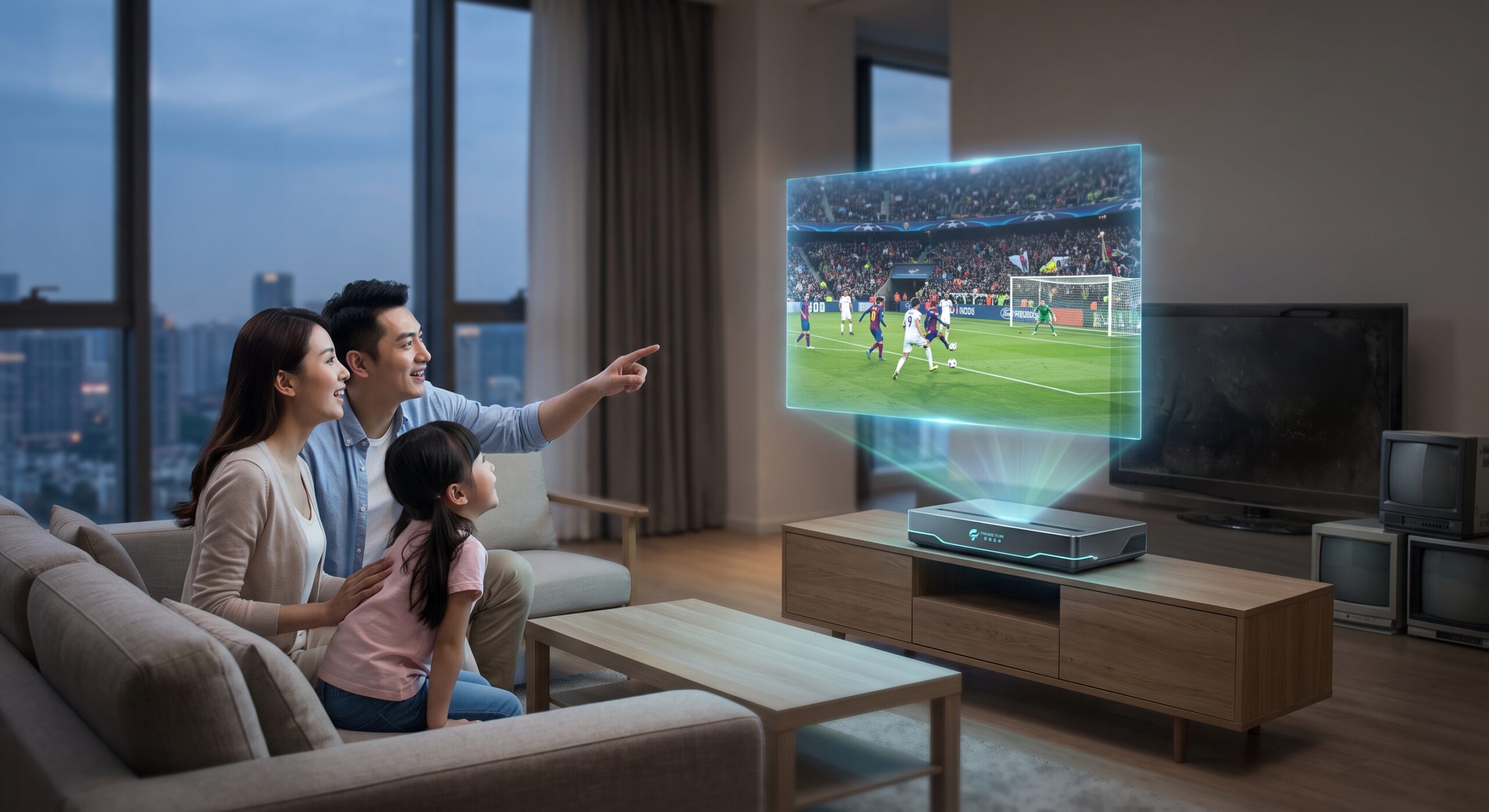
For nearly a century, the evolution of the television has followed a single, predictable path: flat glass screens. From bulky cathode-ray tubes to incredibly thin, wall-mounted OLEDs, we have always been limited to staring at 2D surfaces. But what if the era of the flat screen is completely over?
A team of engineers and researchers in China has recently demonstrated a breakthrough in volumetric display technology that could render traditional televisions—and even modern virtual reality headsets—obsolete. They aren’t building thinner TVs; they are building true, free-space 3D holograms.
Moving Beyond the Screen
Imagine watching a movie, attending a virtual meeting, or playing a video game where the characters and objects appear to physically float in the middle of your living room, viewable from any angle.
Unlike conventional televisions that trap light behind flat glass, or AR/VR headsets that trick your eyes by strapping screens to your face, this new Chinese innovation operates in free space. The technology uses high-precision lasers to manipulate particles or plasma in mid-air, creating physical “voxels” (3D pixels). By trapping and illuminating these particles, the machine constructs physical-looking, three-dimensional holograms that exist in the real world.
A Direct Threat to Silicon Valley?
This advancement represents a major paradigm shift. Right now, Silicon Valley giants like Apple and Meta are pouring billions of dollars into Spatial Computing and Virtual Reality, betting that the future of digital interaction involves wearing heavy headsets.
However, China’s focus on volumetric 3D displays completely bypasses the need for wearables. If consumers can interact with digital objects seamlessly integrated into their physical spaces without the friction of a headset, the multi-billion-dollar VR industry could face an unexpected existential threat. It completely changes the way humans interact with digital media.
The Road from Lab to Living Room
While the concept looks like pure science fiction, it’s important to understand the current limitations of this nascent tech. Currently, the prototypes are relatively bulky and require a significant amount of power. Creating large-scale, high-resolution holograms in mid-air is an immense engineering and physics challenge that involves complex optical traps and precise thermal management.
Because of these hurdles, you won’t be replacing your living room TV tomorrow. However, the foundational physics have been proven, and the race to commercialize volumetric displays is accelerating.
What This Means for the Future
The implications of glasses-free, screenless 3D displays are staggering. It’s not just about home entertainment; this technology could revolutionize medical imaging, architectural design, education, and long-distance communication.
We may be witnessing the beginning of the end for the century-old glass interface. As the technology becomes more refined, affordable, and practical, the familiar black rectangles that currently dominate our living rooms might soon become relics of the past.
Leave a Reply